Urros de Liencres is a stretch of broken coastline in Cantabria, west of Santander. Layers of rock tilt into the sea here and the waves have cut them apart, leaving cliffs, reefs and free-standing stacks — the urros that give the place its name — out in the water with white breaking round them. The coast is known for its sea views and for photography, and it forms one of the set pieces of the Costa Quebrada, the broken coast of central Cantabria.
Urros of Liencres
Local name: Los Urros de Liencres
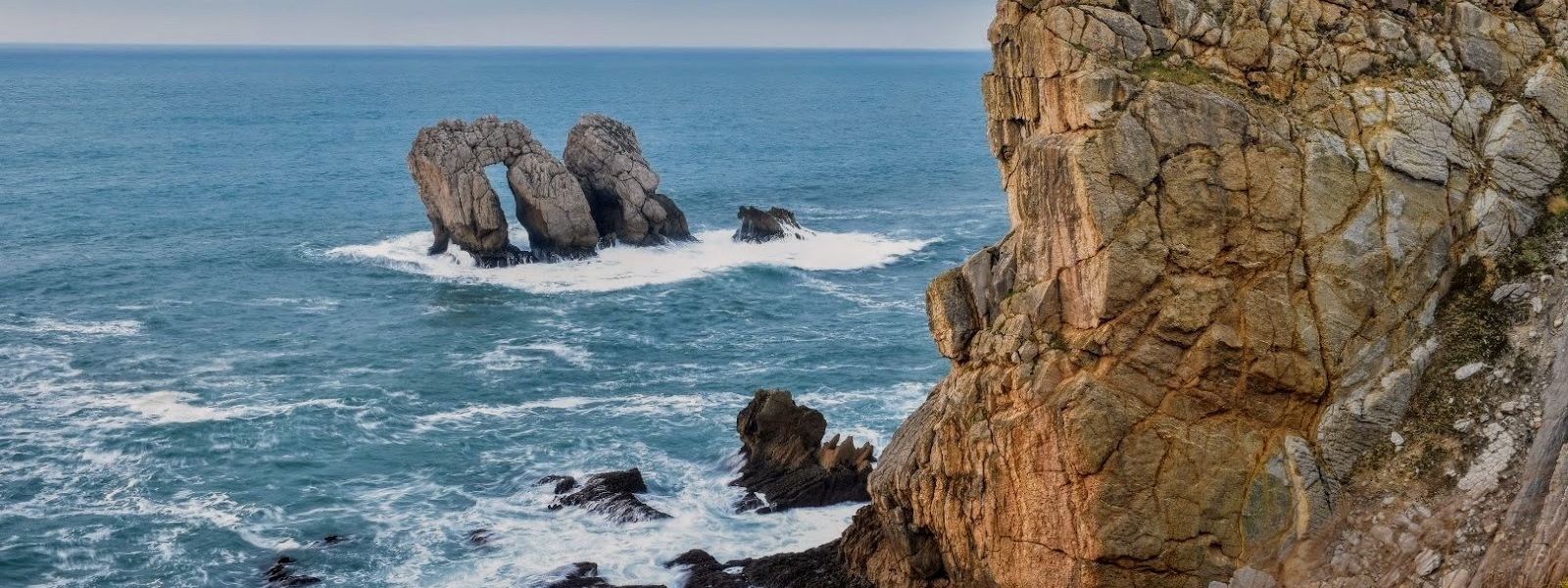
The stacks offshore are the old cliff line — the sea took everything between.
- Entrance
- Free — no ticket.
- Parking
- Two parking areas near the cliffs: a free one 232 m away and a paid one at 257 m.
- Difficulty
- No climb: a walk out from the parking over natural clifftop ground, with the edge unfenced throughout.
- Transport
- Bus stops Hospital de Liencres (ref 2724) and Santa Cruz de Liencres (Hospital), both about 1.2 km from the cliffs.
- Advance booking
- Not needed — there is nothing to book.
- Hours
- Open at any time; nothing here closes.
- Address
- Urros de Liencres, Cantabria, Spain
What makes it special
You hear the sea before you see it. The ground runs out, the cliff drops away, and the stacks stand there in the water with the swell working round their feet, changing shape with every set that comes in.
This is a coast people come to photograph, and the light does most of the work: the rocks turn warm at each end of the day and flat in the middle of it. Paths run along the clifftop in both directions, so walk on past the first viewpoint rather than turning round where the cars are — the view opens differently every hundred metres of it.
Good to know
- Signal: mobile coverage is poor along this coast — save your maps offline before you leave the car.
- Water: there is no drinking water at the cliffs or anywhere within reach of them, so bring what you need.
- Toilets: the nearest toilets, 365 m away, are private rather than public.
- Orientation: an information board stands 216 m from the cliffs, by the parking.
- The edge: nothing here is fenced. Keep well back from it, and keep children and dogs in hand.
Getting there
The approach is by road, and the last part is always on foot. Cars are left at the parking set back from the coast, and from there the way out to the clifftop crosses open ground with no surfaced path under it — walking shoes rather than sandals.
By bus you get as far as the hospital stops at Liencres, which leaves the rest of the distance to cover on foot. Do that in daylight: the cliffs have no lighting of any kind, and the edge is not somewhere to arrive in the dark.
Best time to visit
Best: the first hour of the day and the last hour before sunset.
Avoid: the middle of a bright day, and the clifftop itself while a storm is running.
Low light is what makes the stacks read as stacks — at midday the whole coast goes flat and grey in a photograph. Winter brings the biggest swell of the year and the sea at its most spectacular, but a gale on an unfenced edge is a different proposition from a swell watched from further back, and the weather here comes in off the open water with nothing to slow it.
Sun & daylight
Nearby Places

Similar Places
Urros of Liencres on the map
The clifftop is unfenced and the drop goes straight to rock and water. Edges of this kind undercut and break away, so stay off the lip and off any block that stands proud of the rest, and never turn your back on the sea where waves reach the lower rocks. Mobile coverage is poor, so calling for help is not something to count on.
Get directions

Your whole travel map in one place
Get inspired by new places around the world and find the ones worth the journey
Frequently asked questions
What exactly are the Urros de Liencres?
Free-standing rock stacks and reefs left offshore as the sea cut back the cliff line, on the Cantabrian coast near Liencres in northern Spain.Is there anything to pay?
No. It is open coastline with no ticket and no gate, at any hour of the day or night.Is it worth coming in winter?
The swell is at its biggest then and the coast at its most dramatic. Expect wet, windy weather, and watch from well back rather than from the edge.Is it suitable for children?
Only with a firm hand. There is no railing anywhere along the clifftop and the ground can give way at the edge.