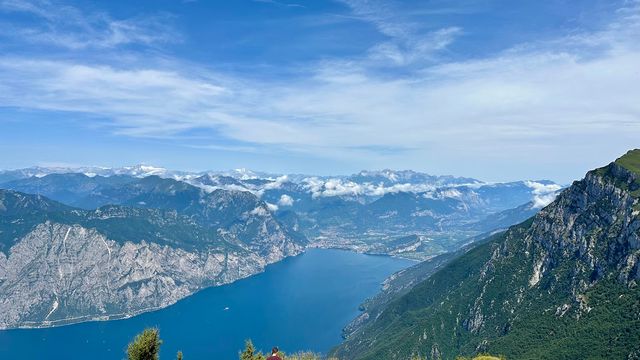
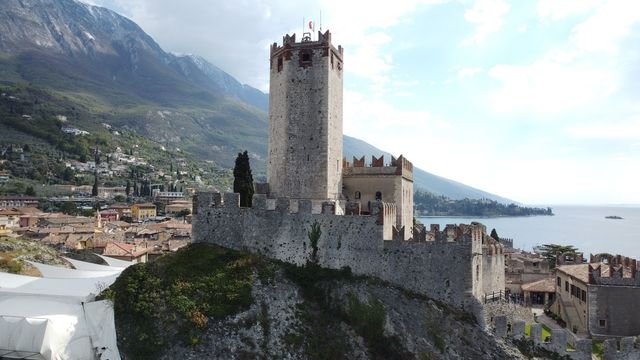
Lake Garda is the largest lake in Italy, 52 km long and 16 km across at its widest, divided between the provinces of Brescia, Verona and Trentino. The northern end cuts into the Alps between steep walls; the southern end opens onto the Po plain, ringed by low morainic hills. The mild climate of the basin supports olives, cypress and lemon this far north. Twenty-six comuni sit on the shore, among them Sirmione and Malcesine with their Scaliger castles, Riva del Garda and Torbole for wind sports, and Gardaland, the largest theme park in Italy.
Lake Garda

- Currency
- Euro (EUR, €). ATMs are widespread in cities and towns and accept major international credit and debit cards. Credit cards are accepted in urban and tourist areas; cash is essential in rural regions and small towns.
- Language
- Italian is the official language and is understood nationwide. Standard Italian is based on the Tuscan dialect. Each region has distinct native languages and dialects (Neapolitan, Venetian, Sicilian, Ligurian, Sardinian and many others). German is co-official in South Tyrol; Slovene in Friuli-Venezia Giulia; French in Valle d'Aosta. English is spoken in major cities, tourist zones and hotels but is less common in rural areas.
- Power plug
- Europlug (Type C), Schuko (Type F) and Type L (Italian three-round-pin) sockets are in use. Voltage is 230V, 50Hz.
- Visa
- Schengen visa-free for 90 days (non-EU/EEA citizens). EU, EEA and Swiss citizens may stay indefinitely. All non-EU/EEA/Swiss visitors must declare their presence within 8 days of arrival. Stays longer than 90 days require an appropriate visa and residence permit.
- Time zone
- Central European Time (CET): UTC+01:00. Central European Summer Time (CEST): UTC+02:00 (last Sunday in March to last Sunday in October).
- Tap water
- Safe to drink. Tap water is well maintained throughout Italy and perfectly drinkable. In some peninsular areas it may be cloudy with a slight taste; most Italians prefer bottled water. Public fountains marked 'Acqua potabile' are safe to refill from. Avoid fountains marked 'Acqua non potabile'. Southern coastal areas may have an unusual taste due to desalination but water is always safe.
- Tipping
- Not customary. Restaurants include a service charge (coperto); waiters do not expect tips. Leaving loose change in bars and cafés is common. Tips cannot be added to credit card bills—bring cash if you wish to tip.
- Emergency
- 112 (Carabinieri, general emergency); 113 (Polizia di Stato); 115 (Fire Department); 118 (Medical Rescue).
When to go
Shoulder
Mar – May
Wildflowers come up on the slopes — primroses, iris, violets and red lilies — and the shore roads carry far less traffic than they will in July.
High season
Jun – Aug
Both shores are at full stretch: lakeside traffic can turn the Verona–Malcesine bus into a three-hour trip, and the extra car ferry between Malcesine and Limone sul Garda runs only in summer.
Shoulder
Sep – Oct
The crowds thin while the daily winds that draw sailors and surfers to Riva del Garda, Torbole and Campione keep blowing.
Low season
Nov – Feb
The basin keeps winter mild enough for olives, cypress and palms to stand on the shore, but the northern end sits inside the Alps and feels every bit of it.
How long to stay
The lake runs 52 km from Desenzano del Garda in the south to Riva del Garda in the north, and the fast ferry covers that end to end in about two and a half hours. Four or five days is enough for one shore and a couple of crossings — a castle town, a boat day, one climb into the hills behind. A week suits both shores plus the Trentino end, where the mountains close in on the water, and leaves room for Gardaland or the Vittoriale without cutting a day short. Anything less than three nights works only from a single base.
Getting around
Ferries do most of the work. Navigazione Laghi runs a daily service linking Desenzano del Garda with Riva del Garda via Peschiera del Garda, Salò and Malcesine, and the fast boat crosses south to north in about two and a half hours. A car ferry shuttles between Torri del Benaco on the east shore and Toscolano-Maderno on the west; a second car ferry links Malcesine with Limone sul Garda in summer. Boat taxis run as well, and cost less time than a road taxi.
Buses reach all three shores: ATV out of Verona with at least five daily routes to Garda and one running through to Riva del Garda, Trentino Trasporti from Trento and Rovereto, SAIA from Brescia via Salò and Gargnano. Tickets come from a tobacconist or on board. Trains on the Milan–Venice line stop at Desenzano-Sirmione and Peschiera; Rovereto is the nearest station to the northern end.
The catch is the shore roads. The Gardesana Occidentale and Gardesana Orientale are the only way round by car, and the Verona–Malcesine bus takes two to three hours when lakeside traffic is heavy.
Local rules
Keep the till receipt on you. Shops around the lake trade from outdoor stands and stalls even when the shop itself is indoors, and the receipt is what proves the purchase.
Do not leave a bag at a ride entrance. Theme park queues have bag drop-off points that nobody watches, and bags are taken from them. A stolen bag usually turns up in the street afterwards with the wallet or the phone gone.
Buy the bus ticket before you need it. On the lake routes, tickets come from a tobacconist or from the driver on board.
What to see
Destinations in Lake Garda
Nearby regions (1)
Frequently asked questions
Which airport is closest to Lake Garda?
Verona, 15 km south of the lake. Brescia-Montichiari is 30 km to the south-west but takes charter flights only. Bergamo is 80 km away, and Milan Linate, Milan Malpensa and Venice are each about 100 km.Can you get around Lake Garda without a car?
Yes. Navigazione Laghi runs a daily boat service between Desenzano del Garda and Riva del Garda via Peschiera del Garda, Salò and Malcesine, buses cover all three shores, and the Milan–Venice railway stops at Desenzano-Sirmione and Peschiera.Is there a car ferry across the lake?
One runs between Torri del Benaco on the eastern shore and Toscolano-Maderno on the western. A second, between Malcesine and Limone sul Garda, operates in summer.Where do people sail and windsurf on Lake Garda?
Riva del Garda, Torbole and Campione, at the northern end, where the winds are strong and blow on a regular daily cycle — down from the mountains in the morning and back up in the afternoon. The Centomiglia regatta is sailed here every year.What language is spoken around the lake?
Italian. Basic English is widely understood, and many people working with visitors speak fluent German, since Germans and Austrians make up a large share of the lake's tourism.