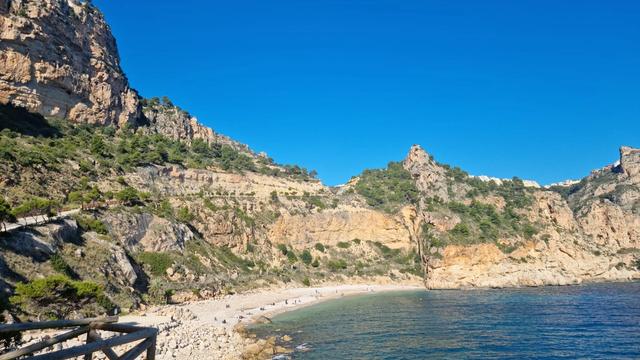
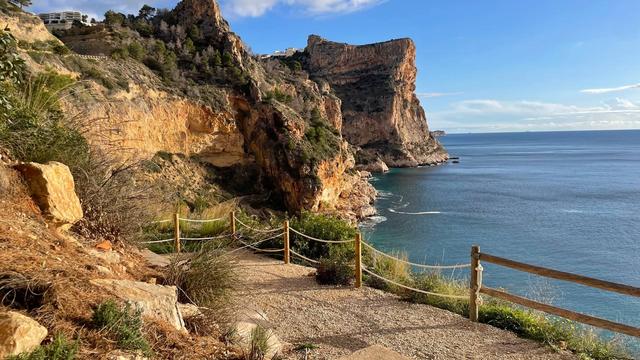
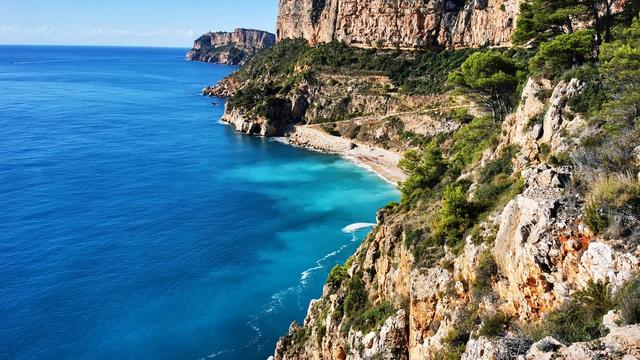
The Benissa Ecological Walk is a public coastal footpath along the shore of Benissa, on the Costa Blanca in the Valencia region of Spain. Built with steps, handrails and benches, it follows the coastline past coves, sandy beaches and pine woodland, and is laid out to show the plants and geology of the shore. It passes La Fustera, where the Benissa tourist office stands close to the path, and reaches the beach at L'Advocat.
Benissa Ecological Walk
Local name: Passeig Ecològic de Benissa

Coastal footpath of steps, handrails and pine woodland linking the coves and beaches of the Benissa shore.
- Entrance
- Free; it is a public coastal footpath with no ticket.
- Accessibility
- Not wheelchair accessible: the path has many steps and narrow stretches. Wheelchair-accessible parking at the car park.
- Parking
- Two free car parks at La Fustera, about 50 m and 180 m away; wheelchair-accessible spaces available.
- Difficulty
- Moderate: repeated steps up and down, narrow stretches with handrails in places; about a couple of hours to the end and back at a fit pace.
- Transport
- Bus to the La Fustera stop, about 230 m away.
- Advance booking
- No booking needed; the path is open to anyone.
- Hours
- Open at any time, every day.
- Address
- Avinguda de la Marina, 307, 03720 Benissa, Alicante, Spain
What makes it special
The path keeps changing level. It drops by steps to a cove, runs along the shoreline at the water's edge, then climbs back into pine woodland above the rocks, and the coastline stays in view nearly the whole way.
Between the coves come sandy beaches where you can stop for a swim, benches along the path and a picnic area. The route was laid out to show the botany and geology of the Benissa shore, so the rock and plants at your feet hold as much interest as the views. Birds work the shoreline and the pines.
Good to know
- Steps run up and down the whole route and some stretches are narrow; walking to the end and back takes a couple of hours at a fit pace.
- There are no public toilets or drinking-water points nearby. Bring water, especially in summer.
- Sections of the path have been closed, and the signs are easy to miss walking in reverse; ask at the tourist office near the car park.
- For a longer day the trail continues along the coast beyond the walk; carry an offline map app.
- Bring a bag and take your rubbish home with you.
Getting there
You arrive at La Fustera, on the Benissa coast. Two free car parks sit about 50 m and 180 m from the walk, and the Benissa tourist office is about 45 m away, the place to pick up a map or ask about closures. The La Fustera bus stop is about 230 m away.
From there you are straight onto the shore path. It is a linear route, so the usual plan is out and back. On foot, the coast trail also continues as far as La Fossa beach in Calpe.
Best time to visit
Best: early morning or late afternoon, in spring and autumn.
Avoid: the middle of the day in high summer.
Much of the route is open rock and steps with shade only where the pines close in, the climbs are hard going in the heat, and the beaches along the way fill up in July and August.
Sun & daylight
Nearby Places
Similar Places
Benissa Ecological Walk on the map
Stretches of the path are narrow and run above a rocky shore; keep children close and watch your footing on the steps. Rock at the water's edge turns slippery when wet, and waves wash over it in rough weather.
Get directions

Your whole travel map in one place
Get inspired by new places around the world and find the ones worth the journey
Frequently asked questions
How long does the Benissa Ecological Walk take?
Walking to the end and back takes a couple of hours at a fit pace, with plenty of steps up and down along the way.Where do you park for the walk?
There are two free car parks at La Fustera, about 50 m and 180 m from the walk. The La Fustera bus stop is about 230 m away.Can you swim along the way?
Yes. The path passes coves and sandy beaches, and one beach of sand mixed with fine shingle has a lifeguard in the summer months.Is the walk suitable for children?
Yes, with care. The path has handrails, benches and a picnic area, but it is narrow in places and full of steps, so keep small children close. A pushchair will struggle on the steps.Is the path wheelchair accessible?
No. The car park has wheelchair-accessible spaces, but the path itself is built around steps.