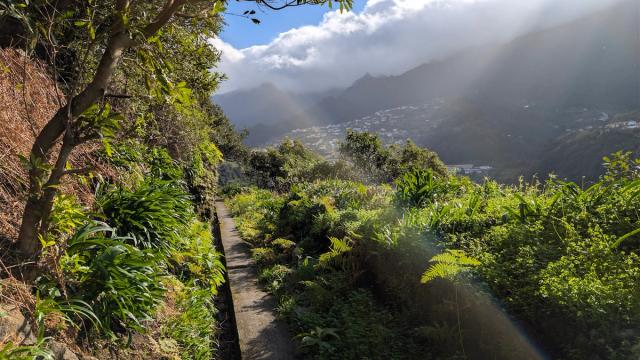
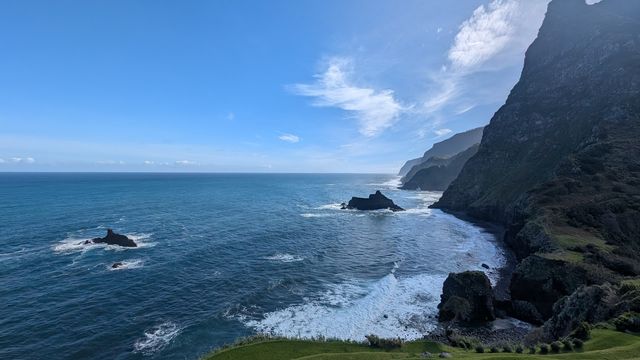
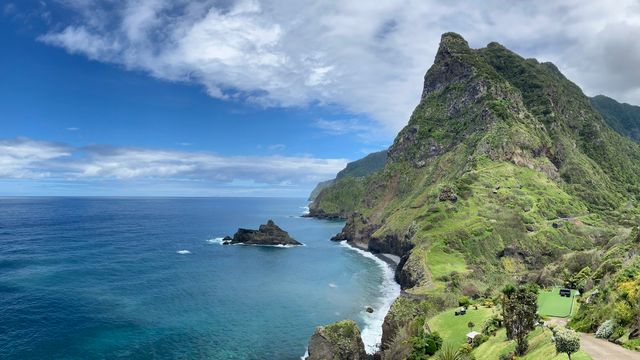
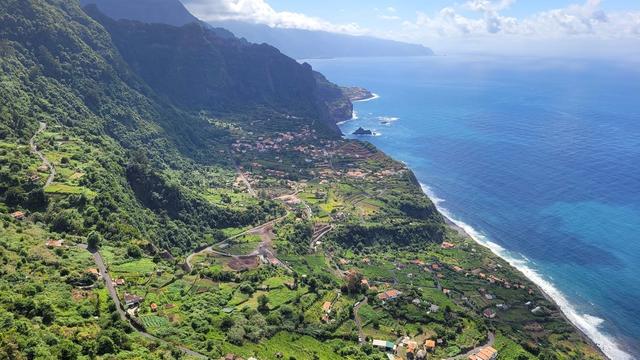
Our Lady of Fátima Chapel stands on a hillside above São Vicente, on the north coast of Madeira. It is a small, well-kept chapel, reached by a staircase from a narrow road below. The draw is the panorama: terraced slopes, green valleys and the open Atlantic, seen from the chapel and its bell tower. A path continues past the building down to a levada and on to a viewpoint over the sea, which turns the stop into a walk rather than a photo halt.
Our Lady of Fátima Chapel
Local name: Capela de Nossa Senhora de Fátima

From the bell tower the view runs over the terraced slopes of São Vicente to the open Atlantic, and most tourists drive straight past the turning.
- Accessibility
- Not wheelchair accessible: the chapel is reached only by steps, and neither the entrance nor the parking is adapted.
- Parking
- Free. A small car park sits below the chapel, about 150 m away, plus a few roadside spaces at the end of the access road. Do not block driveways.
- Difficulty
- 175 steps from the road up to the chapel. Beyond it, the levada path to the sea viewpoint is flat, about 2 km each way.
- Transport
- Nearest bus stop: São Vicente, about 415 m from the chapel.
What makes it special
The reason to climb here is the view. From the chapel and its bell tower the ground falls away over terraced slopes and green valleys, and the Atlantic fills the horizon to the north. The chapel itself is small and well kept, but it is the setting rather than the building that holds people. Lizards sit on the warm stone of the steps and scatter as you pass.
The visit does not have to end at the chapel. A path leaves the far side and drops to a levada, which runs about 2 km to a viewpoint looking out to sea. That stretch is flat and manageable for old and young alike. Most people driving the north coast never turn off for any of it.
Good to know
- Closed doors. The chapel is not always open, and the climb can end at the outside wall. The view does not depend on it.
- Heat. On a sunny day the steps are hard work. Bring water and wear a hat.
- No toilets. There are none at the chapel; the nearest are down in São Vicente, roughly 450 m away.
- Easy to miss. A tree has grown over the sign at the turning, so the access road is simple to drive straight past.
Getting there
You drive here. The approach is a narrow road above São Vicente, and the sign at the turning has been covered by a tree, so it is easy to go past. From the road a staircase climbs to the chapel; it starts beside a house with glass gates, and there is no step-free way up. Walkers can carry on beyond the chapel: a path leaves the far side and drops to a levada, where turning right leads to a viewpoint over the sea. On the way back a dirt track climbs off the levada and rejoins the road.
Best time to visit
Better: a clear day, outside the hottest hours. The panorama is the entire point, and the steps are climbed in full sun.
Avoid: low cloud on the north coast, which closes the view down to the slope in front of you.
The chapel sits away from the coastal road and most visitors never come up, so the viewpoint is rarely busy whatever the hour.
Sun & daylight
Nearby Places

Similar Places

Featured in our guides

Your whole travel map in one place
Get inspired by new places around the world and find the ones worth the journey
Frequently asked questions
Can you go inside the chapel?
Not reliably. The chapel is sometimes locked, and the visit is then limited to the outside and the view. Nobody is on site to open it.What can you see from the top?
Green valleys, terraced hillsides and the Atlantic. The widest view is from the chapel's bell tower.Is there a longer walk from the chapel?
Yes. A path drops from the far side of the chapel to a levada; turning right leads about 2 km to a viewpoint over the sea. The levada stretch is flat, and a dirt track brings you back up to the road on the return.How busy does it get?
Rarely busy. The chapel is off the coastal road and overlooked by most visitors to the island.