The Cactus Garden is a botanical garden in Guatiza, on Lanzarote, built in a quarry where lapilli, the black volcanic gravel locally called picón or rofe, was dug to spread on fields and hold in moisture. Created in 1991 as the last project of César Manrique, it holds some 4,500 cacti and succulents from the Americas, Madagascar and other arid regions, chosen and planted by the botanist Estanislao González Ferrer. A restored gofio windmill stands at its highest point.
Cactus Garden
Local name: Jardín de Cactus
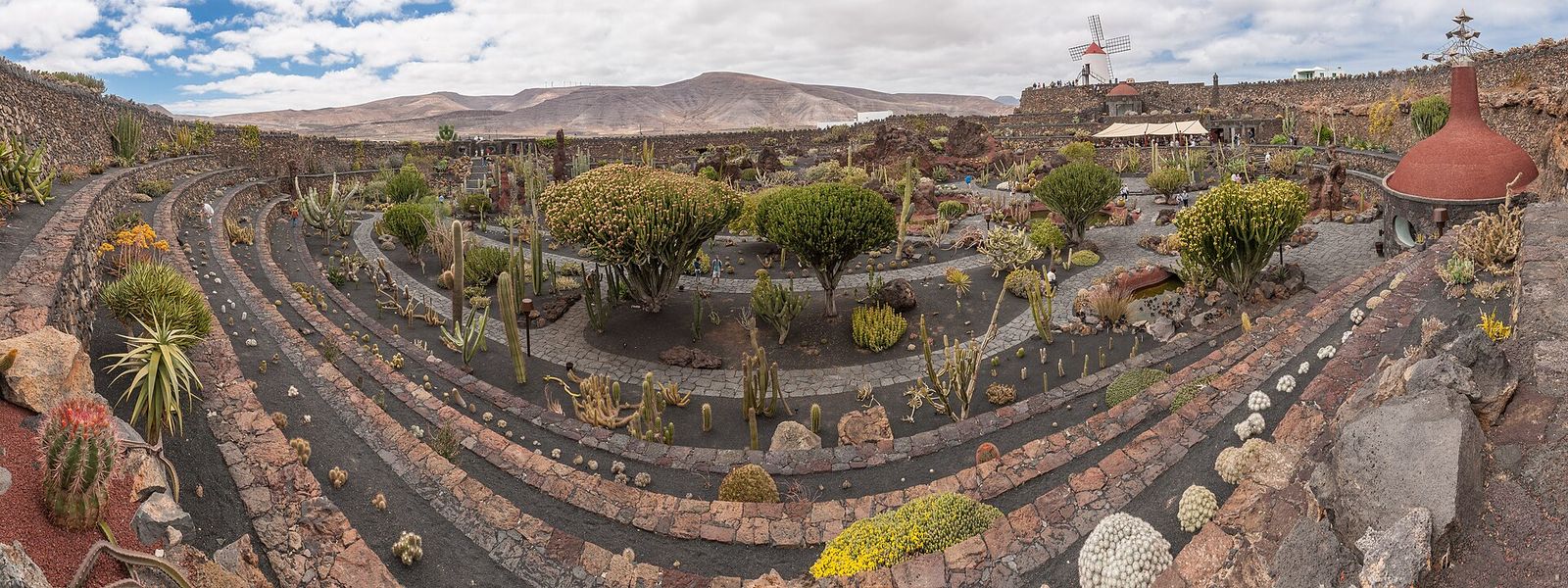
Terraced cactus garden in a former volcanic-gravel quarry, César Manrique's last project, crowned by a restored windmill.
- Entrance
- Paid entry, about €10 per person.
- Accessibility
- Wheelchair-accessible entrance, parking and toilets. Inside, some paths have steps and an uneven surface, and the windmill viewpoint is reached by stairs.
- Parking
- Free car park at the garden, about 60 m away in a straight line, plus free street parking; wheelchair-accessible spaces.
- Difficulty
- Easy: you park beside the garden and walk in. Inside, some paths have stairs and bumpy ground, and the windmill at the top is reached by steps.
- Transport
- Bus stop Jardín de Cactus (Guatiza), about 70 m away.
- Hours
- Daily 10:00–17:00.
- Address
- Av. Garafía, 35544 Guatiza, Las Palmas, Spain
What makes it special
The whole garden lies in a bowl of black volcanic gravel, its terraces stepping down like the seats of an amphitheatre and every one of them packed with cacti. Some are species you might keep on a windowsill at home, grown here into giants. Paths and stairs wind between them, past ponds and channels crossed by small bridges, where fish and small lizards show themselves.
The setting is the point. César Manrique took a worked-out quarry, where lapilli was once dug to mulch the fields, and made it the last of his projects on the island. The prickly pears in the fields around Guatiza belong to the same story: they are grown to raise cochineal, the insect behind carmine dye.
Climb to the restored windmill at the top, once used to grind gofio, the island's toasted grain flour. You can go inside, and the view runs over the garden and the countryside beyond.
Good to know
- Steps and uneven ground. Some paths have stairs and a bumpy surface; a pushchair struggles, a baby carrier works.
- The windmill is up a stair. The viewpoint at the top is reached by steps, and you can go inside the mill.
- Little shade. The garden is an open quarry of cacti and gravel; bring a hat and water around midday.
- Mind the spines. Cacti line the paths, so keep small children's hands close.
- Café with a view. A café on site looks out over the garden, and there are toilets for visitors.
Getting there
The garden stands in Guatiza, among the fields of prickly pear that surround the village. Most people come by car and leave it in the garden's own free car park, about 60 m away in a straight line, with free street parking around it as well. The bus stop is named Jardín de Cactus (Guatiza) and stands about 70 m away. From the gate, the paths drop down into the old quarry and climb again to the windmill at the top.
Best time to visit
Best: first thing after opening, or late in the afternoon before closing.
Avoid: the middle of the day.
The quarry is open to the sun with little shade, and both the heat and the crowds build towards midday; low sun early and late also throws the ribs and spines of the cacti into relief against the black gravel.
Things to do nearby
All tours in Teguise on GetYourGuide
Paid links: booking through them supports YowJourney.
Sun & daylight
Nearby Places

Similar Places

Your whole travel map in one place
Get inspired by new places around the world and find the ones worth the journey
Frequently asked questions
Can you visit the Cactus Garden with a wheelchair or a pushchair?
The entrance, parking and toilets are wheelchair accessible. Inside, some paths have steps and bumpy ground, and the windmill viewpoint is reached by stairs, so a pushchair struggles in places.Who created the Cactus Garden?
César Manrique, as his last project, in 1991. The botanist Estanislao González Ferrer chose and planted the specimens.Can you go inside the windmill?
Yes. The restored windmill at the top of the garden, once used to grind gofio, is open to look around, and it gives a view over the garden and the surrounding countryside.Is there anywhere to eat or drink?
Yes, there is a café on site with a view over the garden.Is parking free?
Yes. The garden has its own free car park, and there is free street parking nearby.