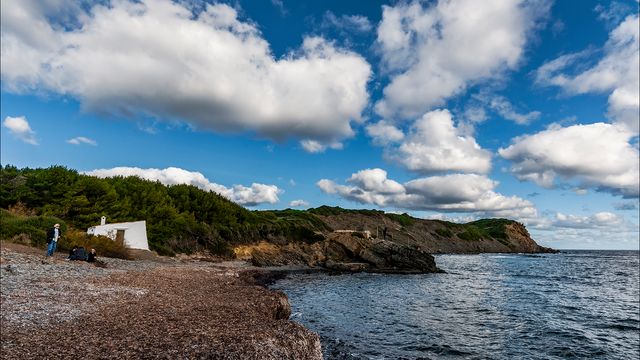
Cala de Llucalari lies on the southern coast of Menorca, in the municipality of Alaior, inside a natural preserve. The bay opens at the mouth of a deep ravine, and the beach head is about 40 metres of large rounded grey stones — macs, in the local word — with virtually no soft sand. A single massive cliff separates it from Son Bou, the developed resort beach next door, and Stage 16 of the Camí de Cavalls passes just behind the bay. Nothing is built on the shore, and the cove stays sparsely visited.
Cala de Llucalari
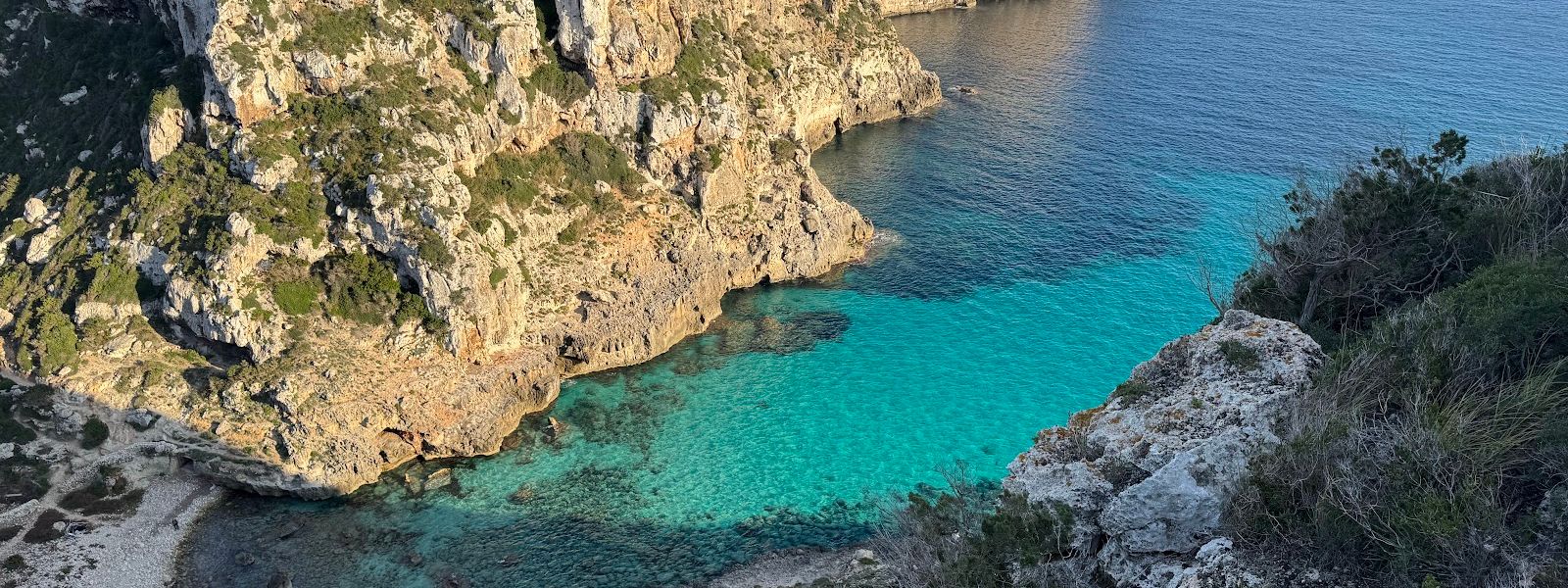
Wild stone-covered cove at the mouth of a ravine, reached on foot along the Camí de Cavalls.
- Entrance
- Free, no ticket.
- Accessibility
- Not accessible: the only way in is a steep rocky cliff path, with no step-free route and no wheelchair-accessible parking.
- Parking
- No parking at the cove and no vehicle access to the water. Free public parking about 1 km away in a straight line at Son Bou; a nearer car park, about 700 m off, is for customers only.
- Difficulty
- 20 to 30 minutes on foot from the eastern end of Son Bou beach, around 1.2 km, climbing a steep rocky cliffside path and dropping into the ravine. Rugged, unshaded ground; hiking shoes or trainers needed.
- Transport
- Bus stops Son Bou - Platja (3275) and Son Bou rotonda (3205), both about 1 km away.
- Advance booking
- Not needed.
- Hours
- Open at any time.
- Address
- Alaior, 07730, Balearic Islands, Spain
What makes it special
The cliffs above the cove open straight onto the southern sea horizon, and the rocks up there are the sunset seat: no obstacle, just bare water. Wild goats hold the rocky terraces, entirely unafraid of people and inclined to see you off, which is half the entertainment. Egyptian vultures call from hollows in the limestone walls. In the water, once you are past the shore stones, the clarity is remarkable and the fish are not timid, because almost nobody swims here — this is a serious snorkelling spot for anyone willing to work for the entry. Son Bou fills with holidaymakers in summer; one cliff away, this shoreline is empty.
Good to know
- No facilities. No toilets and no drinking water at the cove, and none nearby — carry all the water you will drink.
- Underfoot. The beach head is large smooth grey stones and almost no sand, so finding a spot for a towel takes improvisation.
- Seaweed. Thick banks of dried Posidonia often block the shoreline, and entry on foot turns slimy, awkward and sometimes impossible.
- Footwear. Trainers or hiking shoes for the path, and thick-soled water shoes if you mean to get into the sea over the stones.
- No shade. The route and the shore are sun-baked and completely unshaded, from the first climb to the last.
Getting there
The driving ends at Son Bou — nothing goes closer to the water. From the eastern end of the beach a signposted marker points to Stage 16 of the Camí de Cavalls, and from there it is 20 to 30 minutes on foot, around 1.2 km: up a steep, rocky cliffside path, then down again into the ravine. No shade at any point on it. Accounts of the effort run from an easy hike for anyone with a little experience to short but intense, and it is the little hills and rocks that do the work. The nearest public parking sits about 1 km away in a straight line, with another car park about 700 m off that belongs to its customers. Bus stops Son Bou - Platja and Son Bou rotonda are both roughly 1 km away.
Best time to visit
Best: sunset, watched from the rocks above the cove, where the cliffs open onto the southern sea horizon with nothing in the way.
Avoid: counting on a swim when the shoreline is banked with dried Posidonia — getting into the water on foot can be impossible, and the weed gives no warning from the top of the path.
The cove is sparsely visited at any hour and stays that way through the summer, when Son Bou next door is full. The walk in is unshaded in both directions, so anyone timing it for the sunset should reckon on the return in fading light.
Sun & daylight
Nearby Places



Similar Places

Cala de Llucalari on the map
The path climbs an unfenced cliffside above open sea, and the rounded shore stones shift underfoot and turn slippery where the weed is wet. Wear shoes with grip and keep well back from the edge.
Get directions
Your whole travel map in one place
Get inspired by new places around the world and find the ones worth the journey
Frequently asked questions
Can you drive to Cala de Llucalari?
No. You park at Son Bou and walk in on Stage 16 of the Camí de Cavalls from the eastern end of the beach — 20 to 30 minutes, around 1.2 km, over a steep rocky path.Is there sand on the beach?
Virtually none. The beach head runs about 40 metres and is covered in large rounded grey stones, called macs locally.Can you swim and snorkel here?
The deeper water is clear and excellent for snorkelling, but thick banks of dried Posidonia seagrass often block the shoreline and make entry on foot awkward or impossible. Thick-soled water shoes help.Are there toilets or drinking water?
No toilets and no drinking water at the cove, and none nearby. Bring plenty of water — the walk and the shore are completely unshaded.Is it busy, like Son Bou next door?
No. Son Bou is the developed resort beach a cliff away, and Llucalari stays sparsely visited even in summer, with no buildings on the shore.