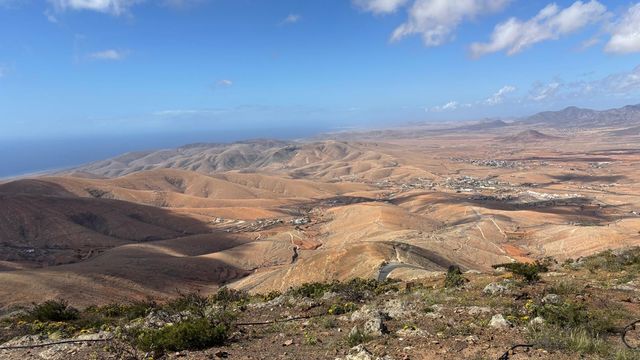
Guise and Ayose Viewpoint stands in the hills of central Fuerteventura, above Betancuria, the island's old capital. Two bronze statues represent Guise and Ayose, the kings of Maxorata and Jandía, the two realms into which the Majos, the island's native people, were divided when the European conquest arrived in the early fifteenth century. A panel beside them tells that history. The view takes in barren hills, the ocean on one side and Betancuria on the other.
Guise and Ayose Viewpoint
Local name: Mirador de Guise y Ayose
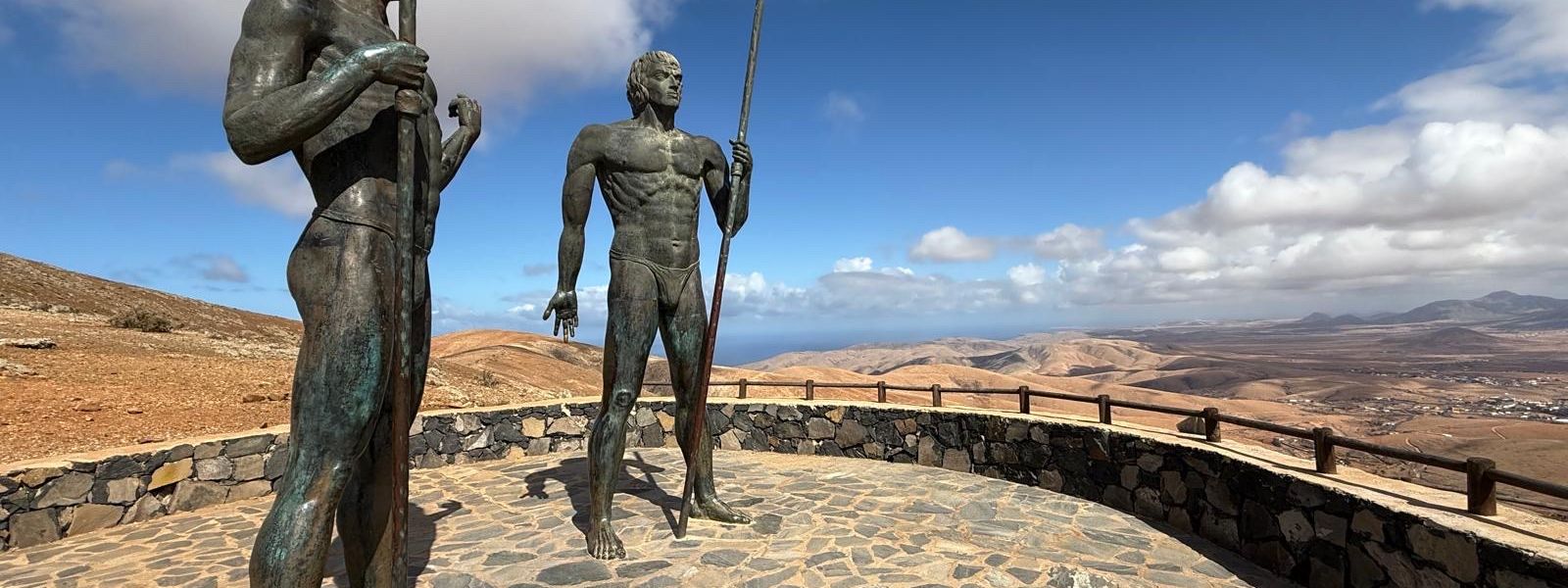
Windswept hilltop viewpoint above Betancuria, with bronze statues of the island's two native kings, Guise and Ayose.
- Entrance
- Free; there is no ticket.
- Accessibility
- Wheelchair-accessible parking and entrance; a ramp leads up to the viewpoint.
- Parking
- Two free car parks on asphalt, about 30 and 40 m from the viewpoint; spaces are few.
- Difficulty
- None: you park about 30–40 m away and take a ramp up to the platform. Expect strong wind.
- Transport
- Nearest bus stop: Betancuria, about 1.7 km away in a straight line.
- Advance booking
- No booking needed.
- Hours
- Open at all times.
- Address
- 35637 Betancuria, Las Palmas, Spain
What makes it special
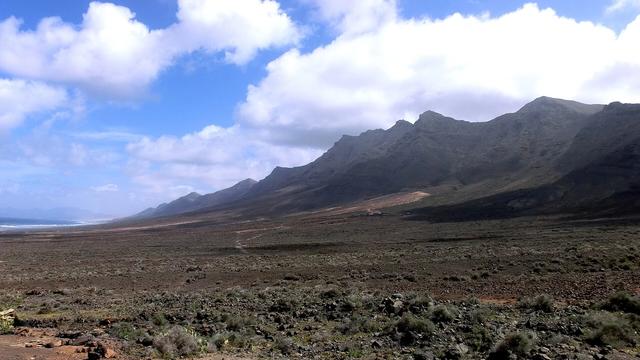
Two bronze kings stand on the platform with the whole middle of the island laid out behind them. The hills are bare, folded and coloured in rust, brown and ochre, and the eye runs across them to the ocean on one side and down to the houses of Betancuria on the other.
Guise and Ayose ruled the two halves of Fuerteventura when the European conquest began, and the panel next to the statues tells how that ended. It gives the view a story: this is the land they divided between them.
The wind belongs to the visit. It comes across the ridge hard enough to make you lean into it between the car and the statues, and it carries a chill even when the sun is out.
Good to know
- The platform takes strong, cool wind. Bring a jumper or a jacket, even on a sunny day.
- There are no toilets and no drinking water at the viewpoint or nearby. Fill up before you come.
- Parking spaces are few. The car park is busy at some times and has room at others.
- A ramp leads up to the viewpoint for visitors with limited mobility.
- Hold the car door firmly when you open it: gusts can catch it.
Getting there
You arrive by car. Two free car parks on asphalt sit about 30 and 40 m from the viewpoint, so the statues are in sight as soon as you step out, and a ramp takes you up to the platform. The short crossing is where the wind first hits.
Without a car, the nearest bus stop is Betancuria, about 1.7 km away in a straight line; the distance on foot is longer than that.
Best time to visit
Best: a clear day, early in the morning or late in the afternoon.
Low sun brings out the reds and browns in the bare hills and throws long shadows into the valleys, so the relief reads far better than under a flat midday light.
Avoid: days of calima or storm cloud.
Saharan dust haze flattens the view and hides the ocean, and when a storm builds over the hills the exposed platform is no place to linger.
Sun & daylight
Nearby Places
Similar Places
Featured in our guides
Guise and Ayose Viewpoint on the map
The viewpoint is exposed and gusts hit hard and suddenly. Keep hold of children, hats and loose items, and do not lean out over the edge of the platform.
Get directions
Your whole travel map in one place
Get inspired by new places around the world and find the ones worth the journey
Frequently asked questions
Who are Guise and Ayose?
They were the two kings of Fuerteventura's native people, the Majos, ruling the realms of Maxorata and Jandía when the European conquest arrived in the early fifteenth century. A panel beside the statues tells their history.Is there parking at the viewpoint?
Yes. Two free car parks on asphalt sit about 30 and 40 m from the viewpoint. Spaces are few, and at busy times the car park fills.Is the viewpoint wheelchair accessible?
Yes. There is wheelchair-accessible parking, and a ramp leads up to the viewpoint.Are there toilets or water?
No. There are no toilets and no drinking water at the viewpoint or nearby, so bring what you need.What can you see from the viewpoint?
Barren, colourful hills across the middle of the island, the ocean on one side and Betancuria, the old capital, on the other.