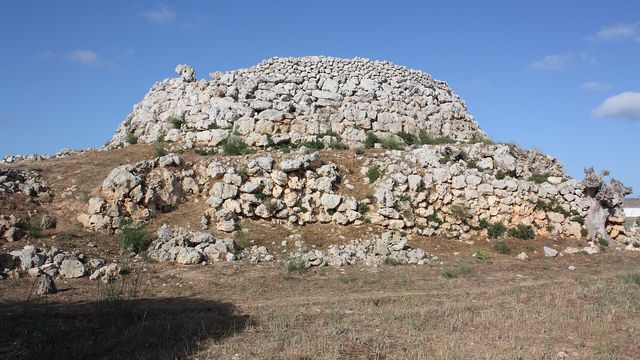
Torre d'en Penjat is a Martello-type coastal defence tower built by the British in the late 18th century on a hill beside Fort Marlborough, at Cala de Sant Esteve near Es Castell. It guarded the entrance to Maó harbour, and a stone wall linked it to the fort. Its official name was Torre Stuart, after General Stuart, the British governor of Menorca. The popular name, El Penjat, "the hanged man", comes from the gallows that stood here for prisoners condemned at Sant Felip Castle. Restored in 1989, the tower belongs to the Spanish Ministry of Defence.
Torre d'en Penjat

Late-18th-century British Martello tower above Cala de Sant Esteve, with a roof terrace over the mouth of Maó harbour.
- Accessibility
- No wheelchair access: the approach is on foot, the door is reached by an iron stair and the roof by a spiral staircase.
- Parking
- Two free car parks, about 370 m and 680 m from the tower in a straight line.
- Difficulty
- A walk from the car park, the nearer one about 370 m away in a straight line, on a route without signposts; inside, an iron stair and a spiral staircase lead to the roof.
- Transport
- Nearest bus stop: Av. Cinquena, about 2.3 km away in a straight line.
- Advance booking
- Not needed; the tower is open at any time.
- Hours
- Open at any time.
- Address
- 07720 Cala de Sant Esteve, Balearic Islands, Spain
What makes it special
An iron stair leads up to the original door on the first floor, and a spiral staircase climbs from there onto the roof. From the top the whole mouth of Maó harbour opens out: Maó itself, La Mola across the water, and Quarantine Island (Illa de la Quarantena) inside the harbour.
Torre d'en Penjat is one of the few Martello towers on Menorca that can be entered, and it is in good condition. The 1989 restoration stripped away later additions — a building set against the tower, a ground-floor doorway, a gun chamber put on the roof in 1947 — and returned it to its 1798 plan. The first floor held separate quarters for the officer and the men. Below them sat the powder store, the food store, the armoury and a cistern sunk into the ground, supplies for a small garrison to hold out about ten days.
East and south-east of the tower, salt pans are cut into the flat stretches of shoreline, and a small spherical building stands in view from the roof. Both are worth the extra walk.
Good to know
- The route from Cala de Sant Esteve along the Camí de Cavalls to the tower is not signposted; have the way on a map before you set off.
- There is no drinking water near the tower, so bring your own. The nearest toilets are about 500 m away in a straight line.
- Entry is by an iron stair and the roof by a spiral staircase; a wheelchair or pushchair will not get in.
- Fort Marlborough stands right beside the tower, so the two fit into one outing.
Getting there
The tower is reached on foot. The nearer car park lies about 370 m away in a straight line, a second one about 680 m. The Camí de Cavalls, the path that runs round Menorca's coast, passes Cala de Sant Esteve, and a Camí de Cavalls information board stands about 500 m from the tower. The branch up to the tower itself is not signposted, so keep a map open on your phone for the last stretch.
The nearest bus stop, Av. Cinquena, is about 2.3 km away in a straight line, which adds a long walk to any bus journey.
Best time to visit
Best: morning or late afternoon, in spring or autumn.
Avoid: the middle of a summer day.
The hill and the coast path around it lie open to the sun, there is no drinking water near the tower, and the cooler hours leave you the energy to walk on along the shore to the salt pans.
Sun & daylight
Nearby Places
Similar Places

Torre d'en Penjat on the map
The ditch around the landward side of the tower is an open drop, and the spiral staircase to the roof turns tightly. Keep children close at the ditch edge and on the stairs.
Get directions
Your whole travel map in one place
Get inspired by new places around the world and find the ones worth the journey
Frequently asked questions
Can you go inside Torre d'en Penjat?
Yes. An iron stair leads to the original first-floor door, and a spiral staircase climbs to the roof terrace. It is one of the few Martello towers on Menorca that can be entered.Why is it called Torre d'en Penjat?
Penjat means "hanged man": the gallows for prisoners condemned at Sant Felip Castle stood here. The tower's official name was Torre Stuart, after General Stuart, the British governor of Menorca.What can you see from the top?
The entrance to Maó harbour, with Maó, La Mola and Quarantine Island in view. The salt pans on the shore to the east and south-east and a small spherical building are visible from the roof too.Where do you park?
There are two car parks, about 370 m and 680 m from the tower in a straight line. The rest is on foot, and the way to the tower is not signposted.Is it good for children?
Children enjoy climbing through the doorway and up the staircase to the roof. Keep them close at the edge of the ditch and on the stairs.