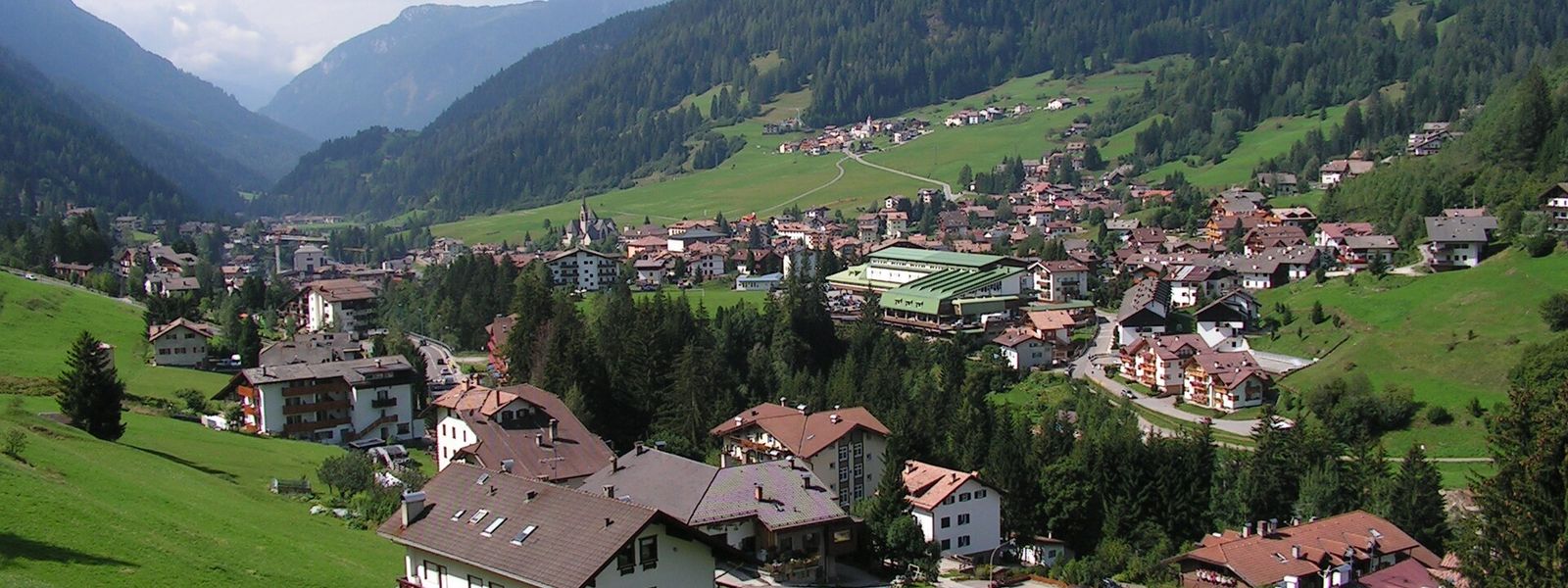
Moena is a village and comune in the Val di Fassa, in Trentino, about 60 kilometres northeast of Trento. It stands at 1,148 metres on the Avisio and is the largest comune in the valley. Ladin is the everyday language: 75.6% of residents gave it as their mother tongue in the 2001 census. The church of San Vigilio has a Gothic bell tower and 18th-century paintings by Valentino Rovisi, and the older San Volfango keeps 15th-century frescoes. Every August the village stages La Turchia, a festival built on the story of an Ottoman janissary wounded at Vienna in 1683.
Moena
- Currency
- Euro (EUR, €). ATMs are widespread in cities and towns and accept major international credit and debit cards. Credit cards are accepted in urban and tourist areas; cash is essential in rural regions and small towns.
- Language
- Ladin is the everyday language: 75.6% of residents declared it their mother tongue in the 2001 census, and the village is Moéna in Ladin. Italian is spoken alongside it throughout, and English is understood in hotels and in the tourist trade.
- Power plug
- Europlug (Type C), Schuko (Type F) and Type L (Italian three-round-pin) sockets are in use. Voltage is 230V, 50Hz.
- Visa
- Schengen visa-free for 90 days (non-EU/EEA citizens). EU, EEA and Swiss citizens may stay indefinitely. All non-EU/EEA/Swiss visitors must declare their presence within 8 days of arrival. Stays longer than 90 days require an appropriate visa and residence permit.
- Time zone
- Central European Time (CET): UTC+01:00. Central European Summer Time (CEST): UTC+02:00 (last Sunday in March to last Sunday in October).
- Tap water
- Safe to drink. Tap water is well maintained throughout Italy and perfectly drinkable. In some peninsular areas it may be cloudy with a slight taste; most Italians prefer bottled water. Public fountains marked 'Acqua potabile' are safe to refill from. Avoid fountains marked 'Acqua non potabile'. Southern coastal areas may have an unusual taste due to desalination but water is always safe.
- Tipping
- Not customary. Restaurants include a service charge (coperto); waiters do not expect tips. Leaving loose change in bars and cafés is common. Tips cannot be added to credit card bills—bring cash if you wish to tip.
- Emergency
- 112 (Carabinieri, general emergency); 113 (Polizia di Stato); 115 (Fire Department); 118 (Medical Rescue).
When to go
High season
Dec – Mar
Winter is the busiest stretch in the valley: snow lies on the village at 1,148 metres, and the valley road carries ski traffic.
Low season
Apr – May
Between the ski season and the walking season Moena empties out, with snow still on the passes and the meadows only just clear of it.
High season
Jun – Aug
Walkers and cyclists take over the pass roads above the village, and from 19 to 21 August the centre is given over to La Turchia.
Shoulder
Sep – Nov
Autumn quietens the valley: clear light on the Dolomite walls, then the first snow on the passes above Moena.
How long to stay
Two or three nights suit the village itself: an evening in the centre, a day up on the passes above it, time for the two churches. A week is the measure if the whole Fassa valley is the plan — Moena sits at the lower end of it, so Canazei and the passes beyond become day trips from here.
Getting around
The Dolomites road (SS48) runs straight through Moena, and most visitors arrive by car. The village sits where the climb to the Passo San Pellegrino leaves the Fassa valley, and the Passo di Costalunga crosses west towards Nova Levante. There is no railway in the valley: the nearest station is Trento, about 60 kilometres to the south-west, and buses cover the valley road from there. In winter the pass roads are driven on winter tyres or with chains in the boot — Italian rules require them wherever the signs say so.
What to see

Destinations in Moena
Frequently asked questions
Where is Moena?
In the Val di Fassa in Trentino, northern Italy, about 60 kilometres northeast of Trento. The village stands at 1,148 metres on the Avisio, a tributary of the Adige, and it is the largest comune in the valley, with 2,563 residents.What language do people speak in Moena?
Ladin. In the 2001 census 1,967 of 2,602 residents — 75.6% — declared it their mother tongue. Italian is spoken alongside it, and the Ladin form of the village name is Moéna.What is La Turchia?
A festival held every year from 19 to 21 August, dated by the villagers to 323 years back. An Ottoman janissary wounded at the Siege of Vienna in 1683 ended up in Moena, fell in love with a local woman and founded a family; his statue stands in the village centre.What is there to see in the village itself?
The church of San Vigilio, with a Gothic bell tower and 18th-century paintings by Valentino Rovisi, and the ancient church of San Volfango, which keeps 15th-century frescoes under a Baroque ceiling painted by Giovanni Guadagnini in the 17th century.Which hamlets belong to Moena?
Forno, Medil, San Pellegrino, Penia, Someda and Sorte. The comune covers 82.6 square kilometres and borders Falcade, Nova Levante, Sèn Jan di Fassa, Predazzo, Soraga and Tonadico.