Arteara Necropolis is an archaeological site on the right bank of the Fataga ravine (Barranco de Fataga), beside the village of Arteara in San Bartolomé de Tirajana, in the south of Gran Canaria. It is the island's largest aboriginal cemetery: more than 800 tumulus graves, built from boulders left by a collapse of the neighbouring Morro Garito, spread over almost 14 hectares. The tombs date from the 5th century BC to the 18th century. The site has been protected since 1973, and an interpretation centre opened in 2014.
Arteara Necropolis
Local name: Necrópolis de Arteara

Aboriginal cemetery of over 800 stone tombs on a rockfall slope in the Fataga ravine, with a visitor centre.
- Entrance
- Paid ticket, sold at the visitor centre.
- Accessibility
- The entrance is not wheelchair accessible, and the paths around the tombs cross rough ground that is steep in places.
- Parking
- Two car parks about 635–650 m away in a straight line, one of them for customers only; the walk to the entrance is about 1 km.
- Difficulty
- About 1 km on foot from the car park, then paths over rough, rocky ground, steep in places, with no shade.
- Transport
- Bus stop Arteara, about 760 m away in a straight line.
- Hours
- Tuesday to Sunday 10:00–14:00; closed on Mondays.
- Address
- Diseminado, 22, 35108 Arteara, Las Palmas, Spain
What makes it special
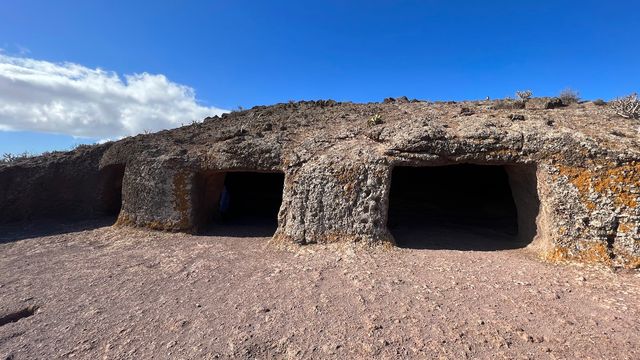
Every mound on the slope is a grave. More than 800 of them sit among the boulders of an old rockfall from Morro Garito, built from the same stone, so at first the cemetery and the landslide read as one field of rubble. Look closer and the shapes separate: truncated cones, pyramids, circles, rectangles, each a stone box for the body under a stacked cap.
The cemetery was in use for some 2,300 years, from the 5th century BC into the 18th, long after the Castilian conquest. A dry-stone wall nearly a metre high, about waist height, once enclosed it and still shows on several sides.
At sunrise on the spring equinox, a ray of light passes through a U-shaped notch in the Amurga massif (Macizo de Amurga) and falls on the King's Tomb (Túmulo del Rey) while the rest of the necropolis stays in shadow.
Good to know
- The walk from the car park to the entrance is about 1 km, so check the opening days before you set off.
- The paths around the tombs cross rough, rocky ground and turn steep in places. Wear proper shoes.
- There is no shade on the slope and no drinking water nearby. Bring water and a hat.
- The entrance is not wheelchair accessible.
- A board beside the visitor centre maps the route around the necropolis.
Getting there
The car parks are about 650 m from the necropolis in a straight line. On foot the route runs through Arteara village and a grove of tall palms, and comes to about 1 km before you reach the entrance.
The bus stop, also named Arteara, is about 760 m away in a straight line, so arriving by bus means a similar walk. The visitor centre stands at the burial ground itself, and the paths around the tombs start from there.
Best time to visit
Best: a morning soon after opening, Tuesday to Sunday.
Avoid: Mondays, when the site is closed, and the middle of a summer day.
The rockfall slope is bare stone with no shade among the tombs, the heat builds towards midday, and low morning sun from over the Amurga massif picks out the shapes of the mounds.
Access & restrictions
Arteara is a protected archaeological zone, listed as a Bien de Interés Cultural since 1985. The mounds are graves built from loose rock: keep to the paths, do not climb on the tombs, and leave every stone where it lies. A stone moved from a cairn is damage to the monument.
Things to do nearby
All tours in San Bartolomé de Tirajana on GetYourGuide
Paid links: booking through them supports YowJourney.
Sun & daylight
Nearby Places

Similar Places
Arteara Necropolis on the map
The paths cross rockfall rubble, rough and steep in places, with loose stone underfoot. There is no shade on the slope, so carry water and cover up against the sun.
Get directions

Your whole travel map in one place
Get inspired by new places around the world and find the ones worth the journey
Frequently asked questions
How old is Arteara Necropolis?
Dating from the site runs from the 5th century BC into the 18th century. People of the Fataga ravine kept burying their dead here for centuries after the Castilian conquest, some 2,300 years of use in all.What happens at the equinox?
At sunrise on the spring equinox in March, a ray of light passes through a notch in the Amurga massif and lights the King's Tomb while the rest of the necropolis is still in shadow. At the autumn equinox in September the rising sun is briefly hidden by the rocks, so it appears to rise twice.How far is the walk from the car park?
About 1 km on foot, through Arteara village to the entrance. The paths around the tombs add more walking over rough ground.Is the site wheelchair accessible?
No. The entrance is not wheelchair accessible, and the paths around the tombs are rough and steep in places.Who studied the necropolis first?
Locals knew the place as the cemetery of the Canarios long before scientists arrived. The first recorded explorations were by Víctor Grau-Bassas in 1886 and the French anthropologist René Verneau around 1887, both for the Museo Canario.