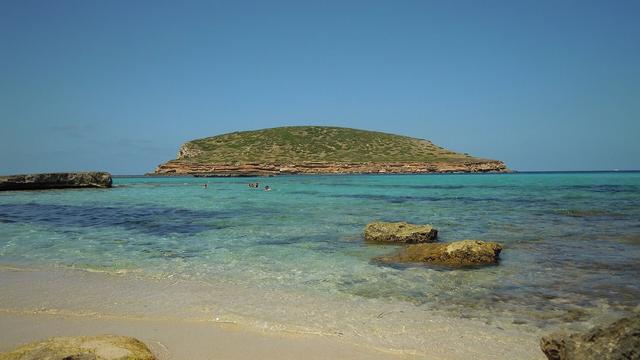
Es Vedrà is a rocky island off the south-west coast of Ibiza, about 2.5 km from the shore at Cala d'Hort in the municipality of Sant Josep de sa Talaia. It rises 413 metres, is built mostly of Mesozoic limestone and belongs to the Cala d'Hort nature reserve. The island is uninhabited. It is known for its sunsets, for a colony of the endangered Eleonora's falcon, and for legends that tie it to the Phoenician goddess Tanit and to the sirens of the Odyssey.
Es Vedra
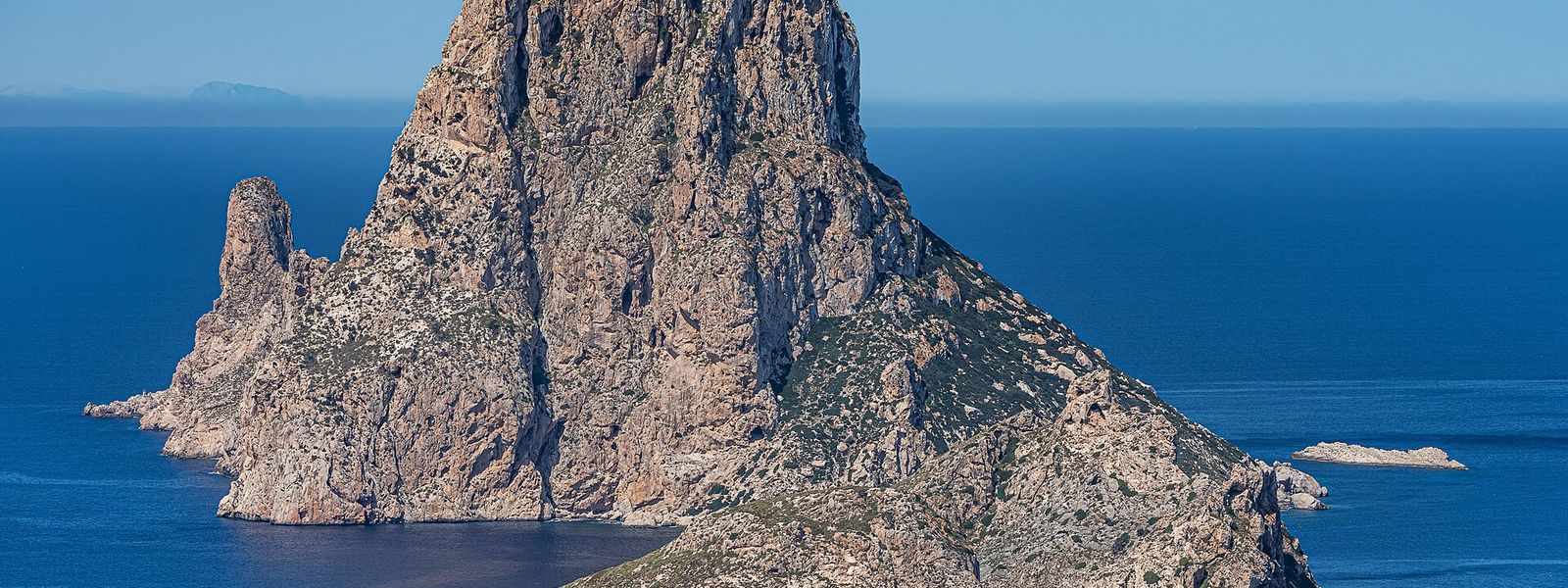
Uninhabited limestone island rising 413 m from the sea off Ibiza's south-west coast, within the Cala d'Hort reserve
- Entrance
- Free: there is no ticket to see the island from the coast.
- Accessibility
- No wheelchair-accessible parking or entrance.
- Parking
- Free unpaved car park about 3.2 km from the island in a straight line.
- Transport
- No bus stop nearby; come by car.
- Advance booking
- Not needed to see the island from the coast.
- Hours
- Open at any time; the island is viewed from the open coast.
- Address
- 07830, Balearic Islands, Spain
What makes it special
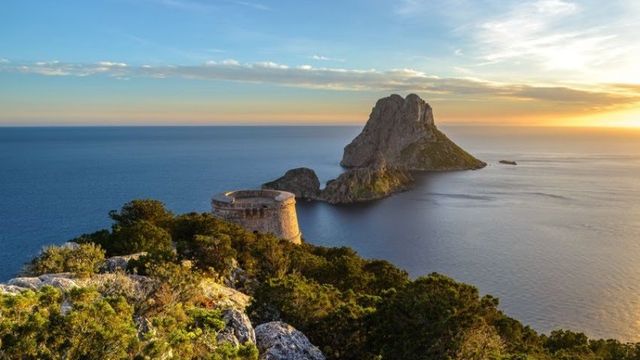
As the sun goes down over the sea, Es Vedrà turns into a dark silhouette: 413 metres of limestone rising straight out of the water, higher than the Eiffel Tower, with the smaller islet of Illa Vedranell beside it.
Nobody lives on it. The wild goats that once did were culled in 2016 to protect the rest of its wildlife, which includes a subspecies of the Ibizan wall lizard and a colony of Eleonora's falcon, an endangered bird of prey.
Legends crowd the rock. It is linked to the sirens who tried to lure Odysseus and to Tanit, the Phoenician goddess who became Ibiza's patroness. An island fable tells of a giant hiding in one of its caves. In 1855 the Carmelite friar Francisco Palau rowed out here to pray and wrote part of his journal in its solitude; he was beatified in 1988. The island's reputation for magnetic energy has no basis in the stone: it holds no magnetic metal.
Good to know
- Es Vedrà is something you look at: it is uninhabited, part of the Cala d'Hort nature reserve, and seen from the coast or from the sea.
- There are no toilets and no drinking water nearby. Bring water, especially if you stay on for sunset.
- No bus stop lies nearby, so plan on coming by car.
- The nearest car park has an unpaved surface.
- If you stay until the light goes, bring a torch for the walk back to the car.
Getting there
Es Vedrà is watched from the shore, and the shore that faces it is the coast at Cala d'Hort, in the south-west of Ibiza, about 2.5 km across the water from the island. No bus stop lies nearby, so the last stretch is by car. The nearest car park has an unpaved surface and sits about 3.2 km from the island in a straight line. From the coast the rock stands in full view over the sea. The island can also be seen from a boat, which brings the cliffs closer.
Best time to visit
Best: late afternoon into sunset, when the sun goes down over the sea and the rock turns to a dark silhouette against the sky.
Avoid: the middle of a summer day, when the high sun flattens the limestone and the heat sits on the exposed coast.
The island changes with every shift of light and weather, and the evening is when it looks its most dramatic.
Sun & daylight
Nearby Places
Similar Places
Es Vedra on the map
The cliffs along the coast facing Es Vedrà are unfenced and the rock near the edge can be loose. Keep well back, never scramble towards the edge for a better angle, and take extra care after dark.
Get directions

Your whole travel map in one place
Get inspired by new places around the world and find the ones worth the journey
Frequently asked questions
Does anyone live on Es Vedrà?
No. The island is uninhabited. Its last residents were a subspecies of wild goat, culled in 2016 to protect the island's other wildlife.How tall is Es Vedrà and how far is it from the coast?
Es Vedrà rises 413 metres and lies about 2.5 km off the coast at Cala d'Hort, in the south-west of Ibiza.Is Es Vedrà magnetic?
No. The island is made mostly of Mesozoic limestone and contains no accumulations of magnetic metal. The story of its magnetism is a myth.When is the best time to see Es Vedrà?
Late afternoon into sunset, when the sun goes down over the sea and the island stands as a dark silhouette.Can you get to the coast facing Es Vedrà by bus?
No bus stop lies nearby, so the approach is by car. The nearest car park is about 3.2 km from the island in a straight line.