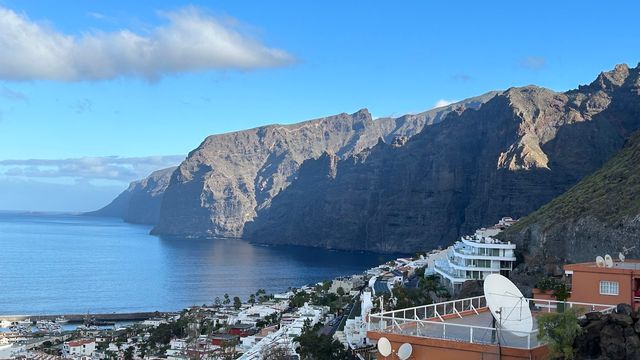
Punta del Fraile Viewpoint stands on the road from Buenavista del Norte to Punta de Teno, the north-western tip of Tenerife in the Canary Islands. Here the road runs along a ledge cut into vertical cliffs of dark volcanic rock, with the Atlantic below. The viewpoint looks out along the coastline and over the ocean, and it is known for the cliff road itself as much as for the view.
Punta del Fraile Viewpoint
Local name: Mirador Punta del Fraile

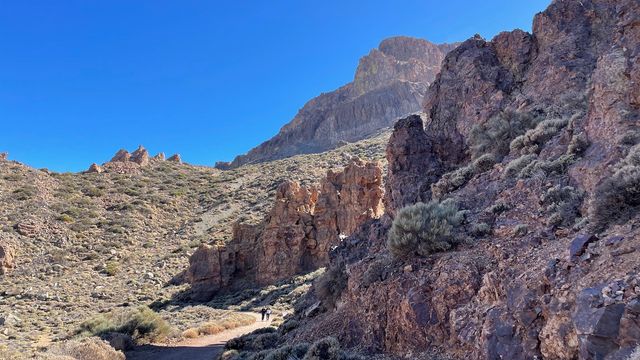
Roadside viewpoint on the cliff road to Punta de Teno, with red-brown lava walls above the Atlantic.
- Entrance
- Free; there is no ticket.
- Parking
- Two parking areas, about 600 m and 975 m away in a straight line.
- Difficulty
- No trail: the approach is along the road itself, cut into the cliff and exposed to wind and falling stones.
- Transport
- Bus stop Camino El Risco, about 1.5 km away in a straight line; buses run on the Teno road when it is closed to private cars.
- Advance booking
- Not needed.
- Address
- Carr. Punta de Teno, 38480 Buenavista del Nte., Santa Cruz de Tenerife, Spain
What makes it special
The road hangs on the cliff. Heading towards the viewpoint, the rock walls rise higher and more vertical with every minute, until the carriageway is a shelf cut into sheer lava with the ocean beneath it. On a windy day the noise along this stretch is enormous.
From the lookout the coastline runs out towards Punta de Teno and the open Atlantic. In the evening the light turns warm and pastel, and the lava around the viewpoint shifts through shades of red and brown.
Good to know
- Private cars and motorbikes can use the Teno road only early in the morning; after that only buses get through. Check the current hours before setting out.
- The road is sometimes closed outright, and stones fall from the cliffs above it. Skip it on stormy, windy days.
- There are no toilets, drinking water or information point at the viewpoint, and none nearby. Bring water.
- The cliff stretch gives no shelter from wind or sun, so bring a layer and a hat.
Getting there
The viewpoint sits on the road out to Punta de Teno, west of Buenavista del Norte. The nearest parking is about 600 m away in a straight line, with a second area about 975 m away, and the last stretch is on foot.
When the road is shut to private cars, the bus keeps running. The nearest stop, Camino El Risco, is about 1.5 km away in a straight line. Walking in along the cliff, the wind is the first thing you hear, and on this stretch stones come down from the rock above.
Best time to visit
Best: early in the day, while private cars are still allowed on the road, or towards evening, when the lava turns red and brown.
Avoid: windy, stormy days, when the road can be closed and stones come down from the cliffs.
The lookout faces the open Atlantic, so the low evening sun comes in off the ocean and warms the colour of the rock.
Sun & daylight
Nearby Places

Similar Places
Punta del Fraile Viewpoint on the map
Stones fall from the cliffs above the Teno road, and on the stretch that hangs over the drop there is nowhere to shelter. Do not linger beneath the rock walls, and stay away in strong wind.
Get directions

Your whole travel map in one place
Get inspired by new places around the world and find the ones worth the journey
Frequently asked questions
Can I drive to Punta del Fraile Viewpoint?
Only early in the morning. After that the Teno road is closed to private cars and motorbikes and only buses get through. Check the current access hours before you set out, or come by bus.Is there a bus?
Yes. Buses keep using the road when it is closed to cars. The nearest stop, Camino El Risco, is about 1.5 km away in a straight line.Is it safe to walk along the road?
Stones fall from the cliffs above, and there is nowhere to shelter on the stretch that hangs over the drop. Keep moving under the rock walls and stay away in strong wind.Are there toilets or water at the viewpoint?
No. There are no toilets or drinking water at the viewpoint, and none nearby, so bring what you need.When is the light best?
In the evening, when the light turns warm and pastel and the lava around the viewpoint takes on shades of red and brown.