Roques de García is a group of volcanic rock formations in Teide National Park, a World Heritage Site, in the municipality of La Orotava in the centre of Tenerife. The rocks are remnants of the island's former summit and stand near Teide volcano. The best known, Roque Cinchado, is a 27-metre pillar of volcaniclastic sedimentary layers; two sills of lava intruded into its upper part have made the top more resistant to erosion. The pillar appeared, with Teide behind it, on the 1,000-peseta banknote.
Roques de Garcia

Group of eroded volcanic rock pillars in Teide National Park, with Teide rising behind Roque Cinchado.
- Parking
- Two free car parks: the asphalt Roques de García car park about 235 m away, and a second about 390 m away. Spaces are hard to find at busy times.
- Difficulty
- The viewpoint is a walk across open ground from the car parks. The loop around the rocks is easy and takes about an hour and a half, on uneven lava with no shade.
- Transport
- Bus stop Parador del Teide (stop 7684), about 400 m away.
- Address
- Roque Cinchado, 38300, Santa Cruz de Tenerife, Spain
What makes it special
Roque Cinchado is the shape everyone recognises: a pillar 27 metres tall, about the height of a nine-storey block, thinner at the base than at the top, with the cone of Teide standing behind it. The top holds because two sills of lava pushed into its upper layers and harden it against erosion, while the softer sediment below wears away.
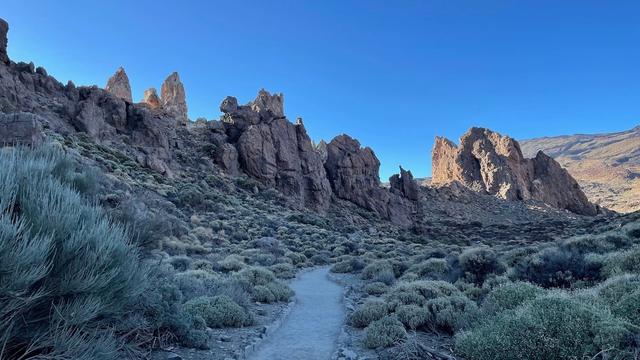
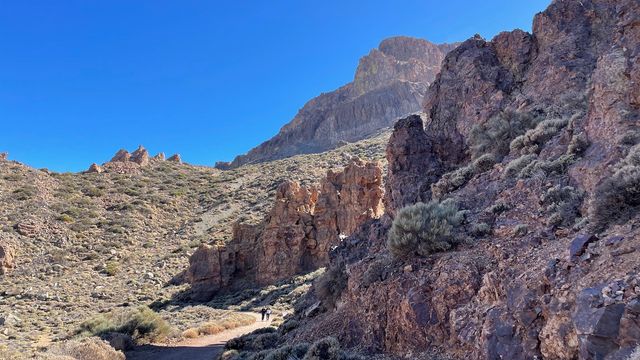
Most people take the picture, look at the Cathedral (La Catedral) and drive on. The loop path around the group takes about an hour and a half and is easy going. It opens up views of Teide and the walls of the old crater, and the ground underfoot changes colour and texture as it crosses one kind of lava after another.
Good to know
- The viewpoint is popular and gets very crowded, and car park spaces are hard to find at busy times.
- Drive slowly past the rocks: people stand in the road to take photos.
- There is no drinking water nearby. Bring your own, especially for the loop walk.
- The nearest toilets charge a fee.
- The loop has no shade, and in summer the heat on it is punishing.
Getting there
Most visitors arrive by car. Two car parks lie close by: the asphalt Roques de García car park, about 235 m from the rocks in a straight line, and a second one about 390 m away. From either, it is a walk across open volcanic ground to the viewpoint in front of Roque Cinchado, where a map board sets out the area.
The nearest bus stop, Parador del Teide, is about 400 m away. Paid toilets stand around 450 m from the rocks. Coming in by road, slow down near the viewpoint: people step into the carriageway for photos.
Best time to visit
Best: early morning, or late afternoon into sunset.
Avoid: the middle of the day, and midday in summer above all.
The bare ground holds no shade and the summer heat on the loop path is hard going, while low sun brings out the layers in the rock and the crowds are thinner at the edges of the day. Sunset draws photographers, though the sun drops behind the surrounding peaks; on the drive down afterwards, gaps in the ridges can show the sea of clouds lit red.
Access & restrictions
Roques de García lies inside Teide National Park, a protected World Heritage Site. Keep to the paths, leave rocks, lava fragments and plants where they are, and do not climb the formations: Roque Cinchado is made mostly of sedimentary rock layers, and every foothold wears it down.
Sun & daylight
Nearby Places


Similar Places

Featured in our guides
Roques de Garcia on the map
The loop path crosses loose, uneven lava in full sun at high altitude. Wear sturdy shoes and carry water and sun protection.
Get directions
Your whole travel map in one place
Get inspired by new places around the world and find the ones worth the journey
Frequently asked questions
How long does the walk around Roques de García take?
The loop around the rocks takes about an hour and a half. The path is easy, but it has no shade and the summer heat makes it hard work.What is Roque Cinchado?
Roque Cinchado is the best-known rock of Roques de García: a 27-metre pillar of volcaniclastic sedimentary layers, capped by harder lava sills. It appeared with Teide behind it on the 1,000-peseta banknote.Can I reach Roques de García by bus?
The nearest bus stop is Parador del Teide, about 400 m from the rocks. Most visitors come by car or with a tour.Is Roques de García a good place for sunset?
Sunset light on the rocks is popular for photographs, but the sun itself goes down behind the surrounding peaks. On the drive down afterwards, gaps in the ridges can show the sea of clouds lit red.