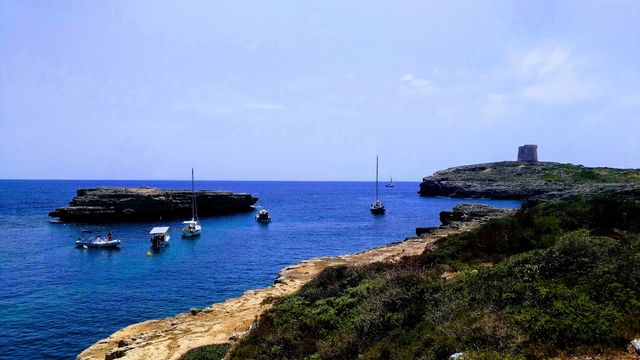
Torre d'Alcalfar is a round stone defence tower on the headland beside Cala Alcaufar, in Sant Lluís on Menorca's south-east coast. The Spanish built it in the late eighteenth century as one of the watchtowers guarding the island's shore, and it has since been restored. It is known for its commanding position, with a wide view over the sea and along the coastline. A coast path links it with Punta Prima.
Torre d'Alcalfar

Restored Spanish watchtower on a rocky headland beside Cala Alcaufar, with open views along the Menorca coast.
- Accessibility
- No wheelchair-accessible parking or entrance. The approach is a rough path over loose rocks, difficult for anyone with limited mobility.
- Parking
- Nearest car parks about 550 m away in a straight line; one is free but for customers only. No wheelchair-accessible parking.
- Difficulty
- Easy walk on a rough, rocky path: about 25 minutes along the coast path from Punta Prima, or a quick walk from Cala Alcaufar.
- Transport
- Nearest bus stop: Alcaufar, about 470 m away in a straight line.
- Hours
- The tower's interior does not open all year; it was closed in May.
- Address
- 07713 Cala Alcaufar, Illes Balears, Spain
What makes it special
From the foot of the tower the coast opens out both ways: the narrow inlet of Cala Alcaufar on one side, the rocky shore running towards Punta Prima on the other, and open sea straight ahead. The tower is a thick-walled stone drum, cleanly restored, standing on low rock with nothing taller around it.
That sightline is why it was built. The Spanish put it here to watch the approaches from the sea, and the same clear view is what brings people out today. The walk is part of it too. The coast path from Punta Prima keeps to the shore the whole way, and the headland itself is calm and open, with the sound of the sea on the rocks below.
Good to know
- Getting inside the tower is not guaranteed. Plan the trip around the headland and the view, and treat the interior as a bonus.
- The path is rough, with loose rocks both small and large underfoot. Wear shoes with a good grip.
- There are no toilets and no drinking water at the tower or nearby. Bring water with you.
- The headland is bare rock with no shade. In summer, bring a hat and sun cream.
Getting there
The last stretch is on foot whichever way you come. From Cala Alcaufar the tower is a quick walk out along the headland. From Punta Prima the coast path follows the shore to the tower in about 25 minutes, an easy walk with the sea beside you the whole way.
The nearest car parks sit about 550 m from the tower in a straight line, and the Alcaufar bus stop about 470 m. From either, the final approach is a rough path over loose stones.
Best time to visit
Best: early morning, when the sun rises over the sea in front of the tower, or late afternoon once the heat has gone out of the rock.
Avoid: the middle of a summer day.
The headland and the path have no shade, and there is no water to be had near the tower.
Sun & daylight
Nearby Places
Similar Places

Torre d'Alcalfar on the map
The path is strewn with loose rocks, and the headland drops to low rock above open sea. Wear shoes with a grip, and keep off wet rocks at the water's edge when waves are running.
Get directions
Your whole travel map in one place
Get inspired by new places around the world and find the ones worth the journey
Frequently asked questions
Can you go inside Torre d'Alcalfar?
Sometimes. The tower can be visited inside, but it does not open all the time, so plan the walk for the headland and the view.How long is the walk from Punta Prima?
About 25 minutes along the coast path. It is an easy walk, though the surface is rough and rocky in places.Is there parking near the tower?
The nearest car parks are about 550 m away in a straight line, one of them for customers only. The rest of the way is on foot.Are there toilets or drinking water at the tower?
No. There are no toilets and no drinking water at the tower or nearby, so bring what you need.Who built the tower?
The Spanish, in the late eighteenth century, as a watchtower guarding this stretch of the Menorca coast. It has since been restored.