Famara Beach lies on the north-west coast of Lanzarote in the municipality of Teguise, beside the village of Caleta de Famara. It runs for two kilometres of sand and volcanic pebbles south of the Risco de Famara, cliffs that rise to 671 m and are the remains of a Miocene volcano. Facing the open Atlantic, the beach is known for strong wind, steady waves and surfing. The cliffs and their coastline belong to the Chinijo Archipelago natural park.
Famara Beach
Local name: Playa de Famara
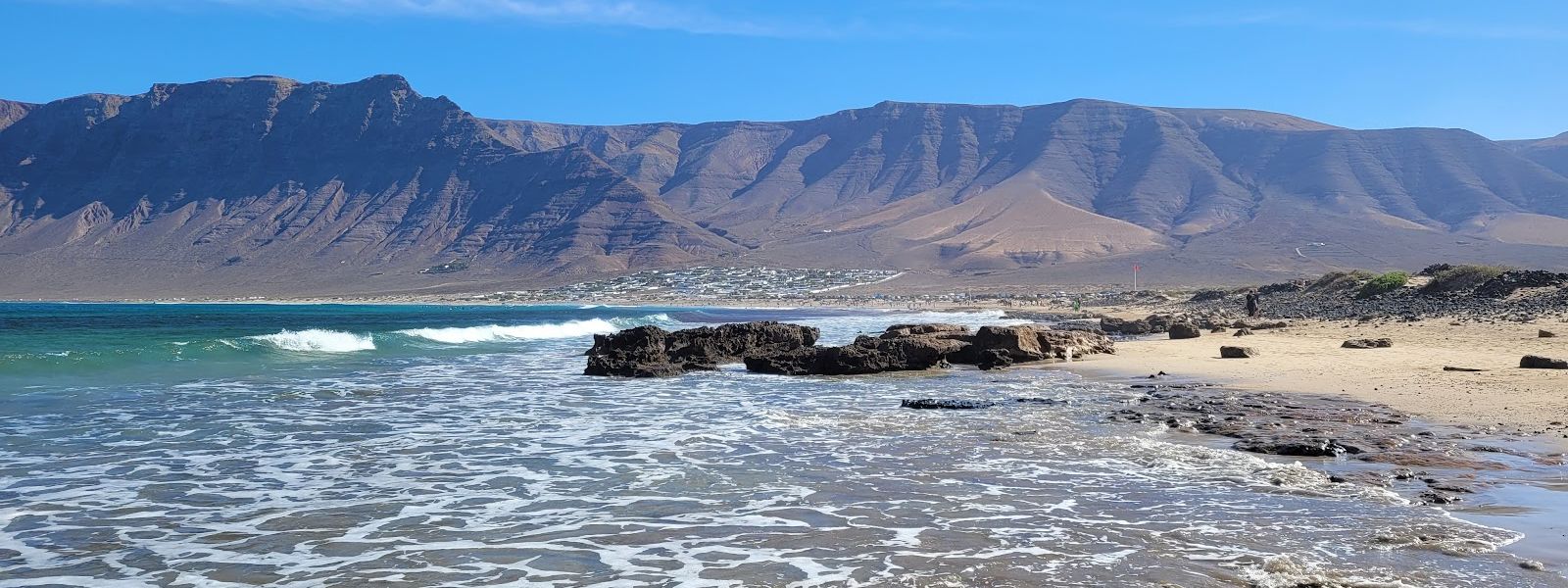
Two-kilometre surf beach of sand and volcanic pebbles beneath the cliffs of the Risco de Famara.
- Entrance
- Free; open public beach.
- Accessibility
- Parking runs along the beach road beside the sand; the beach itself is loose sand and volcanic pebbles.
- Parking
- Free, along the beach road; car parks about 60 m and 120 m away in a straight line.
- Difficulty
- None: you park along the beach road and step onto the sand.
- Transport
- Bus stop Caleta de Famara, about 750 m away in a straight line.
- Advance booking
- Not needed.
- Hours
- Open at all times.
- Address
- Famara, Las Palmas, Spain
What makes it special
From the sand, the Risco de Famara fills the view to the north: a wall of cliff climbing to 671 m at the Peñas del Chache, about twice the height of the Eiffel Tower. It is what is left of a volcanic caldera some ten kilometres across, centred on the south of La Graciosa.
Below it, two kilometres of golden sand and volcanic pebbles take the Atlantic swell head on. Surfers fill the water off the main stretch by the village, and the surf schools in Caleta de Famara bring beginners here to learn to stand up on a board. Walk further along and the crowd thins out into dunes and volcanic rock, with the waves breaking hard against it. On the coastal plain at the foot of the cliffs grow about ten species of plants found nowhere else, isolated there for more than a million years.
Large sandy beaches are scarce on Lanzarote. That is a good part of why this one pulls people in.
Good to know
- There are no toilets at the beach and none nearby, and no drinking water. Plan breaks around the cafés and restaurants in Caleta de Famara.
- The sand has no shade and no facilities. For a long stay, bring food, water and some cover of your own.
- The wind is strong. Bring a windproof layer and expect sand on the move across the open beach.
- The main stretch by the village gets busy with surfers and families. Walk further along for quieter dunes and rock.
- Currents from the west carry rubbish from the North Atlantic garbage patch, and it washes up on this shore.
Getting there
Famara Beach sits on the edge of Caleta de Famara, a small fishing and surfing village in the municipality of Teguise. Most people drive. Cars and camper vans park along the beach road beside the sand, with car parks about 60 m and 120 m away in a straight line, so there is no walk in to speak of.
The nearest bus stop, Caleta de Famara, is about 750 m away in a straight line.
Once you are on the sand, the beach runs on for two kilometres. The quieter dunes and the volcanic rock lie further along, on foot.
Best time to visit
Best: late afternoon into the evening, and after dark on a clear night. The beach faces the open Atlantic to the west, so the light changes over the water as the sun drops, and with little light pollution around the village the stars come out sharp.
Avoid: the middle of a hot day if you plan to stay long. The sand is bare, with no shade anywhere along it, and the wind keeps working on you.
Sun & daylight
Nearby Places
Similar Places

Famara Beach on the map
The beach takes heavy Atlantic surf, and strong currents run along the shore. Swim only in calm conditions, stay within your depth and never turn your back on the waves.
Get directions

Your whole travel map in one place
Get inspired by new places around the world and find the ones worth the journey
Frequently asked questions
Is Famara Beach safe for swimming?
Famara Beach faces the open Atlantic and is known for strong wind and waves, with currents along the shore. Swim only when the sea is calm, and stay within your depth.Is Famara Beach good for beginner surfers?
Yes. The waves suit beginners learning to stand up on a board, and Caleta de Famara has several surf schools.Are there toilets at Famara Beach?
No. There are no toilets at the beach and none nearby, and no drinking water. The village of Caleta de Famara has cafés and restaurants.Where do you park for Famara Beach?
Along the beach road beside the sand, where cars and camper vans line up. Car parks sit about 60 m and 120 m away in a straight line.