The Ferrocarril de Sóller is an interurban railway, and the company that operates it, linking Palma with the northern town of Sóller on Mallorca. The electrified 3 ft (914 mm) narrow-gauge line runs north across the plain from the capital, calls at smaller towns such as Son Sardina and Bunyola, and winds through 13 tunnels in the Serra de Tramuntana. Built on profits from the booming orange and lemon trade, it is sometimes called the Orange Express. In 2019 it carried over a million passengers.
Ferrocarril de Sóller
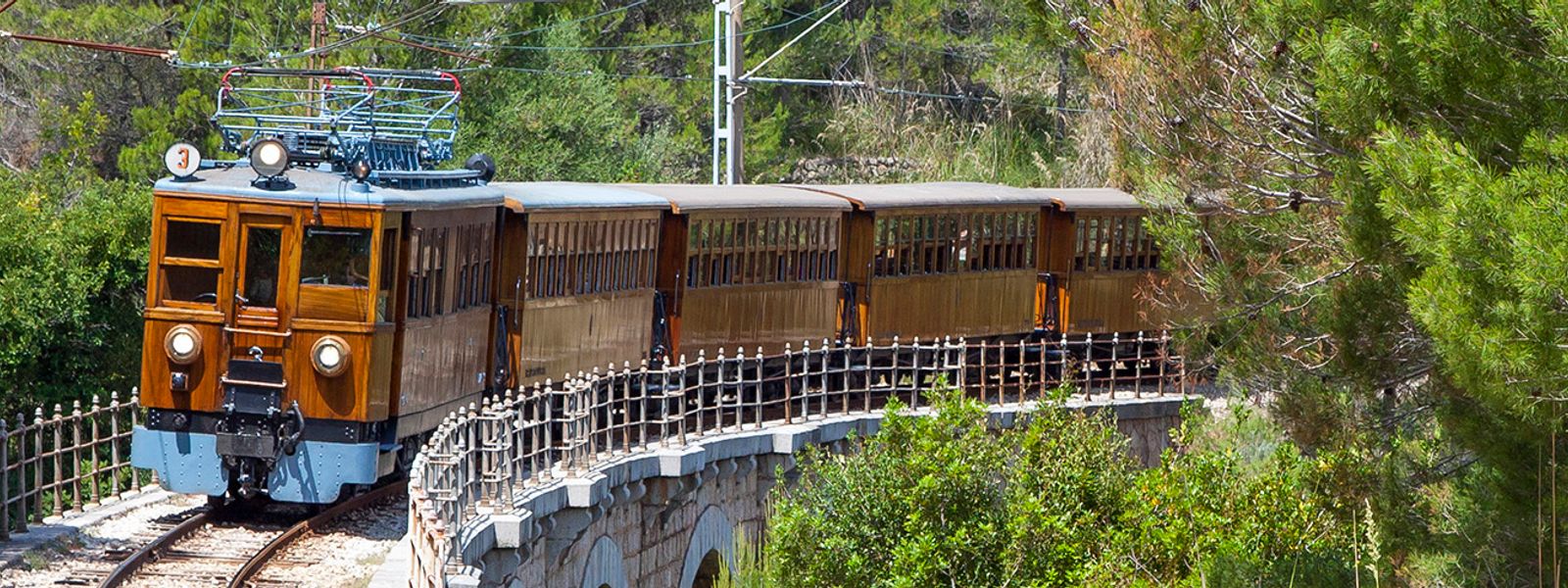
Narrow-gauge electric railway from Palma to Sóller, its wooden carriages crossing the Serra de Tramuntana through 13 tunnels.
- Entrance
- Palma–Sóller single €23, return €30 (2026 fares). A Palma return can be extended with a Sóller tram return for €10; bought on board, the tram costs €10 each way.
- Parking
- Paid car parks near the Sóller station: Plaça Antoni Maura about 60 m away, and another about 200 m away.
- Difficulty
- None: a seated train ride between two stations in the centres of Palma and Sóller.
- Transport
- Trains run between Palma station, just off Plaça d'Espanya, and Sóller station, where the tram to Port de Sóller calls.
- Address
- Plaça d'Espanya, 6, 07100 Sóller, Illes Balears, Spain
What makes it special
Wooden carriages leave Palma across a plain of olive groves, then the line climbs into the Serra de Tramuntana and threads 13 tunnels before it reaches Sóller. The train still works as ordinary transport between the two towns, and it is also the reason many people make the journey at all.
Both ends repay a look. The Palma station is a modest brown brick building, part of it given over to a museum, with glass windows set so the tracks seem to run on into the rooms. Next door, old railway buildings and a brick chimney stand in a park where children climb on play carriages, each named after a town along the line. The Sóller station grew out of Ca'n Mayol, a fortified house from 1606, and holds a museum of works by Picasso and Joan Miró. From there a vintage tram carries on down to Port de Sóller.
Good to know
- The train-and-tram combination adds a Port de Sóller tram return to a Palma return for about half what the tram costs on board.
- Inside the Sóller station, a museum of works by Picasso and Joan Miró fills the time before a return train.
- In Sóller, free public toilets and drinking water are about 60 m from the station, and the tourist office is right beside it.
- At the Palma end, the park next to the station has play carriages for children to climb on.
Getting there
In Palma, the terminus stands just off Plaça d'Espanya: a brown brick building with a large "Ferrocarril de Sóller" sign on the front. It borders the park laid over the underground Estació Intermodal, so anyone arriving there has only the park to cross.
At the Sóller end, the station sits in the town with the municipal tourist office beside it. Paid parking lies about 60 m away at Plaça Antoni Maura, and a second paid car park is about 200 m away. The tram to Port de Sóller calls at the station, so the ride on to the sea is one change away.
Best time to visit
Best: spring and autumn, or an early train in summer.
Avoid: the middle of the day in July and August.
The line carries over a million passengers a year and a summer island fills its best-known ride, while Sóller, down in its mountain valley, gets hot by midday — and most of the day is spent on foot in the town and the port.
Sun & daylight
Nearby Places


Similar Places


Your whole travel map in one place
Get inspired by new places around the world and find the ones worth the journey
Frequently asked questions
Can the train be combined with the tram to Port de Sóller?
Yes. A return ticket from Palma can be extended with a return on the Sóller tram, which works out at about half the price of paying for the tram on board. The tram calls at the Sóller station.Where does the train leave from in Palma?
From its own station just off Plaça d'Espanya, a brown brick building with a large "Ferrocarril de Sóller" sign, next to the park that lies over the underground Estació Intermodal.Why is it called the Orange Express?
The railway was built on the profits of the orange and lemon trade, which was booming at the time, and the nickname stuck.Where does the train stop on the way?
Between Palma and Sóller it calls at smaller towns such as Son Sardina and Bunyola before winding through 13 tunnels in the Serra de Tramuntana.Is it a good trip with children?
Yes. The park beside the Palma station has train-themed play structures, each a carriage named after a town on the line, and the tram ride on to Port de Sóller extends the day.