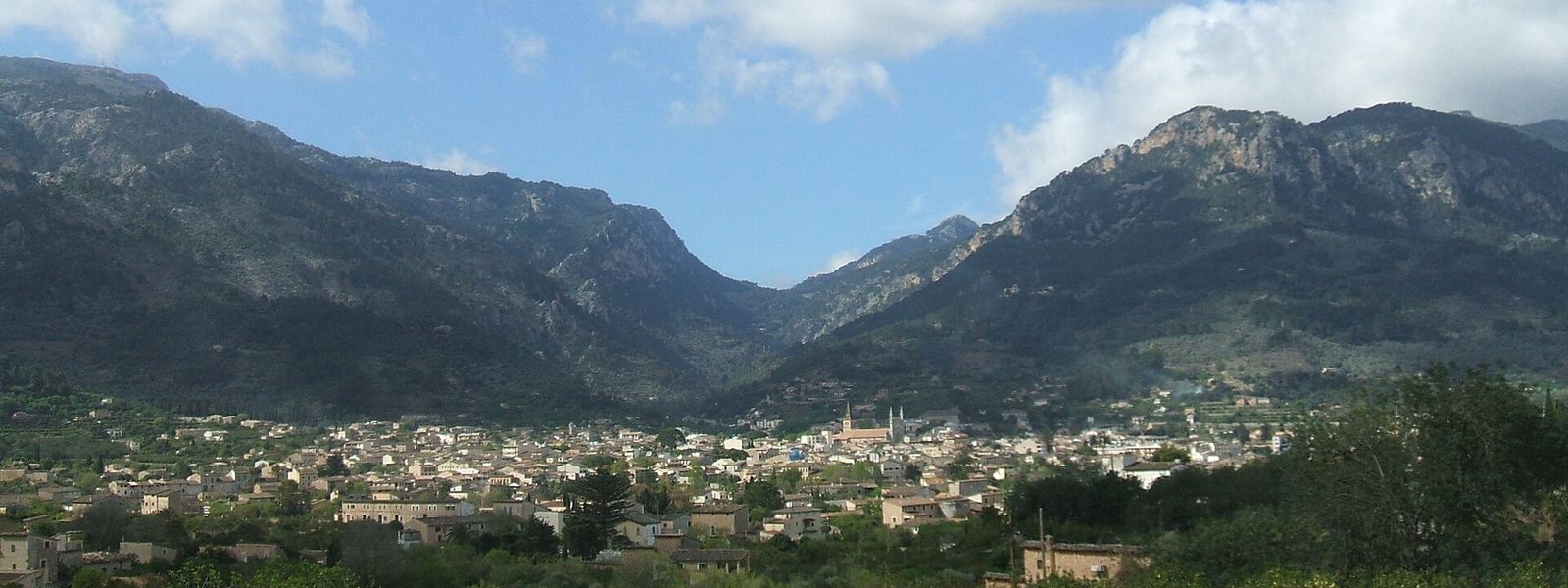
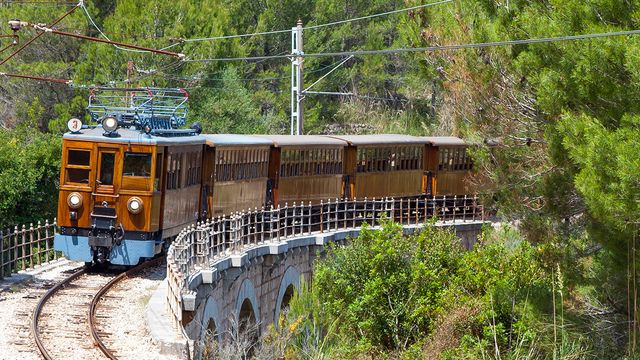
A wooden tram rumbles out of the railway station and straight across Plaça Constitució, where cafés sit under plane trees around a fountain. Sóller made its money from oranges, lemons and olives shipped out by sea, and the wealth shows on the square: Joan Rubió's 1904 façade on the church of Sant Bartomeu and the ironwork of his Modernista Banco de Sóller. Most visitors arrive on the heritage train from Palma, then ride the tram down to Port de Sóller.
Sóller
- Currency
- Euro (EUR, €). Credit and debit cards are widely accepted in cities and tourist areas. ATMs are abundant; most charge €2–7 per foreign card withdrawal. Some shops request ID before accepting a credit card. €500 banknotes are not accepted in most shops.
- Language
- Catalan and Spanish are both official languages of the Balearic Islands; the majority speaks Catalan fluently alongside Spanish. English is common in tourism sectors and establishments.
- Power plug
- Europlug (Type C) and Schuko (Type F) sockets; 230 V, 50 Hz
- Visa
- Schengen area: EU, EEA and Swiss nationals enter on national ID card or passport. Many non-EU nationalities have 90-day visa-free access. Non-EEA citizens staying longer than 90 days require an advance visa.
- Time zone
- Europe/Madrid (UTC+01:00 winter time, UTC+02:00 summer time from last Sunday in March to last Sunday in October). Canary Islands are one hour behind mainland Spain.
- Tap water
- Safe to drink throughout Spain. In some southern regions it has high mineral content and may taste unfamiliar; locals often drink bottled water instead. Bottled water is inexpensive and widely available.
- Tipping
- Not mandatory or customary. In restaurants: not expected for simple meals or basic establishments; 5–10% in mid-range or upscale venues if service was exceptional. Always pay cash to the server, not on card. Taxi drivers and hotel staff may appreciate small tips in upscale settings but it is not expected.
- Emergency
- 112
When to go
Low season
Nov – Feb
Bus 231 from Alcúdia and Lluc stops running, and at Epiphany in January the Three Kings parade from the port to the town square, throwing sweets to the children.
Shoulder
Mar – Jun
Bus 231 returns in March, and the Sa Mostra international folklore festival falls between May and July.
High season
Jul – Aug
The train and tram are at their most packed, and in August the feast of Sant Bartomeu brings the correfoc fire-run to the town square.
Shoulder
Sep – Oct
The summer heat eases in the valley while bus 231 still runs to the end of October.
How long to stay
One full day covers the train from Palma, the town centre and the tram down to Port de Sóller, and plenty of people do it as a day trip: the train takes about an hour, bus 204 about 30 minutes. Two or three nights leave time for the Jardí Botànic, the museums and the valley villages of Fornalutx and Biniaraix, and for evenings on the square after the day-trip crowd has gone back to Palma.
Getting around
The centre is for walking. Its streets are narrow and traffic-restricted, so leave the car at the edge of town.
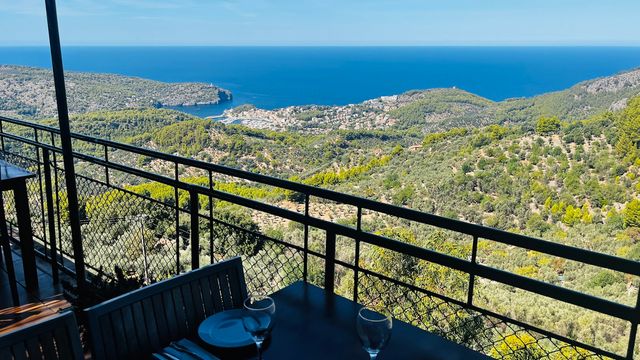
The heritage tram runs from the railway station through Plaça Constitució to Port de Sóller on a 4.87 km single track. It is often full from its first stop, so board at the station. Buses 204 and 231 cover the same stretch, and on foot or by bike you follow the tram tracks along the waterfront. Minibus 232 connects with bus 204 and climbs to Fornalutx. Taxis wait by the railway station.
The caveat is the bus station: a bus signed for Palma is not always going there, and some buses skip it for Centre 2, a stop on the main road 100 m west. Bus 231 to Lluc, Pollença and Alcúdia runs only from March to October.
Local rules
- The Ma-11 road tunnel is closed to cyclists and walkers. Anyone on a bike or on foot takes the old road that hairpins over Coll de Sóller.
- The central streets are traffic-restricted. Park on the edge of town and walk in; the lanes around Plaça Constitució are narrow and not meant for through traffic.
What to see


Destinations in Sóller
Frequently asked questions
How do I get to Sóller from Palma?
The Ferrocarril de Sóller runs from Plaça d'Espanya in Palma via Bunyola in about an hour, on heritage wooden electric trains; expect them to be crowded even outside high season. TIB bus 204 takes about 30 minutes and continues to Port de Sóller. By car it is 24 km on the Ma-11, through the tunnel under Coll de Sóller.How do I get from Sóller down to the port?
The tram leaves from the railway station and runs to Port de Sóller; it is often full from the start. Buses 204 and 231 cover the same stretch, and walkers and cyclists follow the tram tracks along the waterfront.Can I drive into the centre of Sóller?
The central streets are narrow and traffic-restricted. Park on the edge of town and walk in.What is the Firó?
Sóller's biggest festival, commemorating the Moorish pirate raid of 11 May 1561. Locals dress as turbaned pirates or in traditional costume and re-enact four battles with fireworks: two at the port, one in La Huerta and one in the town square.What is worth seeing in the town itself?
Plaça Constitució, with the church of Sant Bartomeu and the 1912 Banco de Sóller by Joan Rubió, a follower of Gaudí; the Picasso and Joan Miró exhibition inside the railway station; Can Prunera, a 1911 modernist townhouse museum; and the Jardí Botànic on the road to the port, planted with species of the Balearics and other Mediterranean islands.