The Biniai Nou hypogea are two funerary tombs in the municipality of Maó, Menorca, built in the Chalcolithic period. Each chamber is excavated into the rock, while the corridor leading in is built of vertical stone slabs that form a megalithic façade, a type known on the island as a paradolmen. Excavations sponsored by the Museum of Menorca recovered pottery, awls and radiolarite fragments, and a human bone from one tomb gave a radiocarbon date of 2290–2030 BC, the earliest known for the island's prehistory.
Hipogeu de Biniai Nou
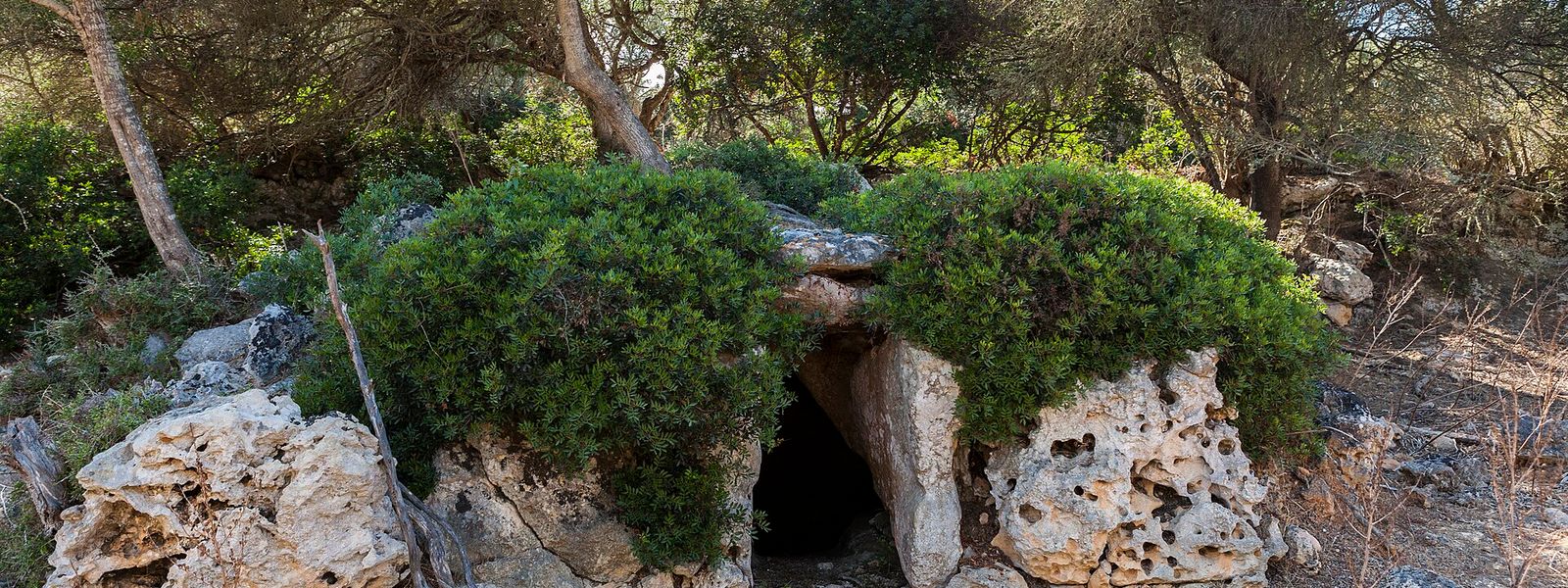
Two rock-cut Chalcolithic tombs near Maó with slab-built megalithic façades, dated to 2290–2030 BC
- Parking
- Nearest car park: free, asphalt, about 1.4 km away in a straight line.
- Transport
- Nearest bus stop: L'Argentina, about 3 km away in a straight line.
- Advance booking
- Required: visits are arranged by phone appointment with the Biniai Nou estate.
- Hours
- No fixed hours; visits by appointment.
- Address
- Mahón, 07701, Balearic Islands, Spain
What makes it special
A human bone from one of these two tombs gave the earliest radiocarbon date yet obtained in Menorca: 2290–2030 BC. The people buried here were among the island's first settlers, farmers and herders who had brought goats, sheep, pigs and cattle across by boat.
Both tombs share the same plan. A slightly concave front of upright slabs opens at the centre onto a corridor, and the corridor leads into a chamber hollowed out of the bedrock. In Hypogeum 1 the passage is roofed with a double layer of slabs, and the oval chamber has a stone bench on the left. Hypogeum 2 is round inside. It held 81 people in primary burials, and its roof fell in while the tomb was still in use; it was put back after excavation.
About 50 m from Hypogeum 1, a capada de moro, an artificial hollow cut into the rock, is worth finding before you leave.
Good to know
- By appointment only. Visits are arranged by phone with the Biniai Nou estate, which shares the site's name.
- There are no toilets or drinking water at the tombs, and none nearby: bring water with you.
- Public transport stops well short of the site; the nearest stop, L'Argentina, is about 3 km away in a straight line.
- The finds from the excavation (pottery, awls, radiolarite) were recovered by a Museum of Menorca team; the tombs themselves stand empty.
Getting there
The tombs lie in open country within the municipality of Maó, and the visit is arranged in advance with the Biniai Nou estate, so the phone call is the moment to confirm where to meet and where to leave the car. The nearest car park, free and asphalted, sits about 1.4 km away in a straight line. The closest bus stop, L'Argentina, is about 3 km away in a straight line, too far for most people to treat the bus as a practical way in.
Best time to visit
Best: spring and autumn, in the morning or late in the afternoon.
Avoid: the middle of a summer day.
The site is open farmland under the Menorcan sun, with no water on hand, and since every visit is booked ahead you can choose a cooler hour when you call.
Sun & daylight
Nearby Places
Similar Places

Your whole travel map in one place
Get inspired by new places around the world and find the ones worth the journey
Frequently asked questions
Can I visit the Biniai Nou hypogea without booking?
Visits are by appointment, arranged by phone with the Biniai Nou estate.How old are the tombs?
They date from the Chalcolithic. A human bone from one of them was radiocarbon dated to 2290–2030 BC, the earliest date known for Menorca's prehistory.What was found inside?
Grave goods including pottery vessels, awls and fragments of radiolarite, a stone used for tools. Hypogeum 2 held 81 people in primary burials.Can I get there by bus?
The nearest stop, L'Argentina, is about 3 km away in a straight line, so the bus leaves a long walk.Are there toilets or water at the site?
No. There are no toilets or drinking water at the tombs, and none nearby.