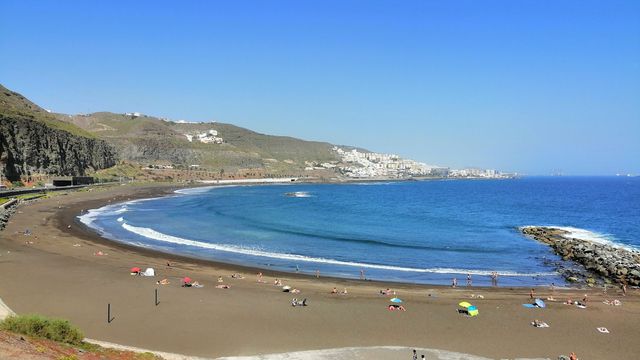
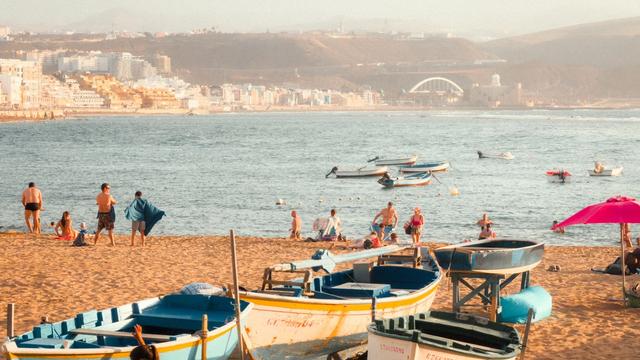
Las Canteras Beach is the main urban beach of Las Palmas de Gran Canaria, on Gran Canaria in the Canary Islands. Just over 3 km of fine golden sand run along the western side of the Guanarteme isthmus, facing northwest, from the foot of La Isleta to the Alfredo Kraus Auditorium. La Barra, a natural sandstone reef parallel to the shore, shelters most of the beach from the swell; the reef was once quarried for stone, which gave the beach its name. It has flown the EU Blue Flag many times since 1989.
Las Canteras Beach
Local name: Playa de Las Canteras
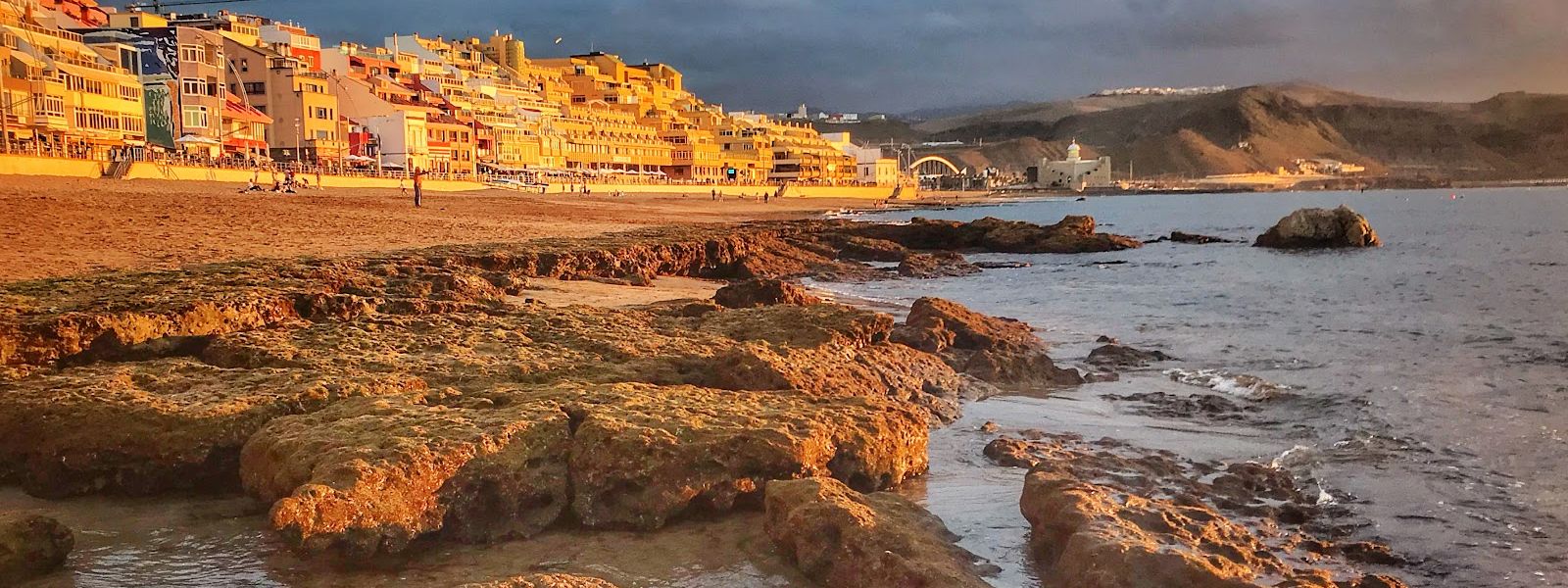
Golden-sand city beach of just over 3 km, sheltered from the Atlantic swell by an offshore sandstone reef.
- Entrance
- Free; public beach with no ticket.
- Accessibility
- The beach holds a universal-accessibility certificate for its bathing services for people with reduced mobility. The Paseo de Las Canteras behind the sand is a paved pedestrian promenade.
- Parking
- Aparcamientos Padre Cueto, a paid public car park about 170 m away.
- Difficulty
- None: a city beach reached from a flat, paved promenade.
- Transport
- Bus stop Tomás Miller (Playa de Las Canteras), stop 311, about 150 m away.
- Advance booking
- Not needed.
- Hours
- Open at all times; the beach and promenade are not gated.
What makes it special
Swim out from Playa Grande and the water stays calm all the way to La Barra, a sandstone reef about 200 m offshore that runs for roughly 2 km along the beach. It works like a natural breakwater: the Atlantic swell spends itself on the outer face, and the bay inside stays sheltered. At low tide the reef surfaces and gulls stand along it.
Bring a mask. Inside the reef the water is about 2 m deep on average and 5 m at most at low tide, with parrotfish, ornate wrasse and canary damsels over rock and sand.
The beach changes along its length. Playa Grande in the north is the calm end, Playa Chica in the middle the rockiest, and La Cícer in the south has no reef in front and belongs to the surfers. Behind it all, the Paseo de Las Canteras promenade lines the sand with cafés and shops.
Good to know
- Lifeguards are not always on duty, so do not count on someone watching the water.
- The sand fills up from Friday to Sunday; midweek gives you more room.
- Free toilets and showers stand along the beach for rinsing off after a swim.
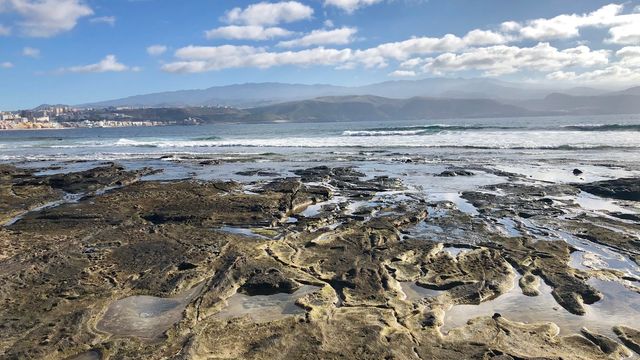
- Low tide reshapes the beach: La Barra and the rocks near the shore break the surface. Check the tide table before you snorkel or swim out.
- The open sand has no shade at midday; bring a hat, or retreat to the cafés on the promenade.
Getting there
Las Canteras Beach lies inside the city, along the western shore of the Guanarteme isthmus, with the Santa Catalina neighbourhood behind it. Whatever you arrive in, the last stretch is on foot along the Paseo de Las Canteras, a paved pedestrian promenade running from the Alfredo Kraus Auditorium at the south-western end to La Puntilla in the north. Several of the streets leading down to it are pedestrianised as well. The Tomás Miller bus stop is about 150 m away, and the paid Padre Cueto public car park about 170 m.
Best time to visit
Best: a weekday at low tide for snorkelling and the rock pools, or late afternoon for the light.
Avoid: Friday to Sunday if you want room on the sand.
The beach faces northwest, so the evening sun falls straight onto it and sets over the sea, though a bank of cloud often sits on the horizon and on clear evenings Tenerife shows across the water.
Sun & daylight
Nearby Places

Similar Places
Featured in our guides
Las Canteras Beach on the map
La Cícer, at the southern end, has no reef in front of it and takes the open Atlantic swell and its currents. Swim inside La Barra off Playa Grande, and leave the water beyond the reef to experienced swimmers on calm days.
Get directions

Your whole travel map in one place
Get inspired by new places around the world and find the ones worth the journey
Frequently asked questions
Is Las Canteras Beach safe for swimming?
Playa Grande, the northern stretch, is the most sheltered: La Barra breaks the swell and the water inside stays calm for much of the year. La Cícer at the southern end has no reef in front and takes the waves. Lifeguards are not always on duty.Can you swim out to the reef?
Yes. La Barra lies about 200 m offshore, and swimmers reach it from Playa Grande. Beyond it is open Atlantic, for experienced swimmers and divers only, on days when the currents and tide allow.Is Las Canteras Beach good for snorkelling?
Yes. Playa Chica and Playa Grande each have an area set aside for diving inside the reef, 5 m deep at most at low tide and about 2 m on average. No special equipment is needed. Currents occur now and then, more often at Playa Chica.Where do surfers go on Las Canteras Beach?
La Cícer at the southern end, over a sandy bottom, plus breaks over volcanic rock at La Barra and La Puntilla. These suit all levels and work best at high tide. El Confital, beyond La Puntilla, is for experts.Why is it called Las Canteras?
Canteras means quarries. Stone was once cut from La Barra, the reef offshore, for buildings in the city including Santa Ana Cathedral. The quarrying has stopped; the name stayed.