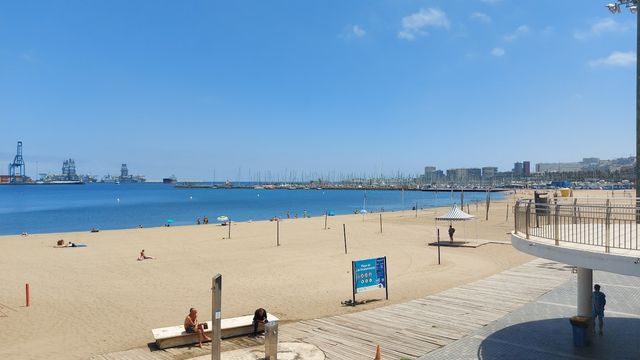
La Laja Beach is a public beach in the municipality of Las Palmas de Gran Canaria, at the southern entrance to the city beside the GC-1 motorway. Its fine sand runs grey to brownish-black, about 1,200 m long and about 30 m wide on average. A breakwater built at the south end around the 1990s made the currents partly less dangerous, and in the same decade sand from the nearby seabed was added. A seafront promenade runs along it. The beach is known for surfing and for weekend lateen-sail regattas.
La Laja Beach
Local name: Playa de la Laja

Dark-sand surf beach at the southern entrance to Las Palmas, with strong waves and the GC-1 motorway right behind it
- Entrance
- Free: public beach.
- Accessibility
- A seafront promenade runs along the beach and wheelchair access has been improved; there are no public toilets, accessible or otherwise.
- Parking
- Free car park about 700 m away in a straight line; a second car park about 870 m away.
- Difficulty
- No climb: a walk in from the bus stops, about 600 m away, or the car park, about 700 m away in a straight line, then a promenade along the beach.
- Transport
- Interurban buses heading south stop at Playa de La Laja; city lines 12 and 9 (L1 at night) end at Hoya de La Plata, about 800 m on foot.
- Advance booking
- Not needed.
- Hours
- Open at all times.
What makes it special
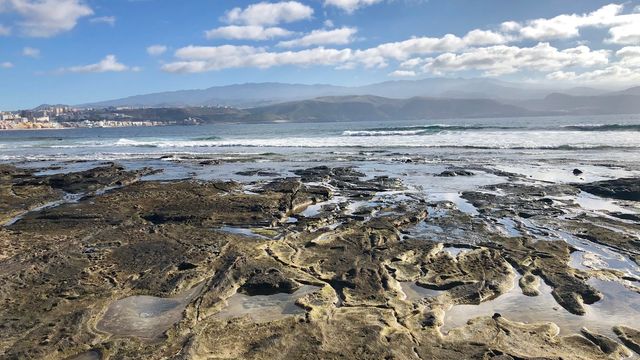
Surfers come for the swell. The currents and waves rolling onto this open shore have made La Laja one of the favourite beaches among surfers, and the dark sand, grey to brownish-black and backed by vegetation, runs for about 1.2 km.
Between April and October, every weekend, the south end becomes the starting line for the weekly regatta of Canarian lateen-sail boats. The beach rarely fills up. On a wet, windy day it is empty, and some stretches are clothing-optional.
The GC-1 motorway runs right behind the sand. Its noise ranges from lost under the waves to a steady background of traffic and exhaust.
Good to know
- There are no public toilets and no drinking water at the beach or nearby. Bring water.
- No bars or restaurants on the beach: bring your own food and drink.
- The bottom is sandy, so water shoes are not needed.
- Some stretches of the beach are clothing-optional.
- The promenade and cycle path stop at the Triton statue at the south end. Going further south means the motorway hard shoulder: do not walk or cycle it.
Getting there
By car, the beach sits right off the GC-1 at the southern entrance to Las Palmas de Gran Canaria. The nearest car park is about 700 m away in a straight line, with a second one about 870 m out, and the rest is on foot.
Interurban buses heading south stop at the beach; the nearest stops are about 600 m away. City buses end their run at Hoya de La Plata, about 800 m from the sand by road and path, both fine on foot. Once there, a seafront promenade runs along the beach.
Best time to visit
Best: from 1 July to 30 September for swimming, and any weekend from April to October to see the lateen-sail regatta leave from the south end.
Avoid: days of heavy swell if you are not a confident swimmer.
The currents on this open shore can be strong, and the lifeguard, rescue and first-aid service covers only July to September.
Sun & daylight
Nearby Places
Similar Places
La Laja Beach on the map
The shore takes strong waves and the currents can still be strong despite the breakwater. Swim only when lifeguards are on duty, and stay out of the water when the surf is big.
Get directions

Your whole travel map in one place
Get inspired by new places around the world and find the ones worth the journey
Frequently asked questions
Is La Laja Beach safe for swimming?
The bottom is sandy and the swell is moderate, but the currents can be strong. Lifeguards are on duty from 1 July to 30 September; outside that period, and on big-wave days, be very careful.Are there toilets at La Laja Beach?
No. There are no public toilets and no drinking water at the beach or nearby, so bring water with you.Can I get to La Laja Beach by bus?
Yes. Interurban buses heading south stop at the beach, and city buses end at Hoya de La Plata, about 800 m away on foot by road and path.Is La Laja Beach good for surfing?
Yes. Its currents and swell have made it one of the favourite beaches among surfers.Is the motorway noisy?
The GC-1 runs right behind the beach. The traffic ranges from barely audible over the waves to a steady background of noise and exhaust.