Museu Militar de Menorca fills part of an 18th-century barracks block on the main square of Es Castell, the town the British laid out at the entrance to the harbour of Maó. The collection covers firearms, artillery, uniforms, maps, photographs and a long written history of how the port and the island were defended, through the periods of British, French and Spanish rule. Below the display rooms, a recovered stretch of catacombs and an air-raid shelter form the last part of the route.
Museu Militar de Menorca
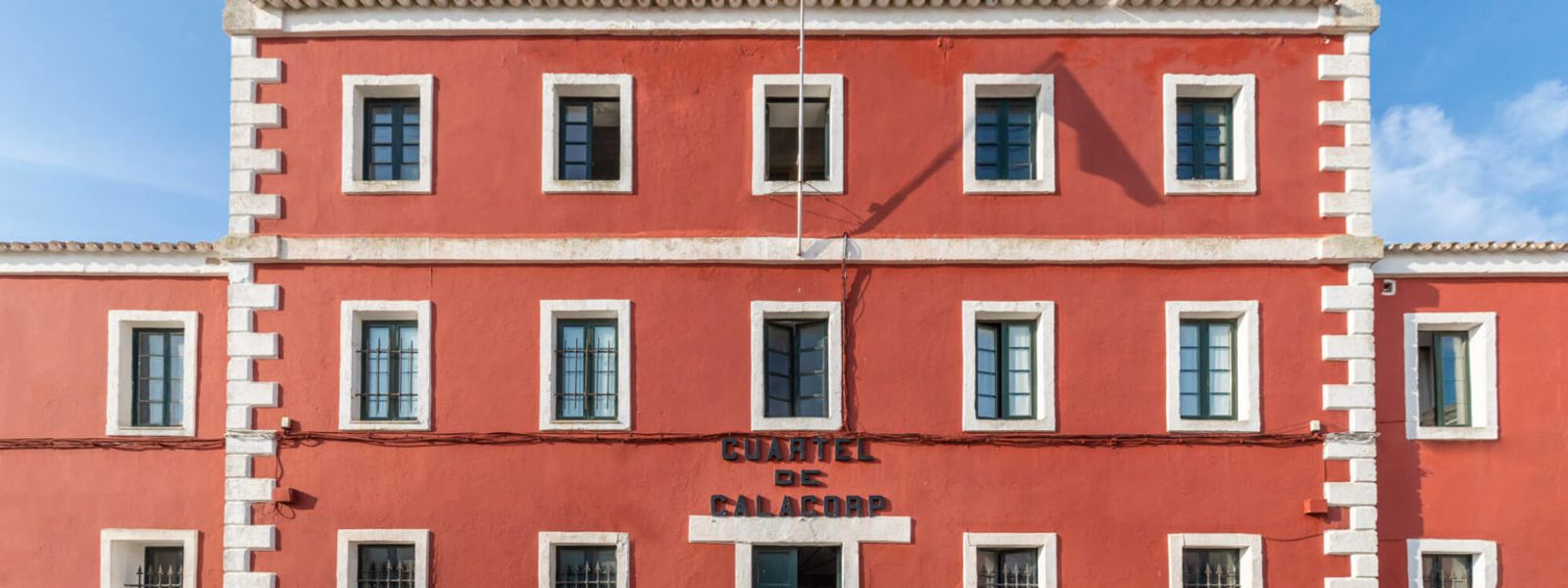
Military museum in an 18th-century barracks on the main square of Es Castell, with catacombs and an air-raid shelter below.
- Entrance
- Free. A donation box sits on the front desk.
- Accessibility
- Step-free, wheelchair-accessible entrance and main display rooms; no accessible seating. The catacombs and air-raid shelter below are reached by stairs only. Toilets on site.
- Parking
- Free public car parks about 120 m away in a straight line.
- Difficulty
- No walk in — the entrance is off the main square, with car parks about 120 m away. Stairs lead down to the catacombs and the shelter.
- Transport
- Bus stop Esglèsia des Castell (ref 8130) about 190 m away; Fontanelles (ref 8120) about 430 m.
- Advance booking
- Not needed — walk in during opening hours.
- Hours
- Wednesday to Friday, 10:00–13:30. Closed Monday, Tuesday, Saturday and Sunday.
- Address
- Plaça de s'Esplanada, 19, 07720 Es Castell, Illes Balears, Spain
What makes it special
The heavy anti-aircraft guns stand in rooms that look too small to have taken them, and the question of how they were got in there stays with you round the rest of the museum. Among the uniforms and the gun cases there is a monkey riding a goat. Keep going down: below the display floors a recovered length of catacombs and an air-raid shelter open out, cool and still after the rooms above. The written history is thorough — maps, photographs and documents on the defence of the port, the forts around it and the town of Es Castell itself — and enough of it is in English to follow the whole thread.
Good to know
- A midweek museum — it opens on three mornings a week and closes at lunchtime, so it has to sit in the first half of the day.
- Bring a coin — a donation box stands on the front desk by the entrance.
- Allow a couple of hours — the labels, maps and documents carry most of the content, and enough of it is in English to follow.
- Stairs below — the catacombs and the shelter are reached by stairs, and there is no step-free way down to them.
- Museum before forts — it sets out the history of the harbour and the town, and the fortifications read better afterwards.
Getting there
The museum sits on the main square of Es Castell, at the entrance to the harbour of Maó. There is no approach walk — the door is off the square. Two car parks lie about 120 m away in a straight line, and the nearest bus stop, Esglèsia des Castell, is about 190 m off; Fontanelles is about 430 m. Public toilets are about 130 m away and a drinking water point about 74 m. Inside, the display rooms are on the flat, and the catacombs and shelter below are reached by stairs.
Best time to visit
Best: a midweek morning, and a wet one for preference — this is one of the few things in Es Castell that works in rain, and the lower level stays cool when the town is baking in August.
Avoid: the weekend and the start of the week, when the museum is shut, and the last half hour before closing, which is not enough time for the written material.
The opening window is short and falls mid-week, so the rest of the morning has to fit around it.
Sun & daylight
Nearby Places

Similar Places

Your whole travel map in one place
Get inspired by new places around the world and find the ones worth the journey
Frequently asked questions
How long does a visit take?
Allow around two hours if you read as you go. The written history is extensive and enough of it is in English to follow.Is the whole museum step-free?
The entrance and the main display rooms are wheelchair accessible. The catacombs and the air-raid shelter below are reached by stairs, with no step-free way down.Is it worth taking children?
Yes. The artillery, the tunnel below and a monkey riding a goat hold attention, and there are toilets on site.Museum or the harbour forts first?
The museum first. It lays out the history of the port and of Es Castell, and the fortifications around the harbour make more sense afterwards.Where do you park and where is the bus stop?
Two car parks sit about 120 m from the museum in a straight line, and the Esglèsia des Castell bus stop is about 190 m away.