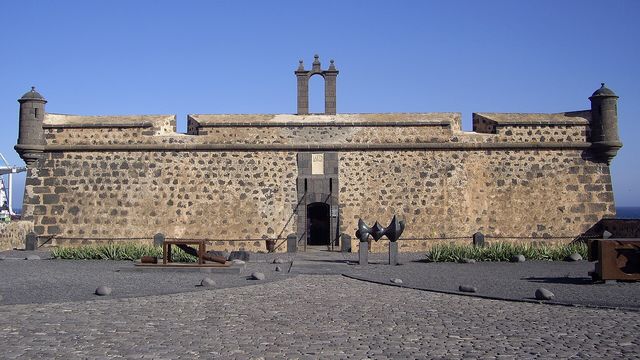
San Gabriel Castle is a stone fortress on the small Islote del Quemado, just off the seafront of Arrecife, the capital of Lanzarote. It was built to a 1587 design by the engineer Leonardo Torriani after Turkish-Algerian pirates burned the earlier wooden fort in 1586. In the 18th century the Puente de las Bolas joined the islet to the town. The castle has housed a museum since 1972, renamed the Museo de Historia de Arrecife in 2014, and was declared a Bien de Interés Cultural in 1979.
San Gabriel Castle
Local name: Castillo de San Gabriel
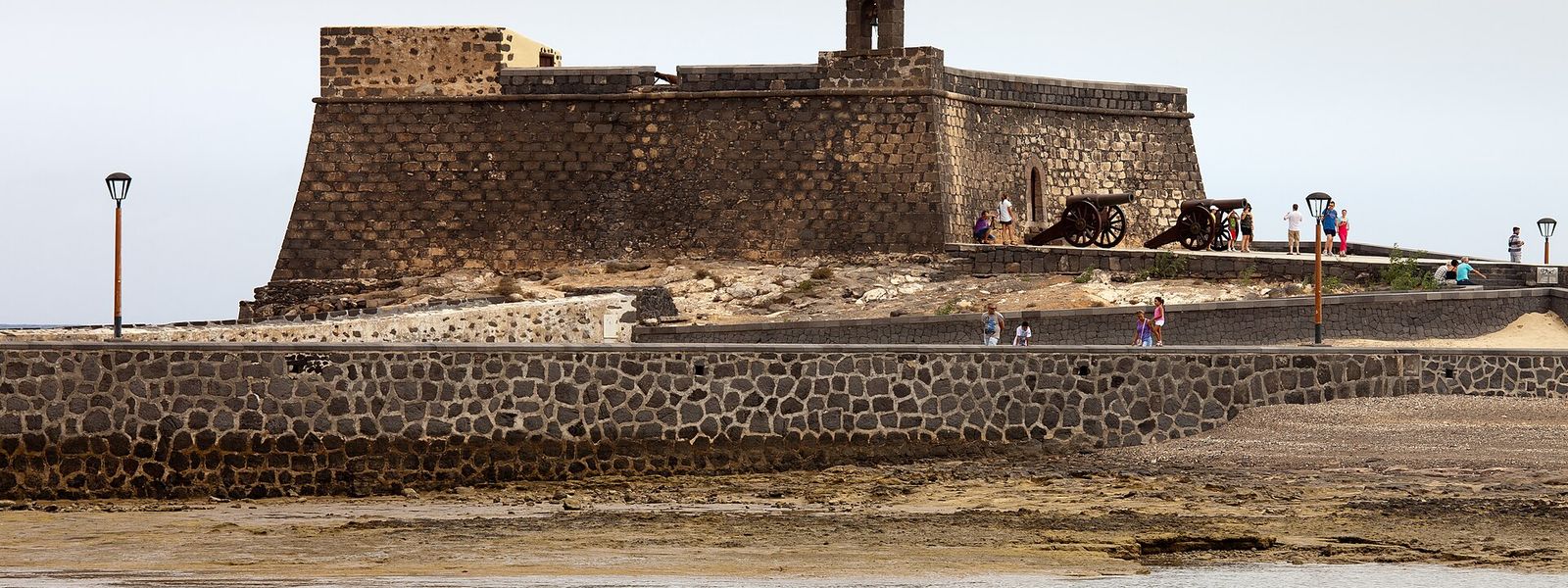
Sixteenth-century stone fort on its own islet off Arrecife, reached by a bridge capped with two stone balls
- Entrance
- Free; donations are welcome.
- Accessibility
- The walkways are uneven brick and cobble that jolt a wheelchair; a ramp runs beside the stairs at the castle, but the entrance is not wheelchair-accessible and there is no accessible parking.
- Parking
- Paid public car park about 360 m away in a straight line; no wheelchair-accessible parking.
- Difficulty
- A walk over the water on brick and cobbled walkways with an uneven surface; stairs lead up to the castle, with a ramp alongside.
- Transport
- Bus stops Parque Viejo and Calle Real, both about 240 m away.
- Advance booking
- No booking; you queue at the museum door, and the line moves fairly quickly.
- Hours
- Monday to Friday 10:00–17:00, Saturday 10:00–14:00, closed on Sunday.
- Address
- Lanzarote, Castillo de San Gabriel, C. Punta de la Lagarta, 1, Arrecife, Las Palmas, Spain
What makes it special
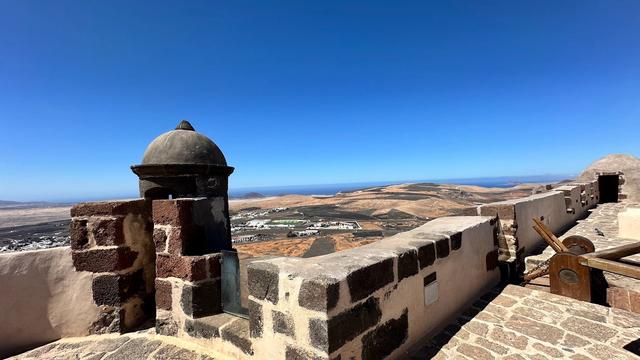
Two stone balls sit on top of the Puente de las Bolas, the 18th-century bridge you cross to reach the fort, and ahead the walls rise straight out of the harbour water. Egrets stand on the rocks and fish move in the water below. The fort itself is squat and plain, with cannons in front and the city and the pier along the inner harbour spread out behind.
The stone is the point of the place. The first fort here was wooden, and Turkish-Algerian pirates burned it in 1586. The next year Leonardo Torriani drew up a stone replacement, with walls round the whole islet, so it could not burn again. Inside, the Museo de Historia de Arrecife tells the story of the castle and the town. It is a modest exhibition, and a walk round takes about half an hour.
Good to know
- Exhibition labels are in Spanish only; the staff at the entrance give a short spoken introduction in English.
- Expect a queue at the museum door on busy days; it moves fairly quickly.
- The walkways are uneven brick and cobble, rough going for wheelchairs and pushchairs.
- The islet takes the full wind off the sea, so bring an extra layer.
- Free public toilets are about 80 m away, but there is no drinking fountain nearby — bring water.
Getting there
The castle stands on its islet just off the Arrecife waterfront, close to the city centre, and the last stretch is on foot over the water. Two walkways lead out to it, so you can go one way and come back the other. One of them crosses the Puente de las Bolas and its drawbridge, with open views across the harbour. Both are laid in brick and cobble, and the surface is uneven underfoot.
The nearest public car park is about 360 m away in a straight line, and the bus stops at Parque Viejo and Calle Real are about 240 m away. Free public toilets stand about 80 m from the castle, and a tourist information office about 270 m.
Best time to visit
Best: a weekday morning, with the sun coming off the sea onto the city waterfront.
Avoid: Sunday, when the museum is closed, and days of strong wind, which blows straight across the open islet.
On bright days the walkways and the museum door fill up even out of season, and the weekday hours give you the most time inside.
Things to do nearby
All tours in Arrecife on GetYourGuide
Paid links: booking through them supports YowJourney.
Sun & daylight
Nearby Places

Similar Places

Your whole travel map in one place
Get inspired by new places around the world and find the ones worth the journey
Frequently asked questions
What is inside San Gabriel Castle?
The Museo de Historia de Arrecife, an exhibition on the history of the castle and the town. The labels are in Spanish only, and the staff at the entrance give a short introduction in English. A walk round takes about half an hour.How old is the castle?
The present fort follows a 1587 design by Leonardo Torriani. It replaced a wooden fort of 1576 that burned during a Turkish-Algerian pirate raid in 1586. It was declared a Bien de Interés Cultural in 1979.How do you get across to the castle?
On foot, along one of two walkways from the Arrecife waterfront. One crosses the Puente de las Bolas, the 18th-century stone bridge with its drawbridge. Going out on one and back on the other gives two different views of the harbour.Can a wheelchair reach the castle?
With difficulty. The walkways are uneven brick and cobble that jolt a wheelchair, and a ramp runs beside the stairs at the castle, but the entrance is not wheelchair-accessible.