Teide Observatory is an astronomical observatory at 2,390 metres on Mount Teide, at Izaña on Tenerife. The Instituto de Astrofísica de Canarias has run it since its inauguration in 1964, and its good seeing drew telescopes from many countries. It is known for its solar telescopes, among them the 1.5 m GREGOR, and for Teide-1, the first brown dwarf, found here in 1995. Optical astronomy later shifted towards the Roque de los Muchachos Observatory on La Palma.
Teide Observatory
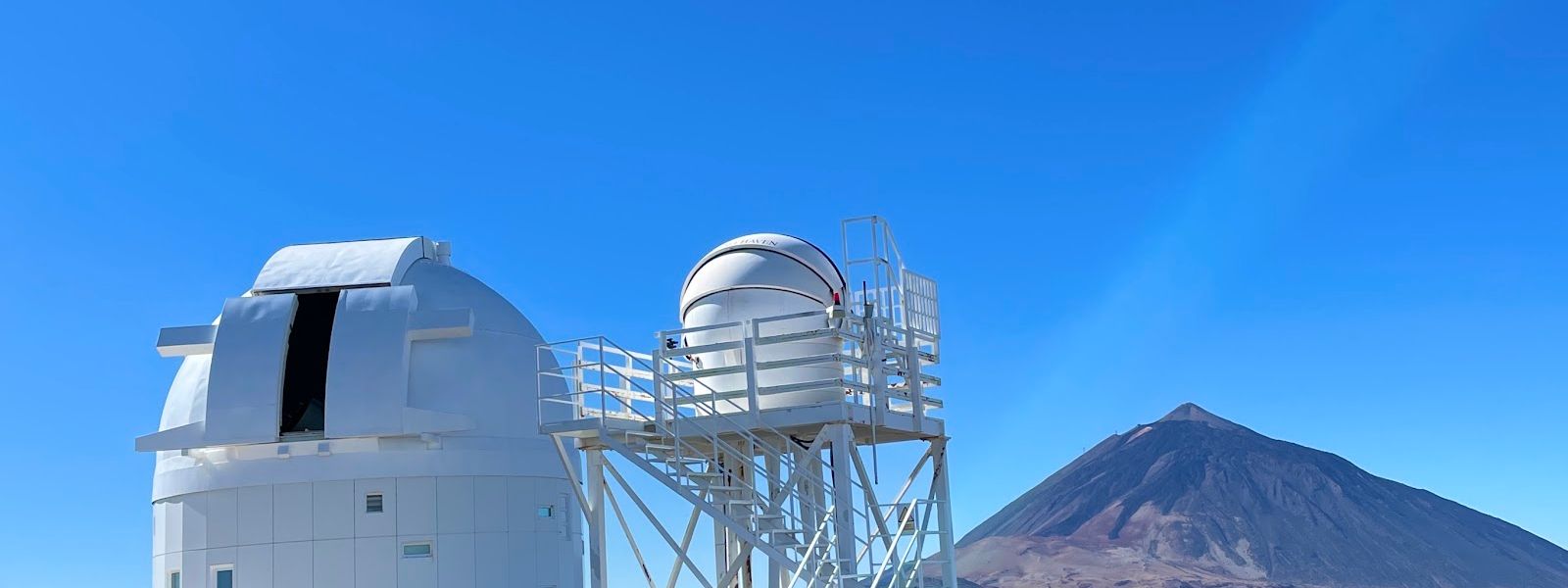
Working astronomical observatory at 2,390 m on Mount Teide, with guided tours to its solar telescopes.
- Entrance
- Entry is with a guided tour, booked in advance.
- Accessibility
- Wheelchair-accessible parking. The tour walks the grounds between telescopes, so walking shoes help.
- Parking
- Asphalt car park about 100 m from the observatory, with wheelchair-accessible spaces.
- Difficulty
- No hike: you drive up and the tour walks between the telescopes at 2,390 m, in strong sun and cool air.
- Transport
- Nearest bus stop: Casa del Caminero, about 4 km in a straight line; in practice you need a car.
- Advance booking
- Required: tours are booked ahead. Same-day booking is possible, and tours can be rescheduled.
- Hours
- Daily, 10:00–16:30.
- Address
- 38570 Izaña, Santa Cruz de Tenerife, Spain
What makes it special
The tour ends with the sun itself. Through two solar telescopes you watch sunspots, flares and the bright edge of the solar disc.
Before that comes a walk among the white domes and towers on the ridge at Izaña, 2,390 m up, where telescopes from Germany, France, Italy, the UK and the European Space Agency share the same air. A guide takes a small group between them, explains what each one studies and leads you inside one of the instruments.
The site has a real record. Teide-1, the first brown dwarf found, was picked out here in 1995 with the 80 cm IAC-80 telescope, and Brian May helped build a building on the grounds to study interplanetary dust. The views from the observatory grounds are worth the drive on their own.
Good to know
- Visits are by guided tour, booked ahead. Tours can be rescheduled, so leave slack in your plans.
- Same-day booking is possible, which makes the tour a fallback when the Teide cable car is shut.
- The tour runs a little over two hours and is a crash course in basic astronomy; younger children may find it heavy going.
- Bring sunscreen, a warm layer and walking shoes: the tour walks the grounds between the telescopes at 2,390 m.
Getting there
You need your own car. The drive up from Las Américas takes about an hour and a half, and the views on the climb invite stops. The road brings you onto the ridge at Izaña, where an asphalt car park sits about 100 m from the observatory in a straight line; from there the tour continues on foot across the site. The nearest bus stop, Casa del Caminero, is about 4 km away in a straight line, which rules the bus out for most visitors. An information board on the volcanoes outside Las Cañadas stands about 185 m from the observatory.
Best time to visit
Best: a clear, bright day, at any time of year.
Avoid: frosty winter days if you are not at ease driving a mountain road.
The highlight of the tour is the sun through the solar telescopes, and sunshine at this height is high all year; in winter, light frosts are possible on the mountain.
Sun & daylight
Nearby Places

Similar Places
Teide Observatory on the map
At 2,390 m the sun burns fast even when the air feels cool, and out of the sun it turns cold; in winter, frost can form on the mountain. Wear sunscreen, bring a warm layer and drive the high road with care in frost.
Get directions
Your whole travel map in one place
Get inspired by new places around the world and find the ones worth the journey
Frequently asked questions
Do I need to book a tour?
Yes, visits are by guided tour booked in advance. Same-day booking is possible, and tours can be rescheduled.How long does the tour take?
A little over two hours: a presentation, a walk among the telescopes, a look inside one of them and solar viewing at the end.Will I see stars?
The observatory is open by day, and the tour's observing is of the sun: sunspots, flares and the edge of the solar disc through solar telescopes.Is the tour suitable for children?
It is a crash course in basic astronomy with a fair amount of theory, which can be a lot for younger children.Can I get there by bus?
The nearest stop, Casa del Caminero, is about 4 km away in a straight line, so you need your own car.