The Telamon Shipwreck lies just off the shore near Las Caletas, north of Arrecife on Lanzarote. The ship was built in Scotland and launched in 1953 as the Temple Hall; after being sold in 1969 and again in 1970 it sailed as the Telamon. On its last voyage, carrying timber, it sprang a leak before reaching Lanzarote and was towed into the bay between Arrecife and Costa Teguise. It ran aground there on 31 October 1981, and the wreck was never removed. It is also known as the Ghost Ship.
Telamon Shipwreck
Local name: Barco Telamón
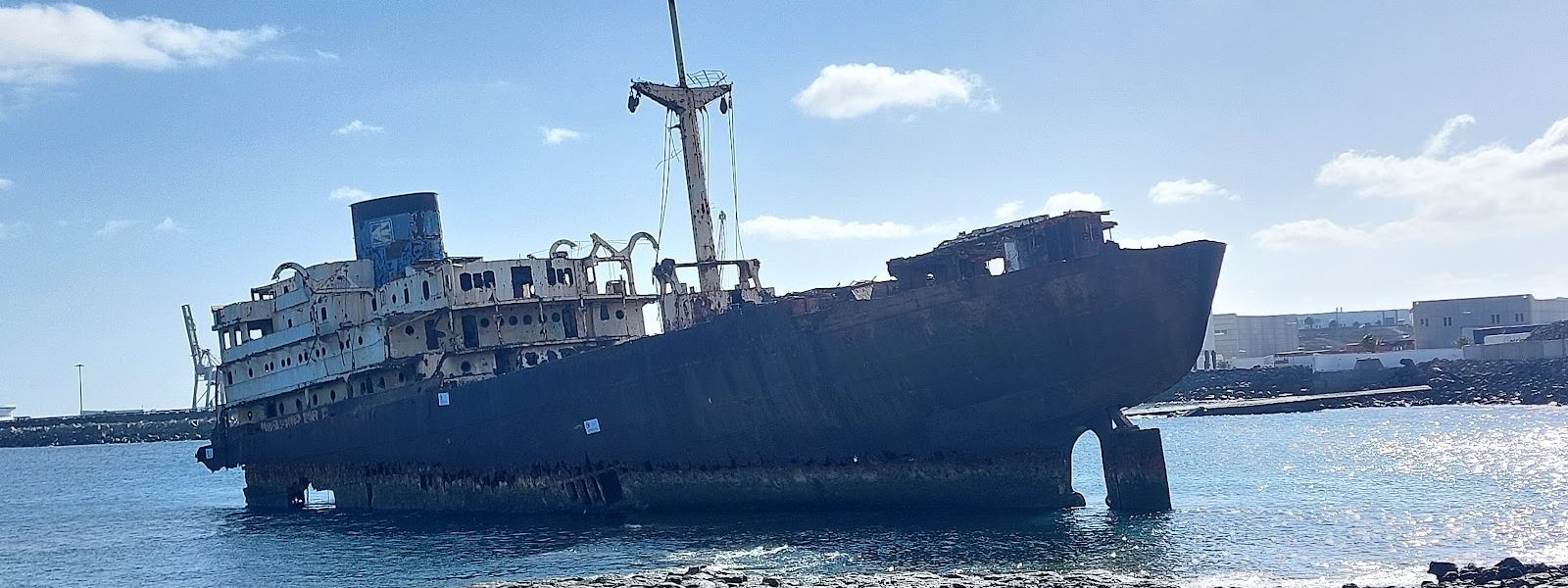
Rusting hulk of the cargo ship Telamon, aground off the shore between Arrecife and Costa Teguise since 1981.
- Entrance
- Free — no ticket; the wreck is viewed from the shore.
- Accessibility
- No wheelchair-accessible parking or access; the wreck is viewed from the shore.
- Parking
- Two parking areas about 300 m away in a straight line; no wheelchair-accessible parking.
- Difficulty
- No hike involved: parking and the Los Mármoles bus stop lie about 270–300 m away in a straight line, and the wreck is viewed from the shore.
- Transport
- Bus stop Los Mármoles, about 270 m away in a straight line.
- Advance booking
- Not needed.
- Hours
- Open at any time; the wreck is viewed from the shore.
- Address
- Ctra. las Caletas, 150, 35500 Arrecife, Las Palmas, Spain
What makes it special
The wreck shows from the coast road before you reach it: a rust-brown hull sitting just off the shore, its frame twisted and holed by more than four decades of salt and swell. It is visible even from a passing bus.
From the water's edge the scale lands. This was a working cargo ship, built in Scotland in 1953, towed into this bay with a leak and left where it grounded. Late in the day the low sun throws hard shadows through the broken plating, and that is the light for photographs. The water around the hull holds fish, barracuda among them.
Good to know
- No toilets and no drinking water at the wreck or nearby — bring water, especially on a hot day.
- The shore has no shade; in the middle of the day bring a hat and sunscreen.
- A zoom lens or binoculars help: the hull sits offshore and going aboard is off-limits.
- The visit is a stop to look and photograph, easy to fit into a trip along the coast between Arrecife and Costa Teguise.
- The wreck is within reach by bicycle from Costa Teguise.
Getting there
The ship is easy to spot from the road between Arrecife and Costa Teguise; it shows from a bus window. Two parking areas lie about 300 m from the wreck in a straight line, and the nearest bus stop, Los Mármoles, is about 270 m away. From either, the last stretch is on foot to the shore, where the hull comes into view across the water. Cycling out from Costa Teguise is another way in.
Best time to visit
Best: late afternoon into sunset. Avoid: the middle of a hot day. Low evening light throws hard shadows across the twisted frame and warms the rust, while at midday the bare shore offers no shade and the light falls flat on the hull.
Access & restrictions
Going out to the Telamon and climbing aboard is prohibited. People do reach it by jet ski, and some climb onto the upper deck, but the hull is rusted through, the edges are sharp and the ship stands in the sea. The place to see it from is the shore.
Sun & daylight
Nearby Places
Similar Places

Telamon Shipwreck on the map
The hull is rusted and breaking up, with sharp metal edges, and it stands in the sea. Stay on the shore and do not try to swim, paddle or ride out to it.
Get directions

Your whole travel map in one place
Get inspired by new places around the world and find the ones worth the journey
Frequently asked questions
Can you go aboard the Telamon?
No. Access to the wreck is prohibited, and the rusted hull has sharp edges. It is seen from the shore.When did the Telamon run aground?
On 31 October 1981. On a voyage carrying timber the ship sprang a leak before reaching Lanzarote, was towed into the bay between Arrecife and Costa Teguise, and grounded there. The wreck was never removed.Was anyone lost when the ship was wrecked?
No. Everyone on board was rescued.Is there parking near the wreck?
Yes. Two parking areas lie about 300 m away in a straight line.Can you get there by bus?
The nearest bus stop, Los Mármoles, is about 270 m away in a straight line, and the wreck is visible from the bus window on the way.