Torre d'en Galmés is an archaeological site on a hill between Alaior and Son Bou, Menorca. The town grew from the start of the Talayotic era, around 1400 BC, and was lived in until the end of Roman rule; Muslim refugees from the Reconquista later reoccupied and adapted some of its buildings. It was one of the largest settlements in the Balearic Islands and is known for its three talayots, a taula enclosure, circular houses, a hypostyle hall and an underground water-storage system.
Torre d'en Galmés
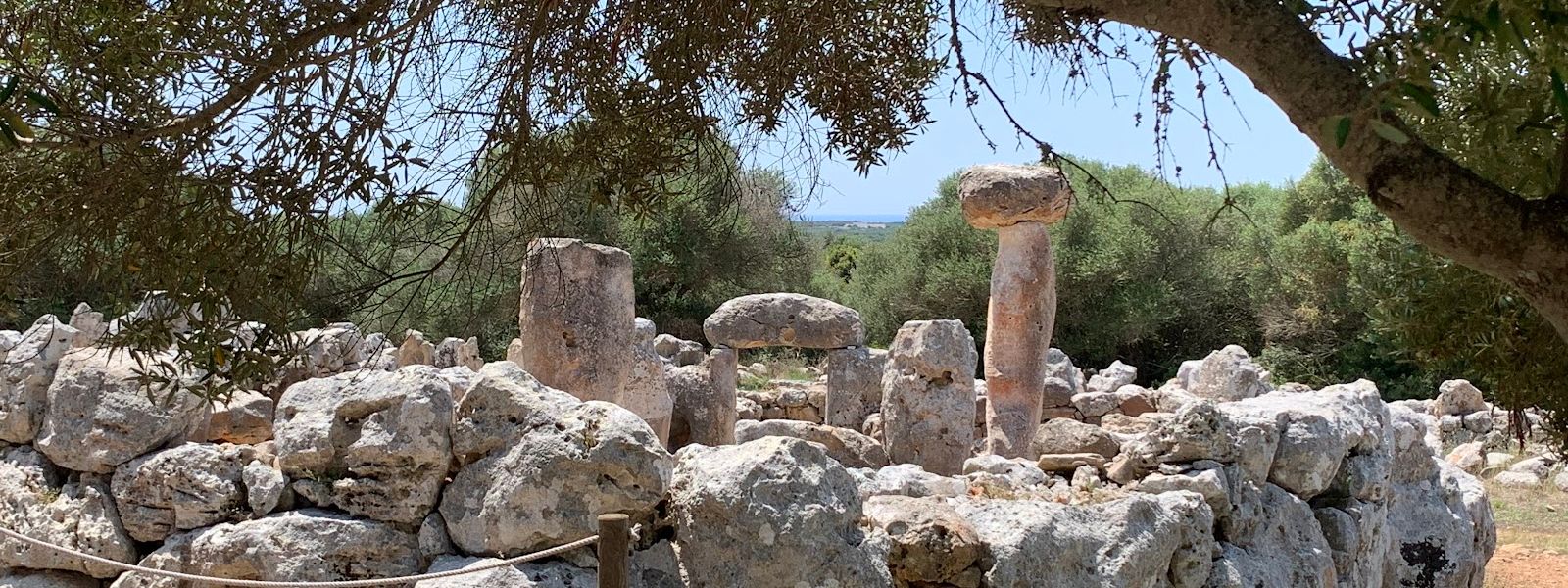
Hilltop Talayotic town of circular stone houses, three talayots and a taula, looking out over Menorca's south coast
- Accessibility
- Wheelchair-accessible parking.
- Parking
- Free car park about 150 m from the site in a straight line; a second parking area about 800 m away. Wheelchair-accessible parking available.
- Difficulty
- An hour to a few hours on foot over open hillside with little shade.
- Transport
- No bus to the site; the nearest stop, Son Bou rotonda, is about 3 km away in a straight line.
- Hours
- Monday 9:00–15:30; Tuesday to Saturday 9:00–20:30; Sunday 9:00–15:30.
- Address
- Camí de Llucalari, km 1.2, 07730, Illes Balears, Spain
What makes it special
Step into the hypostyle hall at the south end of the town and the roof is still overhead: heavy stone slabs laid across columns that widen towards the top. It stands against one of the circular houses and most likely served as a storeroom and a shelter for livestock.
From the top of the three talayots the view runs along Menorca's south coast and, on a clear day, as far as the mountains of Mallorca. The horseshoe-shaped taula enclosure keeps its tall pillar, and the capital that once crowned it lies on the ground between the pillar and the doorway.
Look for the water system too: underground cisterns linked by channels, with hollows half-filled with pebbles to strain the soil out of the rainwater. A bronze figurine of Imhotep, the deified Egyptian architect whose cult spread across the Mediterranean, was found here.
Good to know
- There is little shade, only scattered olive trees. Bring water and a hat: there is no drinking water on site or nearby.
- Allow from about an hour to a few hours to walk the site.
- Information boards stand by the main structures, and some of the caves can be entered by following the tracks.
- The car park is small; in summer, arrive early.
- There are toilets.
Getting there
Torre d'en Galmés stands on a hill in the countryside between Alaior and the south-coast resort of Son Bou, and most people arrive by car. The car park lies about 150 m from the site in a straight line, with a second parking area about 800 m away. From there you walk out onto open hillside, the town spreading down the southern slope towards the sea.
No bus stops at the site. The nearest stop, Son Bou rotonda, is about 3 km away in a straight line.
Best time to visit
Best: early morning, or late afternoon on the days the site stays open into the evening.
Avoid: the middle of a summer day.
The hilltop is open ground with little shade, so the heat builds through the middle of the day, while low, clear light is what carries the view along the south coast towards Mallorca.
Sun & daylight
Nearby Places


Similar Places
Torre d'en Galmés on the map
The site is open hillside with little shade, and summer sun on the bare stone gets fierce by midday. Carry water and a hat, and walk it in the cooler hours.
Get directions
Your whole travel map in one place
Get inspired by new places around the world and find the ones worth the journey
Frequently asked questions
How long does a visit to Torre d'en Galmés take?
From about an hour to a few hours, depending on how much of the site you walk. Information boards stand by the main structures along the way.Is there shade or drinking water at the site?
Little shade, only scattered olive trees, and no drinking water on site or nearby. Bring your own water and a hat.Can I get to Torre d'en Galmés by bus?
No bus stops at the site. The nearest stop, Son Bou rotonda, is about 3 km away in a straight line, so most visitors come by car.Can you see Mallorca from the site?
On a clear day, yes. From the top of the talayots the view runs along Menorca's south coast to the mountains of Mallorca.What is a taula?
A T-shaped stone monument typical of Menorca, generally taken to mark a religious site. At Torre d'en Galmés it stands in a horseshoe-shaped enclosure, its top stone now lying on the ground beside the pillar.