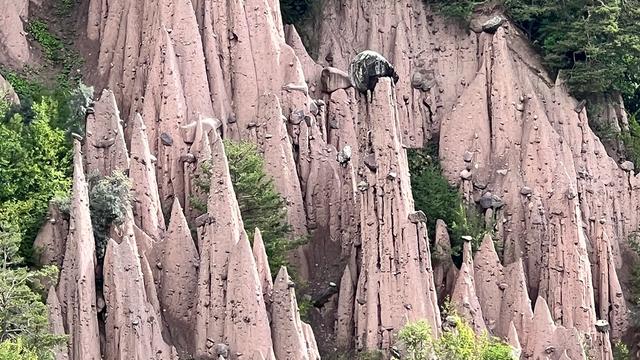
Renon, known in German as Ritten, is a high plateau north-east of Bolzano in South Tyrol, and the municipality named after it. The villages sit between 1,100 and 1,400 metres, on average 800 metres above the Eisack and Talfer valleys, which is why Bolzano has taken its summers up here since the 17th century. Seventeen frazioni are scattered over 111 square kilometres, the main one being Klobenstein (Collalbo). The pull is the cableway from the city, the earth pyramids near Oberbozen (Soprabolzano) and Lengstein (Longostagno), and air cooler than the valley floor.
Renon

- Currency
- Euro (EUR, €). ATMs are widespread in cities and towns and accept major international credit and debit cards. Credit cards are accepted in urban and tourist areas; cash is essential in rural regions and small towns.
- Language
- German is the everyday language here far more than the South Tyrol average: the 2024 census records 94.35% of residents with German as a first language, 5.35% Italian and 0.30% Ladin. Every village carries both a German and an Italian name — Klobenstein is Collalbo, Oberbozen is Soprabolzano, Lengstein is Longostagno.
- Power plug
- Europlug (Type C), Schuko (Type F) and Type L (Italian three-round-pin) sockets are in use. Voltage is 230V, 50Hz.
- Visa
- Schengen visa-free for 90 days (non-EU/EEA citizens). EU, EEA and Swiss citizens may stay indefinitely. All non-EU/EEA/Swiss visitors must declare their presence within 8 days of arrival. Stays longer than 90 days require an appropriate visa and residence permit.
- Time zone
- Central European Time (CET): UTC+01:00. Central European Summer Time (CEST): UTC+02:00 (last Sunday in March to last Sunday in October).
- Tap water
- Safe to drink. Tap water is well maintained throughout Italy and perfectly drinkable. In some peninsular areas it may be cloudy with a slight taste; most Italians prefer bottled water. Public fountains marked 'Acqua potabile' are safe to refill from. Avoid fountains marked 'Acqua non potabile'. Southern coastal areas may have an unusual taste due to desalination but water is always safe.
- Tipping
- Not customary. Restaurants include a service charge (coperto); waiters do not expect tips. Leaving loose change in bars and cafés is common. Tips cannot be added to credit card bills—bring cash if you wish to tip.
- Emergency
- 112 (Carabinieri, general emergency); 113 (Polizia di Stato); 115 (Fire Department); 118 (Medical Rescue).
When to go
Shoulder
Apr – May
The quiet stretch between the winter sports and the summer arrivals from the valley, with long views down over the Eisack and the Talfer.
High season
Jun – Sep
The reason the plateau became a destination: the air is considerably cooler than Bolzano's, and the city's residents have been coming up for the summer since the 17th century. Expect company on the cableway.
Shoulder
Oct – Nov
The summer crowd from the city has gone, the larch woods between the villages turn, and the haze over the two valleys clears.
Low season
Dec – Mar
Snow settles across a plateau that lies between 1,100 and 1,400 metres. Klobenstein has an open-air artificial ice track at 1,198 metres, which has hosted the European Speed Skating Championships and World Cup rounds.
How long to stay
A day covers the headline plateau: cableway up, the earth pyramids near Oberbozen or Lengstein, a walk between villages, cableway down. Two or three nights make more sense in summer, when the cooler air is the whole point of being up here and Bolzano is close enough for a half-day back down in the heat.
Getting around
Two ways up from Bolzano. The cableway climbs to Oberbozen in a single span of about 4 kilometres and takes 12 minutes, which makes it one of the longest single-track cableways in the world; the alternative is the provincial road up from the valley. Once on top, the narrow-gauge railway built in 1907 still works the mountain stretch between Maria Himmelfahrt and Klobenstein, the section the 1960 cableway did not replace. Rail and cableway serve that one corridor. The seventeen frazioni are spread over 111 square kilometres of plateau, and the outlying ones are reached by road. Two of them, Atzwang and Sill, are not on the plateau at all — they sit down on the Eisack and the Talfer.
What to see

Destinations in Renon
Frequently asked questions
How do you get from Bolzano up to Renon?
The cableway runs from Bolzano to Oberbozen: about 4 kilometres in one span, 12 minutes of travel. There is also a provincial road up to the plateau.What is there to see on the plateau?
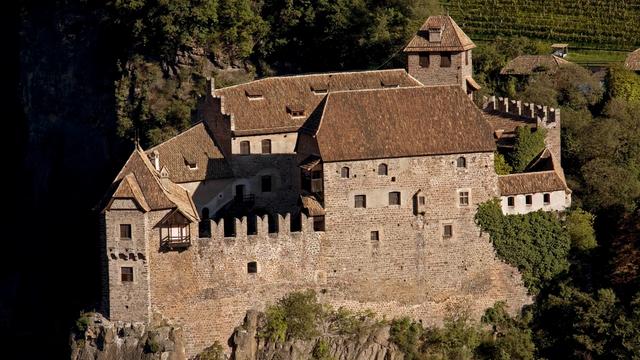
The earth pyramids — groups of fairy chimneys near Oberbozen and Lengstein — are the signature sight. Runkelstein Castle, built in 1237 by the lords of Wangen on a rocky spur, stands on Renon territory. Klobenstein has an open-air artificial ice track at 1,198 metres that has held European Speed Skating Championships and World Cup events.Does the old rack railway still run?
Part of it does. The rack railway of 1907 was replaced in 1960 by the cableway on the climb from Bolzano, but the line still works on the mountain side, between Maria Himmelfahrt and Klobenstein.Is Renon really cooler than Bolzano in summer?
Yes. The plateau lies on average 800 metres above the Eisack and the Talfer, the two rivers that meet at Bolzano, and that difference is why citizens of the city have summered here since the 17th century.Which village is the centre?
Klobenstein, Collalbo in Italian, where the town hall is. It is one of seventeen frazioni in the municipality; the wafer maker Loacker is also based in Renon.