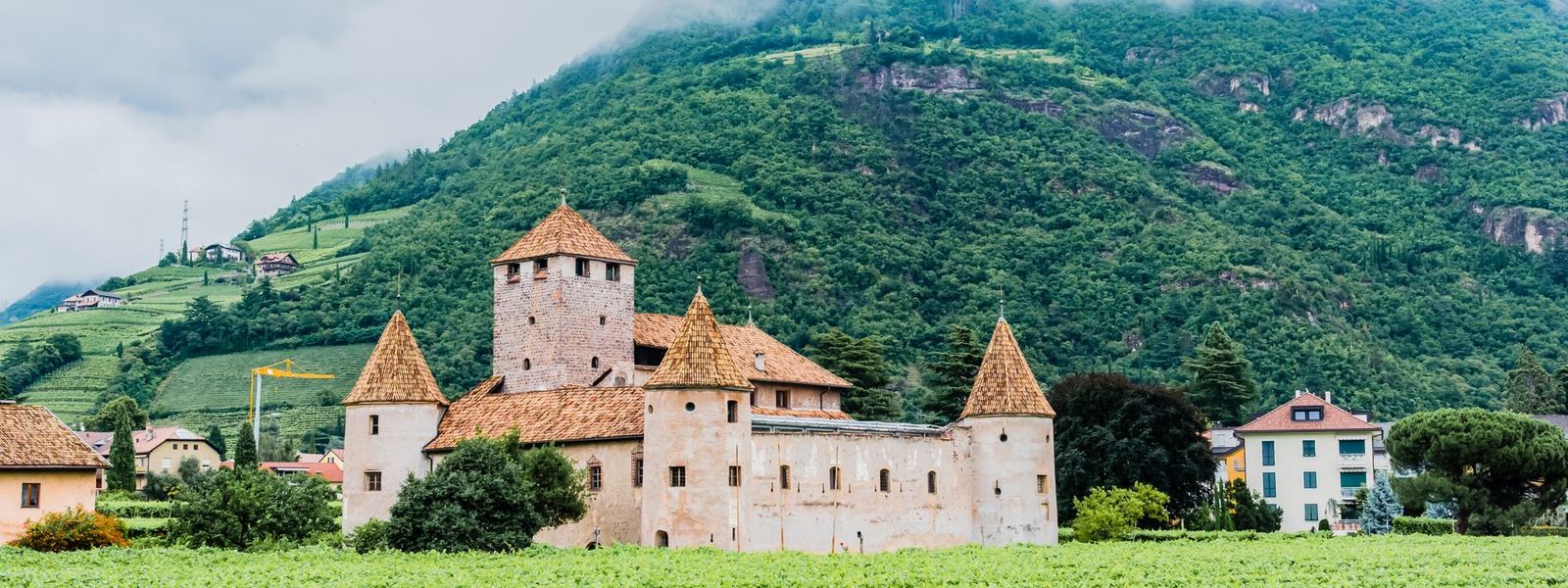
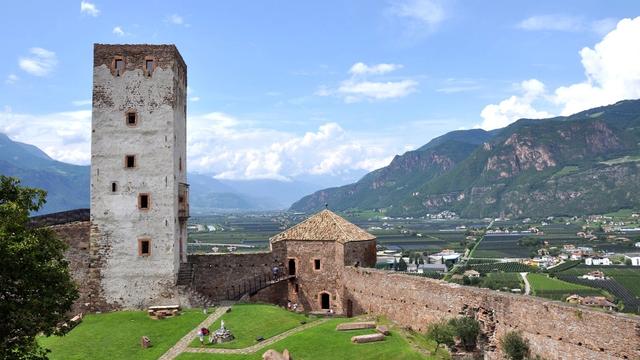
Bolzano stands at 262 metres in the basin where the Sarntal, Eisacktal and Adige valleys meet, at the point where the medieval routes over the Brenner and Reschen passes converged. Italian and German are both official languages, and signage carries both. The medieval centre holds Walther Square, a Gothic cathedral begun in 1184 and the 300-metre arcaded street of Via dei Portici (Laubengasse); the South Tyrol Museum of Archaeology displays the Ötzi mummy. Castles ring the city — Maretsch, Runkelstein and Sigmundskron — and a cable car climbs from the centre to the Ritten plateau.
Bolzano
- Currency
- Euro (EUR, €). ATMs are widespread in cities and towns and accept major international credit and debit cards. Credit cards are accepted in urban and tourist areas; cash is essential in rural regions and small towns.
- Language
- Italian and German are both official, and place names, signs and timetables appear in both. The balance differs sharply from the surrounding valleys: in the 2024 census 74.71% of residents gave Italian as their first language, 24.74% German and 0.55% Ladin. Most German-speakers also speak Italian; the reverse is less common. English is widely used at the university and understood by many younger residents.
- Power plug
- Europlug (Type C), Schuko (Type F) and Type L (Italian three-round-pin) sockets are in use. Voltage is 230V, 50Hz.
- Visa
- Schengen visa-free for 90 days (non-EU/EEA citizens). EU, EEA and Swiss citizens may stay indefinitely. All non-EU/EEA/Swiss visitors must declare their presence within 8 days of arrival. Stays longer than 90 days require an appropriate visa and residence permit.
- Time zone
- Central European Time (CET): UTC+01:00. Central European Summer Time (CEST): UTC+02:00 (last Sunday in March to last Sunday in October).
- Tap water
- Safe to drink. Tap water is well maintained throughout Italy and perfectly drinkable. In some peninsular areas it may be cloudy with a slight taste; most Italians prefer bottled water. Public fountains marked 'Acqua potabile' are safe to refill from. Avoid fountains marked 'Acqua non potabile'. Southern coastal areas may have an unusual taste due to desalination but water is always safe.
- Tipping
- Not customary. Restaurants include a service charge (coperto); waiters do not expect tips. Leaving loose change in bars and cafés is common. Tips cannot be added to credit card bills—bring cash if you wish to tip.
- Emergency
- 112 (Carabinieri, general emergency); 113 (Polizia di Stato); 115 (Fire Department); 118 (Medical Rescue).
When to go
High season
Nov – Dec
The Christmas market runs on Walther Square from the last Friday of November to 23 December with 80 stands, plus a second market of 14 stands in the Palais Campofranco yard. It is the most visited Christmas market in Italy, and the old town is at its busiest.
Low season
Jan – Mar
January is the coldest month — an average of 0 °C, with nights down to −6.2 °C and daytime highs around 5 °C. Once the market stalls come down the centre goes quiet.
Shoulder
Apr – Jun
Spring brings the Föhn down off the northern Alps: relatively warm and strong, then the temperature drops suddenly. Pack for both.
High season
Jul – Oct
July is the warmest month, averaging 22 °C with daytime highs of 29.4 °C, and the summer festival season — jazz, classical music, dance — runs across the city. The Föhn returns in autumn.
How long to stay
Two days give the old centre its due: the arcades, the cathedral, Walther Square and the Ötzi mummy at the archaeology museum. A third day covers Runkelstein Castle or the cable car up to the Ritten plateau. Most people use Bolzano as a base for the Dolomites — the Brenner railway, the A22 motorway and the South Tyrol bus network all meet here, so a longer stay pays off if the mountains are the real target.
Getting around
The old centre is walkable, and the arcades, Walther Square and the archaeology museum all sit inside it. City buses cover the rest: 17 lines, generally 06:00–21:00, with three night lines running until 01:00. A single ticket is €1.50 and covers a second trip within 45 minutes; the Value Card (€5, €10 or €25) drops the fare to €1.20 and also works on interurban buses, cableways and trains across South Tyrol. A 7-day Mobilcard costs €18, a 3-day card €13.
The cable car from the centre climbs to Oberbozen/Soprabolzano on the Ritten plateau. Bolzano station sits on the Brenner line between Verona and Innsbruck, with branches to Merano and Mals. About 50 km of cycle paths carry around 30% of journeys in the city. The airport, 5 km south-east, has no direct link to town apart from taxis; buses 10A and 10B stop 1 km north of the terminal.
Local rules
Everything carries two names. Bolzano is Bozen, Via dei Portici is the Laubengasse, and signs, timetables and addresses use both. Check both forms when you buy a ticket or search for an address.
Ticket machines on board the buses take coins only and sell single tickets and €5 value cards; drivers will not change banknotes. Buy from a tobacconist or a newsagent if you only have notes.
Buying imitation luxury goods from street vendors carries a very high fine in Italy — the fine falls on the buyer.
Stay neutral on South Tyrol's history. Interest in it is welcome; asking German-speakers to justify why German is an official language in Italy lands badly.
What to see

Destinations in Bolzano
Frequently asked questions
Where is Ötzi the iceman on display?
At the South Tyrol Museum of Archaeology in Bolzano, which also holds other archaeological finds from across the province. The mummy makes it one of the leading archaeological museums in Italy.Is Bolzano Italian-speaking or German-speaking?
Both languages are official and the city is signed in both. In the 2024 census 74.71% of residents gave Italian as their first language, 24.74% German and 0.55% Ladin. Most German-speakers also speak Italian; the reverse is less common, and many younger residents speak English.When does the Christmas market take place?
From the last Friday of November to 23 December on Walther Square, with 80 stands. A second market, the Winterwald, sets up 14 stands in the Palais Campofranco yard nearby, and craft and charity markets run elsewhere in the old town over the same weeks. Founded in 1990, it was the first Christmas market in Italy.Which airport should you fly into?
Bolzano has its own airport 5 km south-east of the centre, served by a single airline, SkyAlps, on turboprop aircraft, and fares are relatively expensive. Innsbruck, Verona and Venice are the nearest airports with a broad choice of scheduled flights; Munich and Milan Malpensa are the nearest with intercontinental connections.Is Bolzano safe at night?
It is one of the safest cities in Italy and pickpocketing is uncommon. Stay away from the area around the central railway station after dark — Via Garibaldi, Piazza Verdi, Viale Trento and the Station Park. Piazza dell'Erba, where most of the pubs and clubs are, can turn rowdy at weekends.