The Albaicín is a historic neighbourhood of Granada, in Andalusia, built around a hill on the north side of the Darro River. It has largely kept its medieval street plan from the Nasrid period (13th–15th centuries), and in 1994 UNESCO declared it a World Heritage Site as an extension of the Alhambra and the Generalife. The hill carried the 11th-century Zirid citadel, and the quarter still holds stretches of Zirid walls, medieval cisterns, Nasrid houses, churches built on former mosque sites and the Mirador de San Nicolás.
Albaicin

Hillside Moorish quarter of whitewashed carmens and Nasrid-era lanes, facing the Alhambra across the Darro valley
- Entrance
- Free: there is no ticket to walk the neighbourhood. Monuments such as Dar al-Horra and El Bañuelo are visited separately.
- Accessibility
- The quarter spreads over a hill with a medieval street plan, so getting around means climbing lanes on foot; the Aljibe de San Cristóbal cistern is reached down a staircase.
- Parking
- A car park with public access about 180 m away in a straight line, and another about 290 m away.
- Difficulty
- A walk on foot through lanes that climb the Albaicín hill, with the Mirador de San Nicolás at the top.
- Transport
- Buses stop on the Carretera de Murcia at Carretera de Murcia - Fajalauza and Carretera de Murcia - Pagés - Albaicín, about 290–300 m away.
- Advance booking
- Not needed to walk the neighbourhood.
- Hours
- Open at all times: the Albaicín is a neighbourhood of public streets. Individual monuments keep their own hours.
- Address
- Albaicín, Granada, Spain
What makes it special
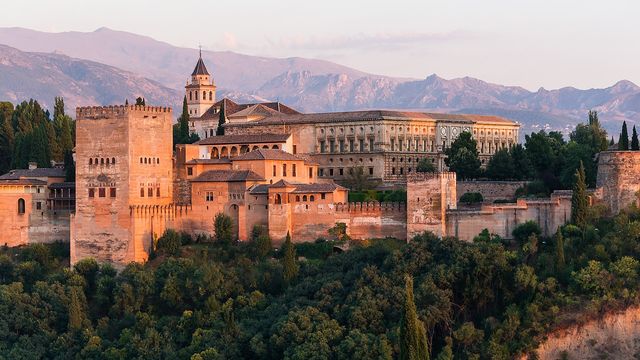
From the terrace beside the Church of San Nicolás, the Alhambra fills the far side of the Darro valley, with the snow of the Sierra Nevada behind it in winter. That view brings most people up the hill. The lanes on the way are the better part.
The Albaicín has largely kept its Nasrid street plan, so alleys twist between whitewashed walls, and those walls hide carmens: freestanding houses with their own orchard or garden. The medieval city shows at street level — the arched openings of cisterns, at least twenty of which survive; the 13th-century Almohad minaret of San Juan de los Reyes; the horseshoe-arched courtyard of the old Great Mosque, kept inside the Church of El Salvador. Dar al-Horra, a 15th-century Nasrid palace, and El Bañuelo, a bathhouse from the 11th or 12th century, are both open to visitors.
Good to know
- There is no ticket for the streets; Dar al-Horra, El Bañuelo and Casa Horno del Oro are visited separately as monuments.
- Plan to walk: the quarter covers a hill, and its lanes still follow the medieval Nasrid street plan.
- Drinking water: the Fuente del Aceituno fountain is about 240 m away in a straight line.
- The nearest mapped toilets, about 530 m and 640 m away, are for customers only.
- The Nasrid house on Cobertizo de Santa Inés is still lived in and closed to the public.
Getting there
Buses stop on the Carretera de Murcia, the road along the upper, northern side of the quarter near the Church and Mirador of San Cristóbal. Two stops serve the Albaicín — Carretera de Murcia - Fajalauza and Carretera de Murcia - Pagés - Albaicín — each about 300 m away in a straight line. A car park with public access lies about 180 m away. From any of them, the rest is on foot.
From the city centre you can walk in from below: Plaza Nueva and the Carrera del Darro mark the lower edge of the quarter along the river, and the Puerta de Elvira, a medieval gate at the start of Calle Elvira, opens its western side.
Best time to visit
Best: late afternoon to sunset at the Mirador de San Nicolás, and early morning in the lanes. The Alhambra stands to the south, so the low western sun lights its walls from the side at the end of the day, while early on the alleys are quiet enough to hear your own footsteps; the terrace fills for sunset, so come well before it.
Avoid: the middle of the day in high summer. A climb on foot through a hillside quarter in Andalusian summer heat is hard going at midday.
Sun & daylight
Nearby Places

Similar Places

Albaicin on the map
Get directions
Your whole travel map in one place
Get inspired by new places around the world and find the ones worth the journey
Frequently asked questions
Are Albaicín and Albayzín the same place?
Yes. Albayzín is an alternative spelling of the same neighbourhood; both come from the Arabic al-Bayyāzīn.Where is the famous view of the Alhambra?
At the Mirador de San Nicolás, the square beside the Church of San Nicolás at the top of the Albaicín hill. The Mirador de San Cristóbal looks over the southern Albaicín towards the Alhambra as well.Can you go inside any of the old Moorish houses?
Yes. Dar al-Horra, a 15th-century Nasrid palace, is open as a historic monument, Casa de Zafra works as an interpretation centre, and Casa Horno del Oro is open to visitors. El Bañuelo, an 11th- or 12th-century bathhouse, is open too.Why is the Albaicín a World Heritage Site?
UNESCO listed it in 1994 as an extension of the Alhambra and the Generalife. The neighbourhood has largely kept its medieval Nasrid street plan and holds Zirid walls, cisterns and houses from the Islamic period.Can you get there by bus?
Yes. Buses stop on the Carretera de Murcia at Carretera de Murcia - Fajalauza and Carretera de Murcia - Pagés - Albaicín, about 300 m away in a straight line; the rest is on foot.