The Alhambra is a palace and fortress complex on the Sabika hill in Granada, begun in 1238 by Muhammad I, founder of the Nasrid dynasty, and enlarged through the 14th century. Its name means 'the red one', after the reddish rammed-earth walls. The Nasrid Palaces, the Mexuar, the Comares Palace and the Palace of the Lions, stand beside the Alcazaba fortress and the Renaissance Palace of Charles V, with the Generalife estate to the east. With the Generalife it has been a UNESCO World Heritage Site since 1984.
Alhambra
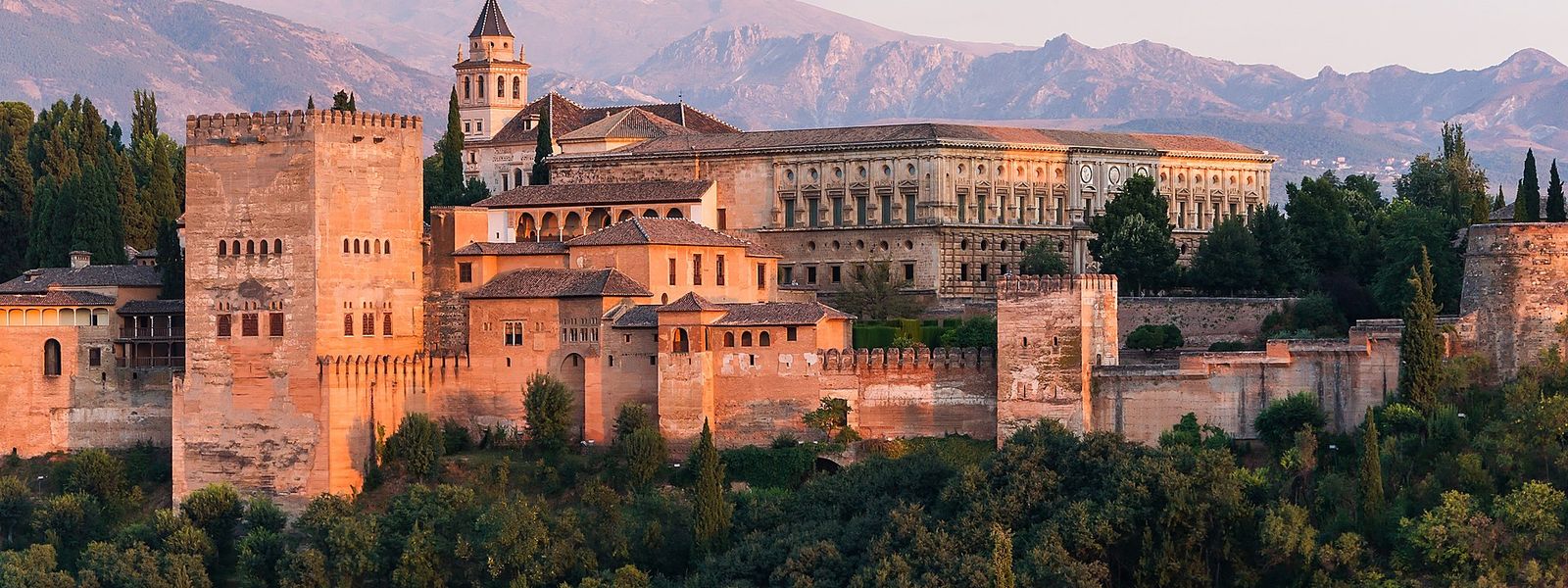
Nasrid palace-fortress on a hill in Granada, with carved stucco halls, courtyard pools and the Generalife gardens.
- Entrance
- Paid ticket, checked against a passport or ID at the main entrance, the palaces and the Alcazaba.
- Accessibility
- Wheelchair-accessible entrance and parking. The grounds run over hills, stairs and stone paths; pushchairs are allowed outside but not in the palace buildings or the Alcazaba.
- Parking
- Paid car park and paid street parking, with wheelchair-accessible spaces; the two closest car parks, about 60 m and 240 m away, are permit-only.
- Difficulty
- Taxis reach the entrance and buses stop about 100–150 m away; inside, two to six hours on foot over hills, stairs and stone paths.
- Transport
- Bus stops Palacio Emperador Carlos V (about 100 m) and Alhambra - Puerta de la Justicia (about 150 m).
- Advance booking
- Needed: book well in advance. The Nasrid Palaces are visited at a set time.
- Hours
- Daily 8:30–18:00; on Friday and Saturday also 20:00–21:30.
- Address
- C. Real de la Alhambra, s/n, Centro, 18009 Granada, Spain
What makes it special
In the Hall of the Ambassadors (Salón de los Embajadores), look up. The dome is built from 8,017 interlocking pieces of wood, a geometric image of the seven heavens, and it rises 18.2 metres above the floor where the sultan held audience, the height of a six-storey building. Next door, the Court of the Myrtles (Patio de los Arrayanes) is laid around a single pool 34 metres long, hedged with myrtle on both sides. In the Palace of the Lions, twelve marble lions carry the basin of the fountain, and the dome of the Hall of Two Sisters breaks into at least 5,000 muqarnas pieces.
The walls are written on. Qur'anic verses and court poetry run through the carved stucco, and some poems speak in the first person, as if the room were talking. From the palaces on the northern wall, low windows look out over the Albaicín. The Generalife gardens lie outside the walls to the east.
Good to know
- Bring your passport or ID. It is checked against your ticket at the main entrance, at the palaces and at the Alcazaba.
- Wear proper shoes and carry water. The grounds run up hills, down stairs and over stone paths, and they are larger than they look.
- Allow the time. A visit runs from two or three hours to six.
- Tour tickets may be collected somewhere other than the main entrance; check where before the day.
Getting there
Buses stop at Palacio Emperador Carlos V, about 100 m away, and at Alhambra - Puerta de la Justicia, about 150 m away. A taxi to the entrance saves your legs for the hours of walking inside.
On foot from the city, the main approach climbs through the Alhambra Woods on the south side of the hill, entered by the Renaissance Gate of the Pomegranates (Puerta de las Granadas).
Driving, there is a paid car park and paid street parking, with wheelchair-accessible spaces. The two closest car parks, about 60 m and 240 m away, are permit-only.
Best time to visit
Best: early morning, with a morning slot for the Nasrid Palaces. In winter the elms are bare and the plan of walls and towers reads more clearly.
Avoid: the middle of the day in summer.
Heat and crowds both build towards midday, on a site you cross on foot for hours.
Access & restrictions
Pushchairs are allowed on the grounds but not inside the palace buildings or the Alcazaba, and baby backpack carriers are refused there too; both go into the lockers. Along the northern wall, the small palace-towers such as the Torre de la Cautiva and the Torre de las Infantas are not normally open to visitors.
Things to do nearby
All tours in Andalusia on GetYourGuide
Paid links: booking through them supports YowJourney.
Sun & daylight
Nearby Places

Similar Places
Featured in our guides

Your whole travel map in one place
Get inspired by new places around the world and find the ones worth the journey
Frequently asked questions
How long does a visit to the Alhambra take?
From two or three hours to six. An unhurried visit takes half a day.Do I need to book Alhambra tickets in advance?
Yes, well in advance. The Nasrid Palaces are visited at a set time, and a morning slot keeps you out of the midday heat.Do I need ID to enter?
Yes. A passport or ID is checked against the ticket at the main entrance, at the palaces and at the Alcazaba.Can I bring a pushchair?
On the grounds, yes. Pushchairs and baby backpack carriers are not allowed inside the palace buildings or the Alcazaba and go into the lockers.Where is the Generalife?
Outside the Alhambra walls, to the east, across a ravine. It was a Nasrid country estate and summer palace, with garden courtyards and 20th-century landscaped gardens on the approach.