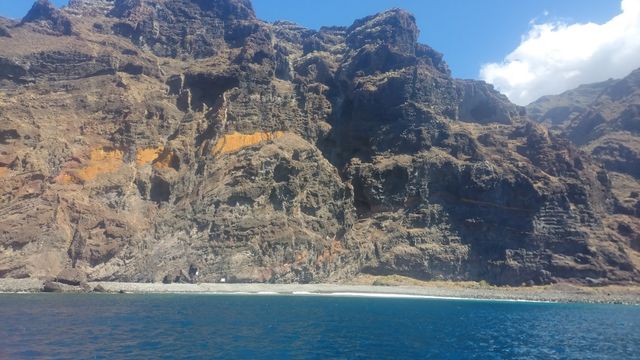
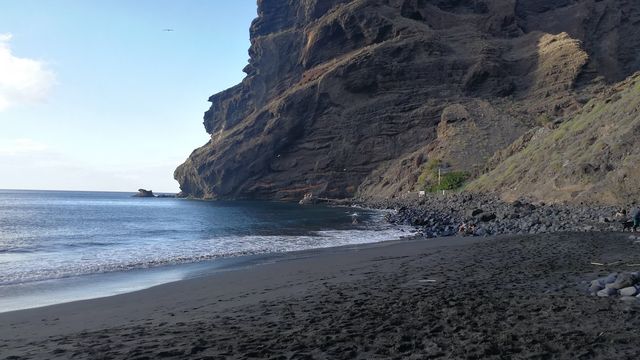
Ancón Beach is a black volcanic sand beach on the north coast of Tenerife, within the municipality of La Orotava in the Canary Islands. It lies at the bottom of the coastal cliffs and is reached on foot, by a steep, narrow path and a final flight of stairs. Old ruins stand beside the sand. The beach is known for its dark sand, its Atlantic waves and for staying uncrowded.
Ancón Beach
Local name: Playa del Ancón

Black-sand beach beside old ruins below the cliffs of La Orotava, reached down a steep footpath.
- Entrance
- Free; there is no ticket.
- Accessibility
- Not accessible by wheelchair or for limited mobility: the only way down is a steep, narrow path and rusty stairs.
- Parking
- Two free asphalt car parks, about 510 m and 560 m away in a straight line.
- Difficulty
- Steep, narrow path of 15–30 minutes each way, ending in rusty stairs; rocks fall onto the path, and the return is uphill.
- Transport
- Bus stops El Tinglado and El Calvario, about 600 m and 630 m away in a straight line.
- Advance booking
- No booking needed.
- Hours
- Open at any time; in winter, high tide can cover the beach completely.
- Address
- El Ancón Beach, 38314, Spain
What makes it special
The sand is black from end to end, and the Atlantic comes in over it in big, heavy waves. Old ruins stand at the edge of the beach.
The water stays shallow for a few dozen metres out, and the surf breaks across that shallow stretch. Everyone arrives on foot down the cliff. The beach stays quiet.
Good to know
- The walk down takes 15 to 30 minutes each way on a steep, narrow path, and the way back is all uphill. Wear shoes with grip.
- The stairs on the last stretch are badly rusted. Take them slowly and test each step.
- Rocks fall onto the path from the slope above. Keep an eye upwards and do not stop under loose ground.
- In winter, high tides can cover the beach completely. Check the tide before you set out.
- There are no toilets and no drinking water at the beach or nearby. Carry water for the climb back.
Getting there
Two asphalt car parks sit about 510 m and 560 m from the beach in a straight line. The nearest bus stops, El Tinglado and El Calvario, are about 600 m away.
From either, the rest is on foot. A steep, narrow path drops down the cliff, 15 to 30 minutes each way, and ends in a flight of rusty stairs onto the sand. Rocks come down onto the path, so watch the slope above you. The climb back up takes the same path.
Best time to visit
Best: a calm day at low tide, in the morning or late afternoon.
Avoid: winter days of high tide and heavy swell, and the middle of a hot day.
High water in winter can leave no beach at all, and the uphill walk back is hard going in full sun, over black sand that heats quickly, with no water anywhere near.
Sun & daylight
Nearby Places


Similar Places
Ancón Beach on the map
Big Atlantic waves break on this shore, the stairs down are badly rusted and rocks fall onto the path. Never turn your back on the sea, take the stairs slowly and do not linger under loose slopes.
Get directions

Your whole travel map in one place
Get inspired by new places around the world and find the ones worth the journey
Frequently asked questions
How long is the walk down to Ancón Beach?
Between 15 and 30 minutes each way, on a steep, narrow path that ends in a flight of rusty stairs. The return is uphill all the way.Is there parking near Ancón Beach?
Yes. Two asphalt car parks lie about 510 m and 560 m away in a straight line, and from there you continue on foot.Can you reach Ancón Beach in winter?
In winter, high tides can cover the sand completely and leave nothing to walk out onto. Check the tide before you go.Is it good for swimming?
The water stays shallow for a few dozen metres, but big waves break across it. Go in only on a calm day and stay close to the shore.Are there toilets or drinking water?
No. There are no toilets and no drinking water at the beach or nearby, so bring what you need.