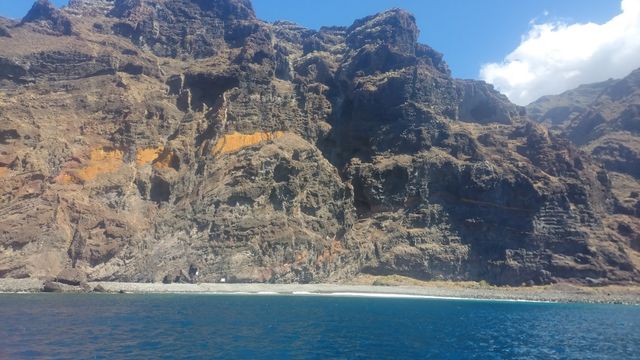
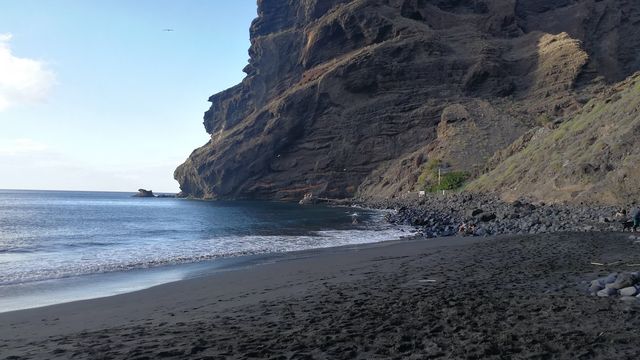
Barranco Hondo Beach is a tiny bay where the Barranco Hondo gorge meets the Atlantic on the north coast of Tenerife, in the municipality of Santa Úrsula. The shore is stones and large boulders, the sea is often rough, and very steep cliff faces close in on both sides. It is known for the walk down the gorge, with views along the north coast, and for the old cave houses in the gorge, now filled with dumped rubbish.
Barranco Hondo Beach
Local name: Playa de Barranco Hondo

Rocky cove at the foot of a steep gorge on Tenerife's north coast, reached by a footpath.
- Entrance
- Free; there is no ticket.
- Accessibility
- Reached only on foot by a path down a steep gorge, with a stretch across landslide debris; not suitable for wheelchairs or limited mobility.
- Parking
- Free paved car park about 1.1 km away in a straight line; another parking area about 930 m away.
- Difficulty
- About 20 minutes down and 30 minutes back up on a gorge path, with one stretch crossing landslide debris.
- Transport
- La Quinta bus stop, about 1.3 km away in a straight line.
- Advance booking
- No booking needed.
- Hours
- Open ground with no fixed hours.
What makes it special
The walk is the draw. The path drops through the gorge between very steep cliff faces, past cacti, with the north coast of Tenerife opening up along the way, and ends in a tiny bay of stones and big boulders. Going down takes about 20 minutes. Coming back up takes about 30.
At the bottom the sea is often rough, with high waves running in over the rocks, so this is a place to sit and watch the water. The old cave houses in the gorge are part of the scene, though dumped rubbish fills them and lies along the way: fridges, mattresses, bed frames.
Good to know
- The shore is rocky, the sea is often rough and high waves break over large boulders. This is no beach for swimming.
- There are no toilets and no drinking water at the beach or nearby. Carry water for the climb back.
- Coming down from the La Victoria de Acentejo side, one stretch of path crosses landslide debris. It is passable with care.
- The path has been closed in the past.
- Dumped rubbish lies in the gorge, and the cave houses are full of it.
Getting there
The last stretch is on foot. The nearest parking lies about 930 m from the beach in a straight line, with a paved car park about 1.1 km away; the La Quinta bus stop is about 1.3 km away. From there the path heads down into the gorge. One way in comes from the La Victoria de Acentejo side, where a landslide has broken the path but left it passable. The walk down takes about 20 minutes and the climb back about 30, so save your legs for the return.
Best time to visit
Best: a dry day with a calm sea, starting early before the heat builds on the climb back.
Avoid: days of heavy swell, and during or just after heavy rain.
The north coast takes the Atlantic swell, which throws high waves onto the boulders, and rain loosens the steep gorge walls where the path already crosses landslide debris.
Sun & daylight
Nearby Places


Similar Places
Barranco Hondo Beach on the map
The sea is often rough, with high waves breaking over large boulders; stay out of the water when there is any swell. The gorge walls are very steep and have slid onto the path, so do not linger beneath them.
Get directions

Your whole travel map in one place
Get inspired by new places around the world and find the ones worth the journey
Frequently asked questions
Can you swim at Barranco Hondo Beach?
It is a poor place to swim. The shore is stones and large boulders, and the sea is often rough with high waves.How long is the walk down to the beach?
About 20 minutes down the gorge path and about 30 minutes back up.Are there toilets or drinking water?
No. There are no toilets and no drinking water at the beach or nearby, so bring what you need.Is the path to Barranco Hondo Beach safe?
It is passable, but on the La Victoria de Acentejo side one stretch crosses landslide debris and the cliff faces above are very steep. Watch your footing and keep moving beneath the walls.