The Cenobio de Valerón is an archaeological site in the municipality of Santa María de Guía, in the north of Gran Canaria. It is the largest pre-Hispanic collective granary: 298 compartments on eight levels, more than 350 storage spaces in all, dug with stone and wooden tools into the tuff of the Montaña del Gallego. The island's inhabitants used it until the conquest at the end of the 15th century. It is protected as a Property of Cultural Interest and open as an archaeological park.
Cenobio de Valeron
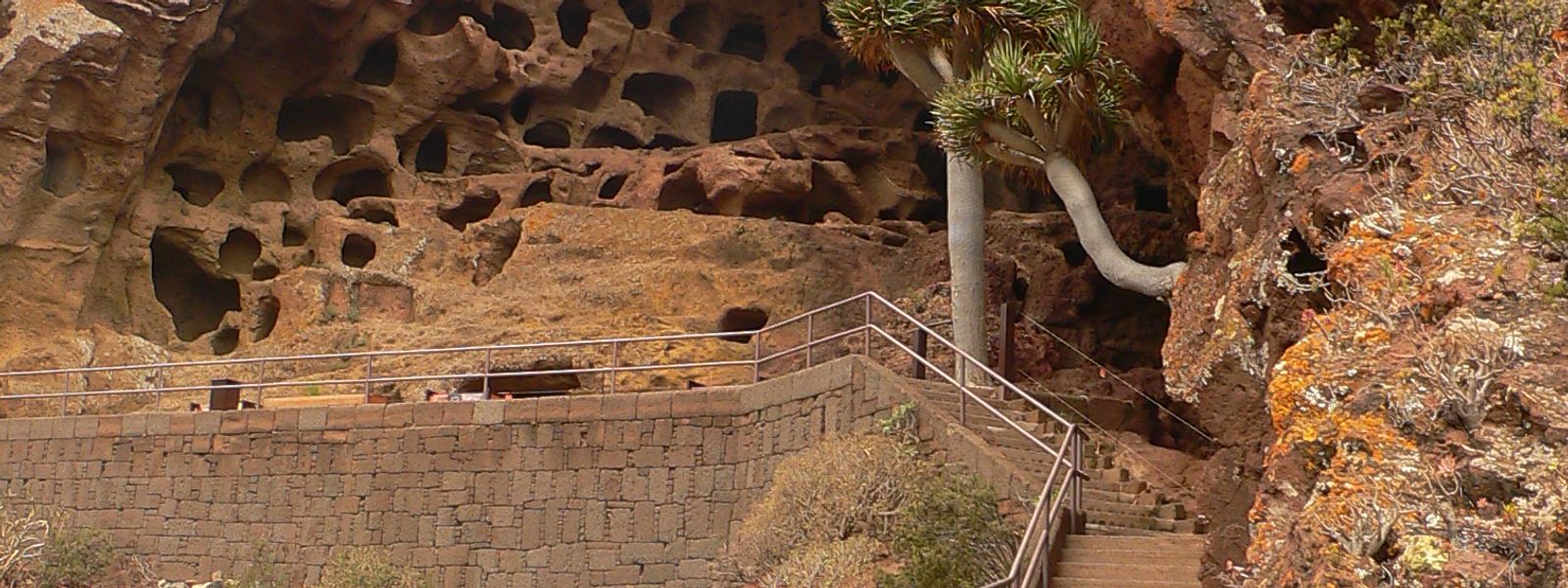
Pre-Hispanic communal granary of nearly 300 cave chambers cut into a tuff cliff above the San Felipe ravine.
- Entrance
- €3; students €2. Tickets are sold at the entrance, and cards are accepted.
- Accessibility
- The entrance is not wheelchair accessible and the circuit has a lot of stairs; there is no accessible parking.
- Parking
- Free car park at the site, which fills up; a second free car park about 180 m away, and free street parking.
- Difficulty
- A walking circuit from the car park with a lot of stairs; the visit takes between 20 minutes and an hour.
- Transport
- Nearest bus stop: Cruce del Hormiguero, about 770 m away in a straight line; the walk from the bus takes about 40 minutes.
- Advance booking
- Not needed: tickets are sold at the entrance.
- Hours
- Tuesday to Sunday, 10:00–17:00. Closed on Mondays and on some holidays, including Christmas and New Year.
- Address
- Cuesta de Silva, S/N, 35458 Guía, Las Palmas, Spain
What makes it special
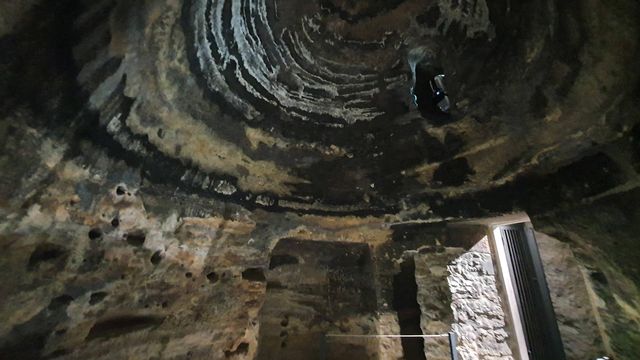
From the path the cliff looks like a honeycomb: rows of dark openings stacked eight levels high under a natural arch of rock. There are 298 of them, each between one and three square metres, cut by hand with stone and wooden tools into soft volcanic tuff. Steps carved into the rock to reach them are still there.
This was a community's grain store. Each chamber had its own door of wood or stone slab, sometimes stamped with a pintadera seal to mark the owner, and the cracks were sealed with ash mortar to keep the crop safe. The site was chosen because it is hidden from the sea and the slopes below are steep enough to defend.
The name means "monastery". For centuries the caves were taken for the home of the harimaguadas, celibate priestesses, until the French archaeologist Guy Marcy recognised them in the 20th century as a granary, close kin to the agadirs of North Africa. Around the site, the mountains and gorges of the north open out over the San Felipe ravine (Barranco de San Felipe).
Good to know
- The chambers are closed to visitors: you see the caves from the path, with information panels and models along the circuit.
- The visit takes between 20 minutes and an hour.
- The circuit has a lot of stairs, and the entrance is not wheelchair accessible.
- The car park fills up, and finding a space can be hard; free street parking is the alternative.
- Toilets are on site. There is no drinking water point nearby, so bring your own.
Getting there
The Cenobio de Valerón sits on the GC-291, a minor road in the hills above the north coast. Leave the GC-2 motorway at exit 20, which is signposted for the site; from there it is about 4 km. Exit 21 also leads round to it. The road has a good surface but plenty of bends, and it runs high along the slope. The eastern end of the GC-291 meets the GC-2 near San Felipe, but you cannot get off the motorway there, so come in from the west.
The free car park is right at the site, with a second one about 180 m away. Without a car, the bus plus a walk of about 40 minutes gets you there; the nearest stop, Cruce del Hormiguero, is about 770 m away in a straight line.
Best time to visit
Best: the afternoon, Tuesday to Sunday.
Avoid: Mondays, and the Christmas and New Year holidays, when the site is closed.
The cliff faces north-west, so the cave openings sit in shade through the morning and catch the sun later in the day.
Access & restrictions
The Cenobio de Valerón is a protected archaeological site. The caves themselves are off-limits, for safety and to preserve them: the visit follows the path in front of the cliff, and nobody enters the chambers. The exhibits along the circuit are not to be touched. The site is fenced and locked at night.
Things to do nearby
All tours in Gran Canaria on GetYourGuide
Paid links: booking through them supports YowJourney.
Sun & daylight
Nearby Places
Similar Places
Cenobio de Valeron on the map
The caves are cut into a steep cliff face above a ravine, and the visitor circuit climbs a lot of stairs. Keep to the path and keep children close.
Get directions

Your whole travel map in one place
Get inspired by new places around the world and find the ones worth the journey
Frequently asked questions
Can you go inside the caves at the Cenobio de Valerón?
No. The chambers are off-limits for safety and preservation, and the caves are seen from the path that runs in front of the cliff.How long does a visit take?
Between 20 minutes and an hour.Is there parking?
Yes, a free car park at the site and free street parking. The car park fills up, so finding a space can take a while.Can you get there without a car?
Yes, by bus and a walk of about 40 minutes. The nearest stop is Cruce del Hormiguero, about 770 m away in a straight line.Why is a granary called a monastery?
"Cenobio" means monastery. The caves were long believed to have housed the harimaguadas, celibate priestesses; in the 20th century the French archaeologist Guy Marcy identified them as a communal granary.