The Corral del Carbón, originally al-Funduq al-Jadida ("the New Inn"), is a funduq built in Granada before 1336 to store grain and lodge visiting merchants beside the city's bazaar. It is the only Nasrid funduq preserved in the Iberian Peninsula. From 1531 it served as a theatre, then as a tenement where coal was weighed and stored, which gave it its name. Restored by Leopoldo Torres Balbás in 1929–1931, it now houses the offices of the International Festival of Music and Dance of Granada.
Corral del Carbon Caravanserai
Local name: Corral del Carbón

14th-century Nasrid merchants' inn with a carved gateway and a courtyard ringed by three storeys of galleries.
- Entrance
- Free.
- Accessibility
- Wheelchair-accessible entrance; the visit is limited to the ground-floor courtyard. No wheelchair-accessible parking.
- Parking
- The nearest car parks are private: one about 200 m away, and the Meliá Granada hotel car park about 220 m away, free but for customers only. No wheelchair-accessible parking.
- Difficulty
- None: the gateway opens off a city-centre street and the courtyard is at ground level.
- Transport
- Bus to Plaza del Carmen – Ayuntamiento (about 120 m) or Plaza de Isabel la Católica (about 130 m).
- Advance booking
- Not needed; entry is free with no ticket.
- Hours
- Daily 9:00–20:00.
- Address
- C. Mariana Pineda, 21, Centro, 18009 Granada, Spain
What makes it special
The gateway stops people in the street. It juts out from the facade like a deep porch, the doors set back under a vault carved into muqarnas honeycomb, the arch framed in interlacing brick and plaster work, and above it a band of Kufic script giving Surah 112 of the Qur'an.
Step through and the noise of the centre drops away. The courtyard is almost square, 16.8 by 15.6 metres, ringed by three storeys of galleries in timber, brick and stone, with a stone basin at the centre where a fountain once stood. It is the layout of the funduqs of Fez, and this is the only Nasrid one left in the Iberian Peninsula: a merchants' inn and grain store from before 1336 that later held a theatre and then a tenement where coal was weighed.
Good to know
- Only the ground-floor courtyard is open to visitors; the rooms around it hold offices and a craft shop.
- There are no information panels inside, so read up on the history before you go.
- A free toilet is on the right as you come in.
- The courtyard is sometimes set with rows of chairs for performances, which cuts into what you can see.
- The visit takes a few minutes; it fits into a walk past the Cathedral and the Alcaicería.
Getting there
The Corral del Carbón stands in the centre of Granada, south of the Albaicín and near the Cathedral, in the streets of the old bazaar quarter. Most people arrive on foot while walking the centre.
Two bus stops lie within about 130 m: Plaza del Carmen – Ayuntamiento, by the town hall, and Plaza de Isabel la Católica. Driving in helps little, since the two nearest car parks, about 200 m away, are private, one of them for Meliá Granada hotel customers only. The gateway opens straight onto the street; look for the wooden eaves on carved corbels above it. The municipal tourist office is about 100 m away.
Best time to visit
Best: in the heat of the day, as a pause on a walk through the centre. Avoid: performance days, when rows of chairs fill the courtyard. The galleries give shade and the courtyard stays quiet while the streets around the Cathedral are busy, and the visit is short enough to slot in between other sights.
Sun & daylight
Nearby Places

Similar Places

Corral del Carbon Caravanserai on the map
Get directions
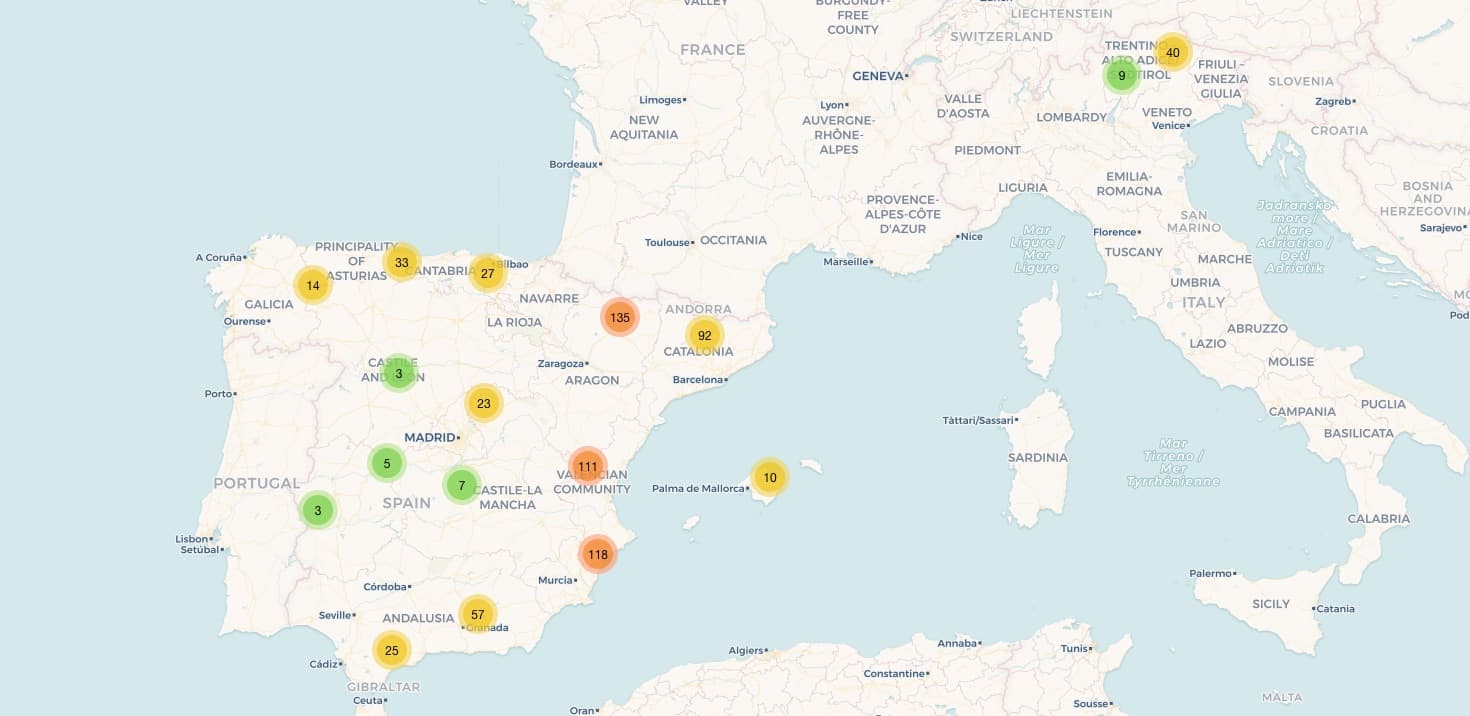
Your whole travel map in one place
Get inspired by new places around the world and find the ones worth the journey
Frequently asked questions
Do you have to pay to enter the Corral del Carbón?
No. Entry is free and there is no ticket; you walk in through the gateway into the ground-floor courtyard.How long does a visit take?
A few minutes. Only the courtyard is open, and there are no exhibits or information panels inside.Why is it called the Corral del Carbón?
In the 17th century the building was a tenement, and its ground floor was used to weigh and store coal. The name means "Courtyard of Coal"; the original Arabic name was al-Funduq al-Jadida, "the New Inn".Can you buy Alhambra tickets there?
Yes. An office in the building sells official tickets to the Alhambra sites, issued by the municipal tourist office.Is there a toilet?
Yes, a free one on the right as you come in from the street.