The Barrio de Santa Cruz is the main tourist neighbourhood of Seville and was the city's judería, or Jewish quarter, in the Middle Ages. It is bounded by the Jardines de Murillo, the Real Alcázar, Calle Mateos Gago and Calle Santa María la Blanca, and holds many of Seville's oldest churches along with Seville Cathedral and the Giralda, the converted minaret of the old mosque. The quarter declined after the expulsion of the Jews in 1492 and was renewed in the 18th century.
Santa Cruz Quarter (Seville)
Local name: Barrio de Santa Cruz

Former medieval Jewish quarter of whitewashed lanes, hidden courtyards and old churches beside the Real Alcázar.
- Entrance
- Free; there is no ticket for the quarter.
- Accessibility
- The streets are level. The lanes are narrow and get crowded.
- Parking
- Paid car park Parking Cano y Cueto, about 280 m away; another paid car park about 290 m away is for customers only.
- Difficulty
- None: level streets, explored on foot at your own pace.
- Transport
- Stops Menéndez Pelayo (Jardines de Murillo), about 320 m away, and Menéndez Pelayo (Puerta de la Carne), about 350 m away.
- Advance booking
- Not needed for the quarter itself.
- Hours
- Open at all times; it is a public neighbourhood.
- Address
- C. Mesón del Moro, 1, Casco Antiguo, 41004 Sevilla, Spain
What makes it special
Lanes bend and narrow between whitewashed houses, balconies trail flowers overhead, and open doorways give glimpses of courtyards hidden from the street. The layout looks random, yet the streets keep leading back out to the main sights.
Under the charm sits a hard history. After Ferdinand III of Castile took Seville from Muslim rule, he gathered the city's Jewish population, the second largest in Iberia after Toledo's, into this one quarter. The 1492 expulsion emptied it. The past is built into the churches: the Iglesia de San Bartolomé was a synagogue, and just outside the barrio the Iglesia de Santa María la Blanca is a 14th-century Mudéjar synagogue turned church. The Plaza de Santa Cruz is the surviving floor of a church demolished during the Napoleonic Wars, where the painter Murillo, who lived in the quarter, was buried.
Good to know
- The streets are level, but the visit is all walking: wear comfortable shoes.
- Bring water, a hat and sunscreen, above all in summer; free drinking fountains stand in the Jardines de Murillo.
- The toilets nearby are in cafés and bars, for customers only.
- The lanes are narrow and fill with tourists and locals; cafés and tapas bars are never far away for a break.
Getting there
The Barrio de Santa Cruz sits in the old town, and the last stretch is on foot. The nearest public transport stops, Menéndez Pelayo (Jardines de Murillo) and Menéndez Pelayo (Puerta de la Carne), are about 320 m and 350 m away. Drivers can leave the car at Parking Cano y Cueto, about 280 m away. Inside, the lanes twist with no obvious plan, but they eventually lead back out to the main sights, and the Giralda above the rooftops gives you a bearing.
Best time to visit
Best: early morning, before the lanes fill, or the evening, when the cafés and tapas bars are at their liveliest.
Avoid: the middle of the day in summer.
Andalusian summer heat peaks in the early afternoon, and the daytime crowds leave little room in streets this narrow.
Sun & daylight
Nearby Places
Similar Places
Santa Cruz Quarter (Seville) on the map
Get directions
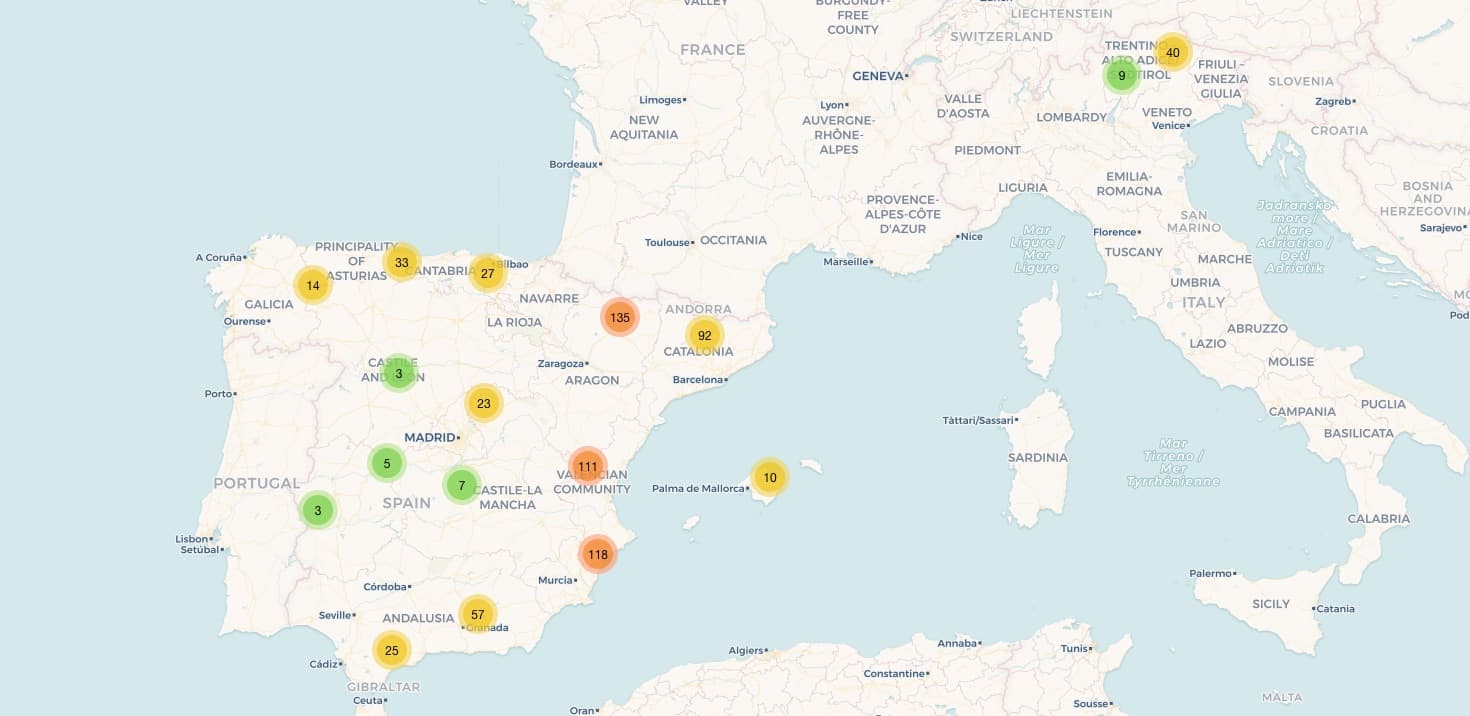
Your whole travel map in one place
Get inspired by new places around the world and find the ones worth the journey
Frequently asked questions
Do you pay to enter the Barrio de Santa Cruz?
No. The barrio is a public neighbourhood of streets and squares with no ticket, open at all hours.Where can I park near the Barrio de Santa Cruz?
Parking Cano y Cueto, a paid car park, is about 280 m away. Another paid car park about 290 m away is for customers only.Was the Barrio de Santa Cruz the Jewish quarter of Seville?
Yes. It was the medieval judería, where Ferdinand III of Castile concentrated the city's Jewish population after the conquest. It declined after the expulsion of 1492. A former synagogue became the Iglesia de San Bartolomé, and the Iglesia de Santa María la Blanca, just outside the quarter, is a converted 14th-century Mudéjar synagogue.Where was Murillo buried?
In the old Iglesia de Santa Cruz, demolished during the Napoleonic Wars; its floor survives as today's Plaza de Santa Cruz. The parish moved to the present Iglesia de Santa Cruz on Calle Mateos Gago, which holds Murillo's painting of the Last Supper.