The César Manrique Foundation is a private cultural institution founded by the Lanzarote artist César Manrique to conserve and spread his work, protect the island's natural environment and promote the visual arts. Its seat is Taro de Tahíche, his former house in the municipality of Teguise, which opened as a cultural centre on 27 March 1992, six months before his death. The building stands on a lava flow from the 1730–1736 eruptions, draws on traditional island architecture and has underground rooms inside volcanic bubbles.
Cesar Manrique Foundation
Local name: Fundación César Manrique
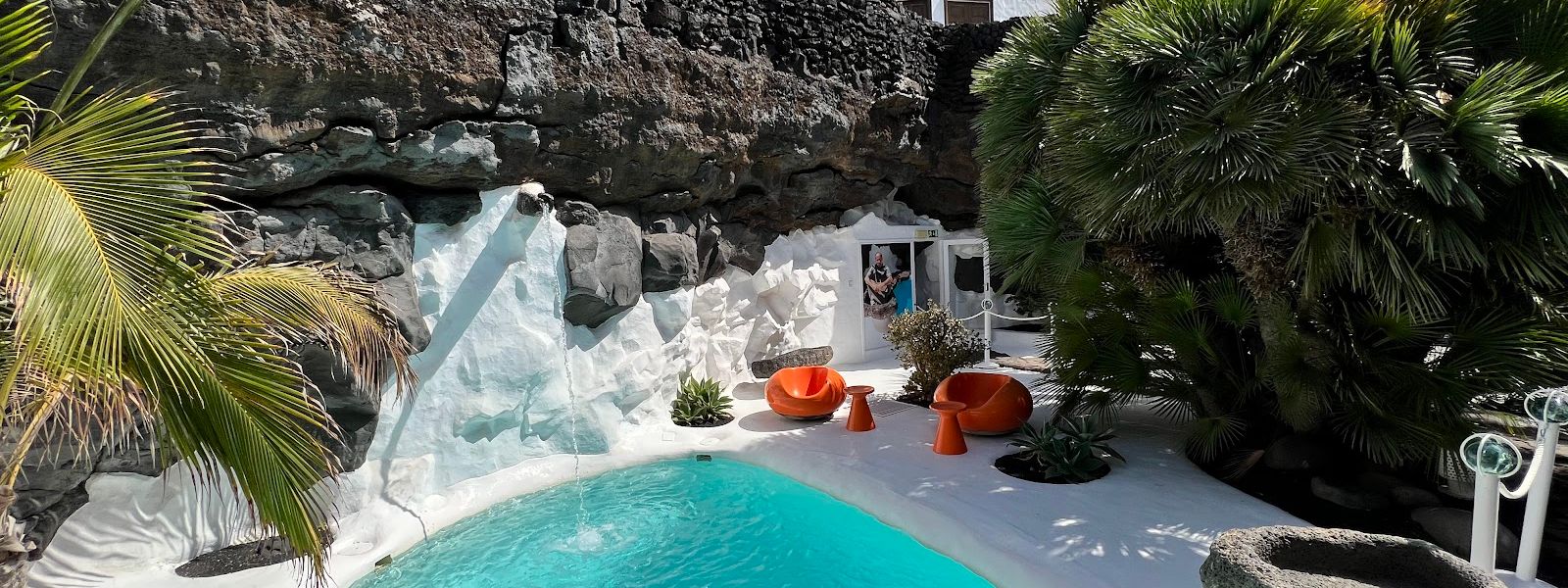
Artist's former home built over a 1730s lava flow, with rooms set inside volcanic bubbles.
- Entrance
- Paid entry: €10 for an adult.
- Accessibility
- Wheelchair-accessible entrance and parking.
- Parking
- Free visitor car park about 90 m away; free street parking and a paid car park are also available.
- Difficulty
- No approach to speak of: the car park is about 90 m from the house.
- Transport
- Bus stop Cruce César Manrique in Tahíche, about 260 m away.
- Hours
- Daily, 10:00–17:30.
- Address
- C. Jorge Luis Borges, 16, 35507 Tahiche, Las Palmas, Spain
What makes it special
Go down from the white house and you are inside the lava. The lower floor is a chain of rooms built into volcanic bubbles, joined by passages through black rock, with daylight falling in through openings overhead. Manrique lived here, and the bubbles were made for living in: a sitting room, a pool, plants reaching up towards the light.
Above ground the building follows the island's traditional architecture, whitewashed and low, with the lava field outside the windows. Two collections hang in the rooms. One is Manrique's own work; the other is the contemporary art he owned, mostly by artists of his generation. Video screenings run continuously on his life and on what he did for Lanzarote.
Good to know
- Allow one to two hours for the house, the two collections and the bubble rooms below.
- There is a café, a gift shop and toilets on site.
- Entrance fees go towards the upkeep and protection of Manrique's sites on the island.
- The Lagomar Museum (Museo Lagomar), another house shaped into rock, makes a natural second stop after this one.
Getting there
The foundation stands at Tahíche, in the municipality of Teguise, beside the road junction that carries Manrique's name. Drivers have a free visitor car park with plenty of space about 90 m away, on asphalt, and there is street parking as well. The nearest bus stop, Cruce César Manrique, is about 260 m away in a straight line, so the last stretch on foot is a walk of a few hundred metres along the road. An information board stands by the entrance.
Best time to visit
Best: mid-afternoon, arriving with the hour or two the visit needs still left before closing. Avoid: late morning, when coach tours on the island circuit tend to arrive. The bubble rooms and passages are narrow, and they feel very different with a handful of people in them than with a tour group.
Things to do nearby
All tours in Teguise on GetYourGuide
Paid links: booking through them supports YowJourney.
Sun & daylight
Nearby Places
Similar Places

Featured in our guides

Your whole travel map in one place
Get inspired by new places around the world and find the ones worth the journey
Frequently asked questions
How long does a visit to the César Manrique Foundation take?
One to two hours covers the house, both collections and the rooms built into the volcanic bubbles.Is there parking at the César Manrique Foundation?
Yes. A free visitor car park with plenty of space sits about 90 m away, and there is street parking too.Can you get to the César Manrique Foundation by bus?
Yes. The Cruce César Manrique stop in Tahíche is about 260 m away in a straight line.Is the César Manrique Foundation wheelchair accessible?
The entrance and the parking are wheelchair accessible.What is there to see besides the house?
Two collections: Manrique's own work, and the contemporary art he owned, mostly by artists of his generation. Video screenings on his life run continuously.