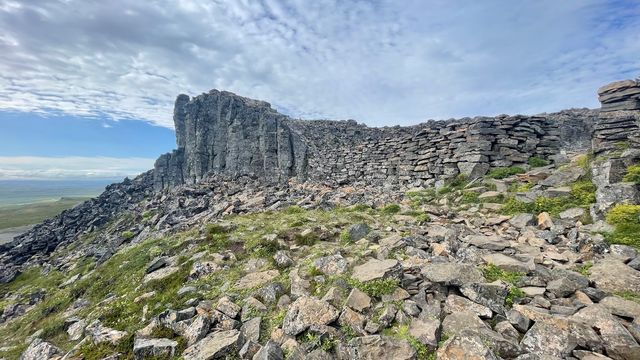
Drangey stands alone in Skagafjörður, in northern Iceland: a flat-topped island of palagonite tuff, the remnant of a volcano about 700,000 years old, rising 180 m above the sea. It is uninhabited. Grettis saga places the outlaw Grettir here for his last years, and he was killed on the island in late autumn 1031. The cliffs hold guillemots, auks, puffins, kittiwakes and fulmars, and local people took eggs and birds from them every spring until the snares went out of use in 1966. Boat tours cross from Sauðárkrókur.
Drangey Island
Local name: Drangey

In the best years, fowlers took more than 200,000 birds off these cliffs; the horsehair snares went out of use in 1966.
- Accessibility
- Not suitable for wheelchair users or anyone with limited mobility: the island is reached by boat, and the way up from the cove is on ropes and ladders.
- Difficulty
- A climb, not a walk. Fixed ropes and ladders lead from the landing cove to the plateau, 180 m above the sea, and the paths on top are narrow.
- Transport
- Boat tours from Sauðárkrókur; there is no other way across.
- Advance booking
- Required — book the boat tour ahead
- Address
- Drangey, Skagafjörður
What makes it special
The boat lands in a cove under the cliffs, and from there the island is climbed rather than walked: fixed ropes and ladders take you through the rock band to the grass on top. Fowlers once went the other way, roping down the same cliffs for eggs. Guillemots nest on the open faces, auks in the deep cracks below them, and puffins dig burrows into the cliff edge. Kittiwakes, fulmars, ravens and falcons are here as well. The tours are run by families from Skagafjörður with long ties to the island, and the saga and the fowling history come with the crossing. Local legend calls Drangey a petrified cow, caught by daylight as two giants drove it across the fjord. Kerling, the hag, still stands in the water to the south.
Good to know
- Cost: The boat tour is not cheap, and it is the only way to set foot on the island.
- Puffins: They are on Drangey in summer, burrowed into the edge of the cliffs.
- Guides: Tours are run by families from Skagafjörður, and the island's history comes with the trip.
- Uninhabited: Nobody lives on Drangey. It is a trip out and back, not a place to stay.
Getting there
Boats cross from Sauðárkrókur, and the crossing is short. They put in at a cove below the cliffs, and from there everything is upward, on fixed ropes and ladders. Nothing about the last stretch is a stroll. If the climb is not for you, Drangey is in clear view from roads 75 and 76, and the island looks different in flat night light than it does at midday.
Best time to visit
Better: summer, for the puffins and the white nights.
Avoid: counting on puffins outside the summer months.
Puffins are on the cliffs through the summer, and that is what most passengers come to see. The same weeks bring light that holds through the night, so Drangey can be picked out from across the fjord at any hour.
Sun & daylight
Nearby Places

Similar Places


Drangey Island on the map
The only route from the landing cove to the top is a climb on fixed ropes and ladders, and the paths above run along the edge of sea cliffs. Anyone uneasy with heights or narrow ground should not attempt it.
Get directions

Your whole travel map in one place
Get inspired by new places around the world and find the ones worth the journey
Frequently asked questions
How do you get to Drangey?
By boat. Tours cross from Sauðárkrókur in Skagafjörður, and there is no other way to land on the island.Is there a climb involved?
Yes. From the landing cove, fixed ropes and ladders lead up through the cliffs to the plateau, 180 m above the sea. The paths on top are narrow.Can you see puffins on Drangey?
In summer, yes. Puffins burrow into the cliff edge, guillemots nest on the open faces and auks in the cracks beneath them. Kittiwakes, fulmars, ravens and falcons also nest on the island.Why is Drangey known from the sagas?
Grettis saga places the outlaw Grettir here for his last years, with his brother Illugi and his slave Glaumur, because the cliffs made the island hard to storm. He was killed on Drangey in late autumn 1031 by Þorbjörn Öngull and his men.Does anyone live on the island?
No. Drangey is uninhabited and was worked seasonally rather than settled. Spring fowling parties sheltered in sheds on the beach at the southernmost tip, and fished from there.