Latrabjarg is a promontory at the far western end of the Westfjords, and the westernmost point in Iceland. Its cliffs run 14 km and rise up to 440 metres, which makes them the largest bird cliff in Europe. Millions of birds nest on them: puffins, northern gannets, guillemots and razorbills, including as much as 40% of the world's razorbills. Route 612 ends at a lighthouse and car park on the headland, and the puffins burrow within metres of it.
Latrabjarg Cliffs
Local name: Látrabjarg
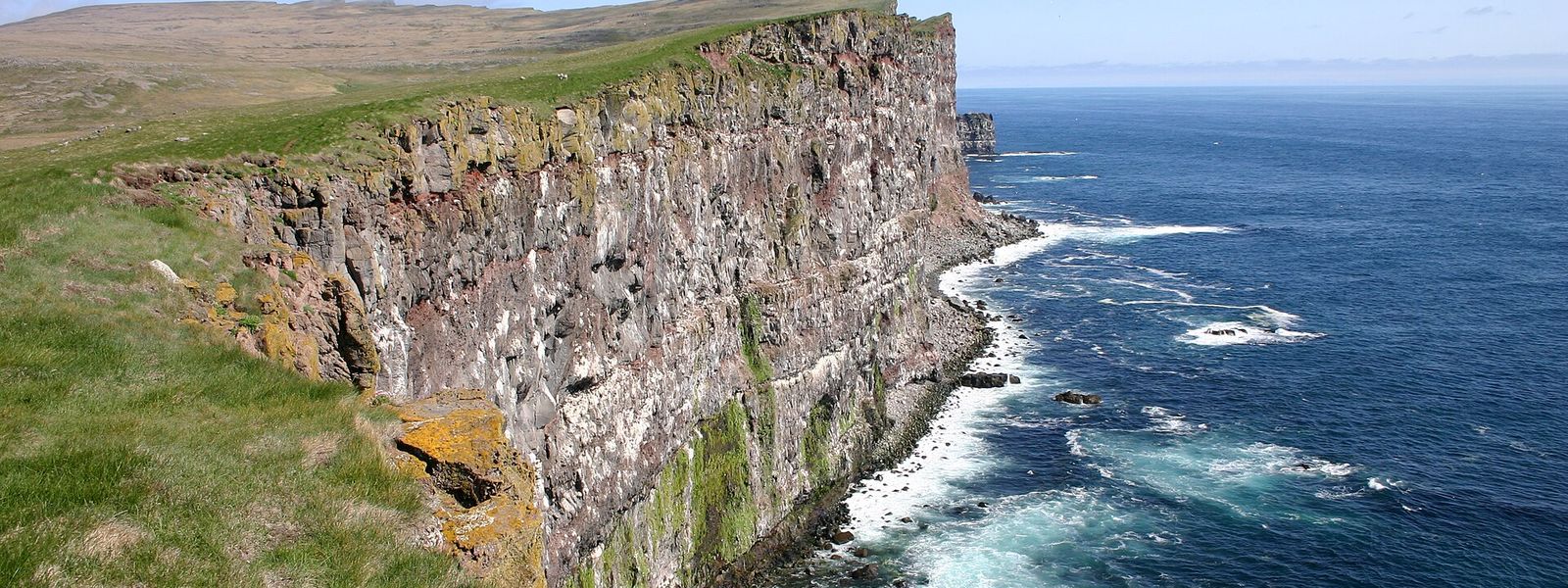
Europe's largest bird cliff: 14 km long, up to 440 metres high, and home to as much as 40% of the world's razorbills.
- Parking
- Free gravel car park at the end of Route 612, by the lighthouse, about 110 metres from the cliff top.
- Difficulty
- Cliff-top walking from the car park with no set turning point; 2 to 2.5 km each way is a common walk. Puffins start right by the lighthouse.
- Transport
- No bus service; the cliffs are reached by car on Route 612.
- Address
- Látrabjarg, 451, Iceland
What makes it special
The puffins here do not keep their distance. They nest in the turf within metres of the lighthouse at the end of Route 612, and they can be found by the dozens close to the car park. Beyond it a trail runs along the cliff top past hundreds of thousands of birds — guillemots, razorbills, northern gannets. The cliff is 14 km long and up to 440 metres high, the largest bird cliff in Europe, and it holds as much as 40% of the world's razorbills. Information panels at the car park set out which bird is which. Bring binoculars: most of what is on the wall below the path is too far off to identify with the naked eye. Puffins are the exception, and they are best picked up near the start of the trail.
Good to know
- No toilets at the cliffs. The nearest are at a separate stop a couple of kilometres back up the road, paid by contactless card.
- Fog is what spoils the day. The road out can close in with very low visibility, and it sits on the cliff top too.
- The drive is long and bumpy. The last stretch out to the headland is gravel.
- Bring binoculars. Most of the birds are far below the path; the puffins are the exception.
- Information panels at the car park cover the birdlife you can expect to see.
Getting there
Route 612 runs out to the headland and ends at the lighthouse. The last stretch is gravel, and the drive is long and bumpy. No bus comes out here, so the cliffs are reached by car. The birds begin at the car park itself — puffins nest within metres of the lighthouse. From there a trail carries on along the cliff top, with no set turning point.
Best time to visit
Better: early morning, or the late evening while the sun is still up.
Avoid: days with fog forecast on the peninsula.
At half past nine in the morning the cliff can be almost empty of people and still full of puffins. Around eight in the evening works as well. Fog is the one thing that takes the place away: it settles on the road and on the cliff top and leaves nothing to see. By early July the puffin season is already near its end, and the birds then leave for the open sea.
Sun & daylight
Nearby Places


Similar Places


Featured in our guides
Latrabjarg Cliffs on the map
The cliff drops as much as 440 metres to the sea. Fog can sit on the cliff top and cut visibility to almost nothing. Stay well back from the edge, and never step closer for a photograph of a puffin.
Get directions

Your whole travel map in one place
Get inspired by new places around the world and find the ones worth the journey
Frequently asked questions
Are there toilets at Latrabjarg?
Not at the lighthouse car park. Toilets are at a separate stop a couple of kilometres back up the road, paid by contactless card.How close do the puffins come?
They nest within metres of the lighthouse and can be seen by the dozens near the car park. Further along the trail they are harder to pick out.Can you get there by bus?
No. There is no public transport to the cliffs. Route 612 leads out to the lighthouse, and the last stretch is gravel.How long is the walk along the cliffs?
There is no fixed route. The trail follows the cliff top, and 2 to 2.5 km each way is a common walk.What birds nest here?
Puffins, northern gannets, guillemots and razorbills, in millions. As much as 40% of the world's razorbills nest on this cliff.