Þríhnúkagígur is a dormant volcano in the Brennisteinsfjöll volcanic system, near Reykjavík in Iceland's Capital Region. It has not erupted in the past 4,000 years, and the magma that filled the chamber beneath the crater drained away. The empty chamber is 213 metres deep and covers 3,270 square metres. Cave explorer Árni B. Stefánsson found it in 1974, and it opened to visitors in 2012. It is the only volcano in the world that lowers visitors into a magma chamber by lift.
Þríhnúkagígur Volcano
Local name: Þríhnúkagígur
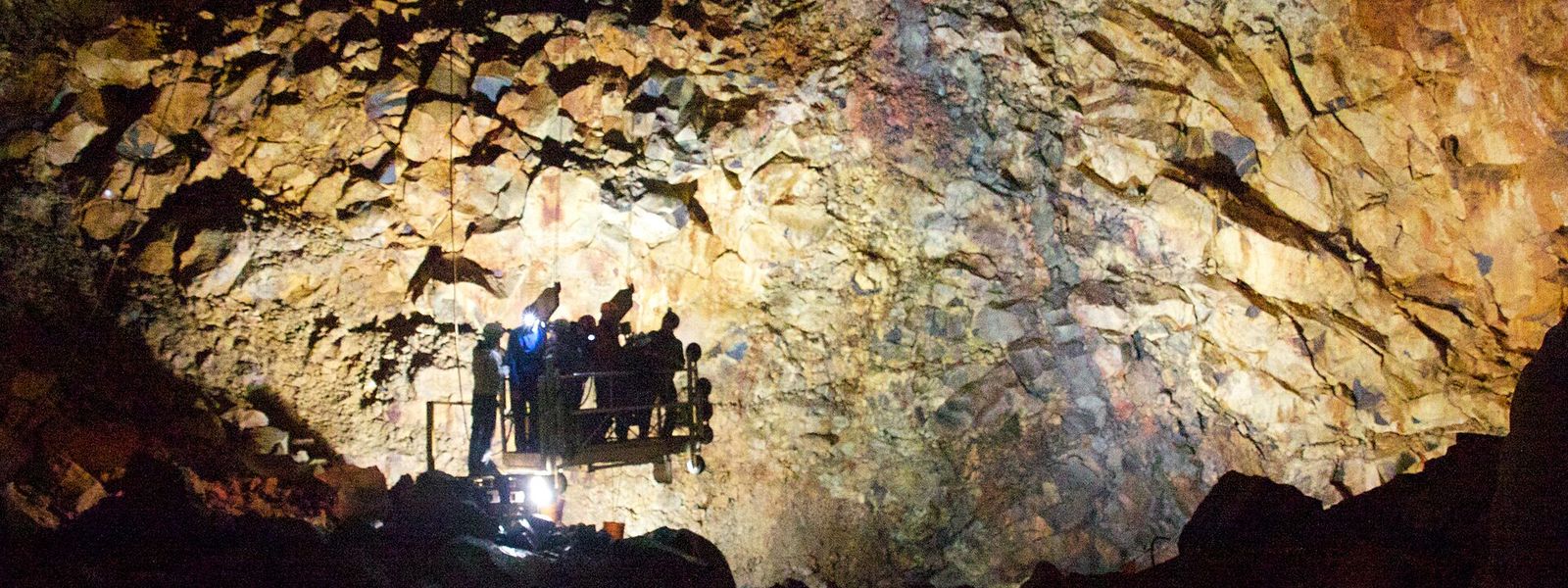
The only volcano in the world where a lift takes visitors 213 metres down into the magma chamber itself.
- Entrance
- Guided tour only (paid)
- Accessibility
- No wheelchair-accessible entrance and no accessible parking.
- Difficulty
- A long walk from the meeting point to base camp, then a climb up to the lift, and the same route back. Harder going in snow.
- Transport
- Tour pickup from Reykjavík, or self-drive to the meeting point
- Advance booking
- Required — the Inside the Volcano tour must be booked in advance.
- Hours
- Listed as open 24 hours. The magma chamber can only be entered on the Inside the Volcano tour.
What makes it special
The magma that once filled Þríhnúkagígur drained away and left the chamber under the crater empty. An open lift carries visitors from the rim down to the floor, 213 metres below, through a space covering 3,270 square metres. The rock walls are strongly coloured, and photographs flatten them. At the bottom a roped-off path keeps you to one part of the floor, and the guide stays close by. No other volcano in the world lets you do this. In 2015 the Icelandic band Kaleo descended with fourteen support staff and recorded a live version of "Way Down We Go" on the chamber floor.
Good to know
- Book ahead — the Inside the Volcano tour, run by 3H Travel, is the only way into the magma chamber.
- The lift is open — you ride down in a safety harness clipped to the car, and stay on a roped-off path at the bottom.
- Snow makes the walk hard work — the route to the crater is long in any conditions and heavier under snow.
- Soup at base camp — Icelandic soup is served there as part of the tour.
- Toilets on site, and cards are accepted, contactless included. The volcano is not set up for young children.
Getting there
Everything from the meeting point is on foot. First a long walk out to base camp, then a climb up the cone to the lift. The lift covers the last 213 metres, straight down. The same walk brings you back afterwards, so keep something in reserve for the return leg.
Best time to visit
Better: when the ground is clear of snow, when the walk out to the crater is at its easiest.
Avoid: snowy conditions, unless you are happy with a long walk that turns into a workout.
What changes through the year is the approach, not the chamber. The magma chamber is underground and looks the same in any weather. The walk to it and back is the part that will tire you out.
Things to do nearby
All tours in Capital Region on GetYourGuide
Paid links: booking through them supports YowJourney.
Sun & daylight
Nearby Places

Similar Places



Þríhnúkagígur Volcano on the map
The lift into the chamber is open-sided. You ride it in a safety harness clipped to the car, and at the bottom you must stay on the roped-off path.
Get directions

Your whole travel map in one place
Get inspired by new places around the world and find the ones worth the journey
Frequently asked questions
Can you go inside the volcano on your own?
No. The Inside the Volcano tour, operated by 3H Travel, is the only tour of the magma chamber available to the general public, and it has to be booked in advance.How do you get down into the magma chamber?
By open lift from the crater rim to the floor, 213 metres down, wearing a safety harness clipped to the car. At the bottom you walk a roped-off path with a guide nearby.Is the volcano still active?
It is dormant. Þríhnúkagígur belongs to the Brennisteinsfjöll volcanic system and has not erupted in the past 4,000 years. The magma that filled the chamber drained away, which is what left the void.How much walking is involved?
A long walk from the meeting point out to base camp, then a climb up the cone to the lift, and the same route back. Snow makes it considerably harder.How big is the chamber?
It is 213 metres deep and covers 3,270 square metres. Cave explorer Árni B. Stefánsson found it in 1974, and it opened to visitors in 2012.