Rauðhólar are a cluster of red rootless cones on the south-eastern edge of Reykjavík, between the Ring Road and the lake Elliðavatn. The name means Red Mounds, after the iron-stained rock. They formed about 5,000 years ago, when the Elliðaárhraun lava flow ran over a shallow lake and steam explosions threw up cone after cone. Most of the craters were later quarried for gravel. What is left is protected as part of the Heiðmörk nature reserve.
Rauðhólar Craters
Local name: Rauðhólar
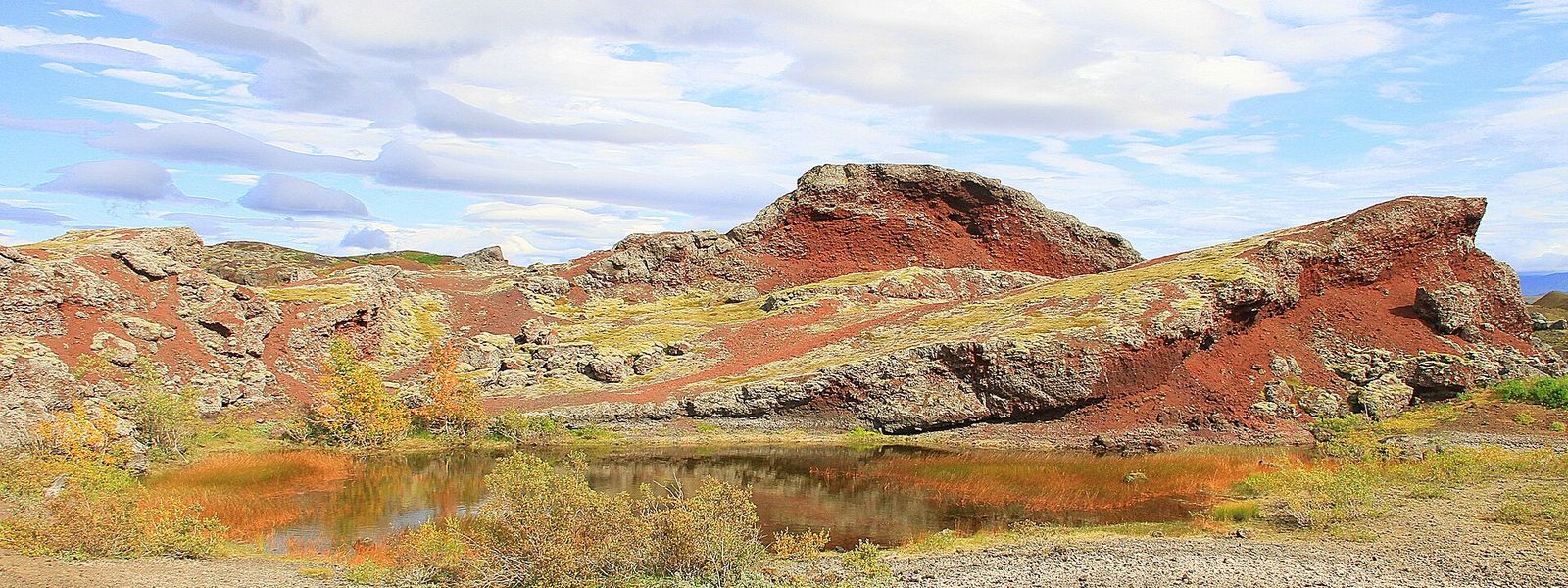
Over 100 craters stood here once; most were dug away for gravel around the Second World War and went into Reykjavík Airport and the city's roads.
- Entrance
- Free.
- Parking
- Free at the entrance
- Transport
- Just off Route 1 on the city's SE edge
- Hours
- Open 24 hours, every day.
What makes it special
The colour is the point. Red scoria stands against green moss, and the contrast holds through the year. The mounds are scoria — loose, crumbly rock rather than solid stone — and some carry more than one crater on the same hill. Scientists counted 150 cones here at the start of the twentieth century. The largest was 212 m across and rose 22 m above the lava around it. Horses are ridden between the mounds. The overall effect is closer to another planet than to a city park.
Good to know
- Horses have right of way. Riders use this ground. Step aside and let them pass.
- Dung on the ground. Horses are ridden here and leave it behind. Wear boots you can rinse off, not trainers.
- A stop, not an outing. The mounds lie right off the main road and work as a quick stop rather than a destination of their own.
Getting there
Rauðhólar sit on the south-eastern outskirts of Reykjavík, between Suðurlandsvegur — the south Iceland leg of the Ring Road — and the lake Elliðavatn, with the Norðlingaholt district close by. The mounds are right off the main road, which is why most people take them as a stop on the way in or out of the city rather than a trip of its own. Horse riders use the same ground, so expect to share it.
Best time to visit
Best: clear weather, late in the day towards sunset. Avoid: flat grey cloud.
The red only shows when there is light on it. At sunset the low sun deepens it and the landscape looks stranger still. The contrast between red scoria and green moss holds all year, so winter is no reason to skip the place.
Access & restrictions
Rauðhólar are protected as part of Heiðmörk, the nature reserve on the south-eastern edge of Reykjavík. What is left of the cones is a conservation area, not a gravel pit. Leave the drone behind: horses are ridden through the mounds, and a drone in the air frightens them.
Sun & daylight
Nearby Places


Similar Places



Rauðhólar Craters on the map
The scoria slopes are loose and crumble underfoot — stay on the worn paths, both for your ankles and for the protected cones themselves.
Get directions

Your whole travel map in one place
Get inspired by new places around the world and find the ones worth the journey
Frequently asked questions
What exactly are the Rauðhólar?
Rootless cones, also called pseudocraters. They were built by steam explosions where the Elliðaárhraun lava flow ran over a shallow lake about 5,000 years ago. They have no direct connection to a magma reservoir below.Why are the mounds red?
Iron in the rock has oxidised. The name Rauðhólar means Red Mounds. Against the green moss on the lava the red reads strongly, and the contrast is there in every season.Is it worth coming in winter?
The colour holds all year round, so the main sight does not go away. What changes is the light: the red needs some sun on it, and under flat cloud the mounds look dull.Where else in Iceland can you see rootless cones?
They are common in Iceland. Other well-known groups are Skútustaðagígar at the lake Mývatn in the north, Landbrotshólar near Kirkjubæjarklaustur and Álftaversgígar on Mýrdalssandur. Outside Iceland the formation is rare, and similar structures have been identified on Mars.