Þrístapar is a group of three hillocks in Húnavatnshreppur, in Northwest Iceland. The last execution in Iceland took place here in January 1830, when Agnes Magnúsdóttir and Friðrik Sigurðsson were beheaded for murder. Two stakes on the hill mark the spot. Information plaques set out the killings, the sentence and the abolition of capital punishment in Iceland. Nothing is staged and nothing is reconstructed: the visit is the ground itself and the reading.
Þrístapar
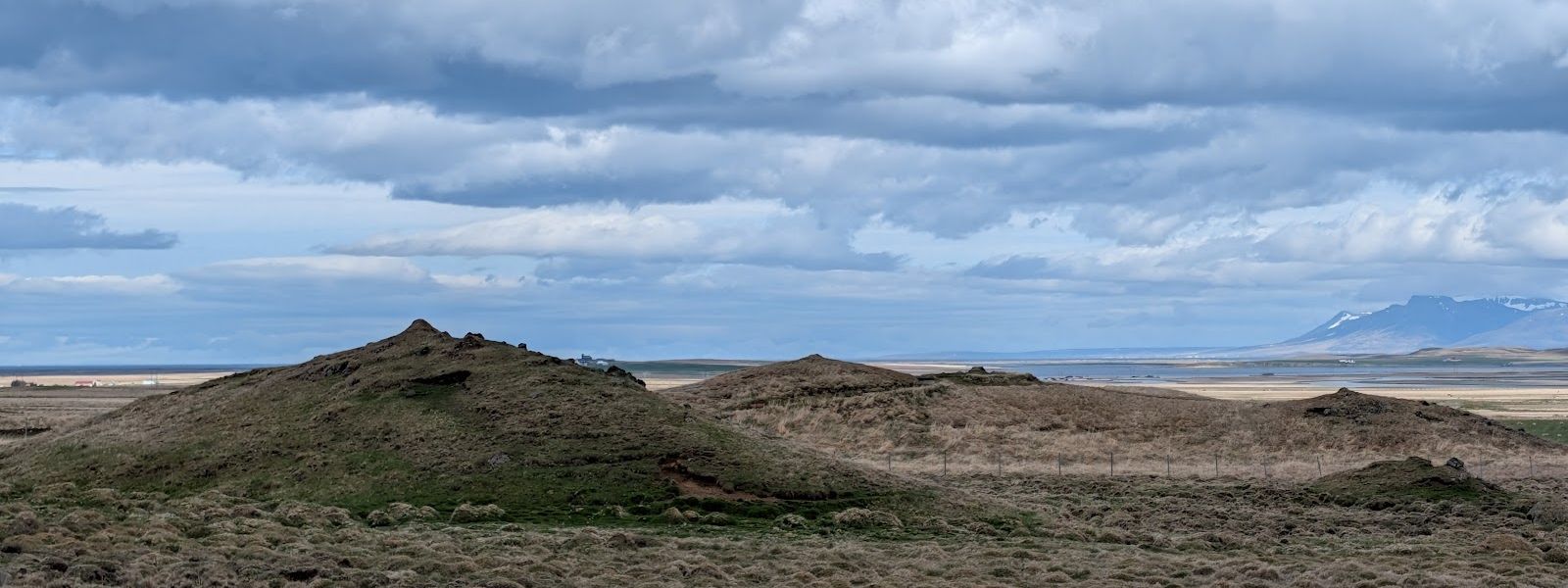
The last execution in Iceland was carried out on these hillocks in January 1830, and two stakes still mark the spot.
- Entrance
- Free, no entrance fee.
- Accessibility
- Wheelchair-accessible parking at the site.
- Parking
- Free car park at the site; roadside parking is free as well.
- Difficulty
- Easy — a few minutes' walk from the car park
- Hours
- Open 24 hours, every day.
- Address
- Vatnsdalshólar, off Route 1, 541 Húnabyggð
What makes it special
The exhibit here is text. A run of information plaques covers the killings at Illugastaðir, the trial, the execution of 1830 and the later abolition of the death penalty in Iceland. Walk up the hillock and you stand on the execution site, marked by two stakes. A QR code on site leads to more material on the case.
Hannah Kent's novel Burial Rites is built on the same events, told from the side of Agnes Magnúsdóttir, the last woman executed in Iceland. Readers of it recognise every name on the plaques. Without an interest in the history there is little to hold you here — the hillocks are grass, and the story is the whole of it.
Good to know
- Toilet: there is one on site and it is not free — around 300 ISK, payable by card.
- Everything is outdoors: the plaques stand in the open, on and around the hillock. Bring a windproof jacket.
- Photograph the QR code: it leads to further material on the case, which you can read later.
- Read first if you can: Hannah Kent's Burial Rites is based on these events and gives the plaques context.
- Not a viewpoint: with no interest in the history, there is little here beyond the hillocks and the toilet block.
Getting there
Þrístapar is reached by car. The site lies in Húnavatnshreppur, in Northwest Iceland, and has its own car park. From there the visit is on foot: the plaques are read along the way, and the execution site with its two stakes is up the hillock. There is no building to go into, so the walk is the visit.
Best time to visit
Better: in daylight, with enough time to read every plaque.
Avoid: the dark hours of midwinter.
The site is open at all hours, but the whole visit consists of reading outdoors. How much daylight you have decides how much you take away from the stop.
Sun & daylight
Nearby Places


Similar Places



Your whole travel map in one place
Get inspired by new places around the world and find the ones worth the journey
Frequently asked questions
What happened at Þrístapar?
The last execution in Iceland took place here in January 1830. Agnes Magnúsdóttir and Friðrik Sigurðsson were beheaded for the murders at Illugastaðir. Agnes was the last woman executed in Iceland.Is there a toilet on site?
Yes, and it is not free. Use costs around 300 ISK and can be paid by card.What is there to see apart from the plaques?
The hillocks themselves and the execution site on top, where two stakes stand. The plaques carry the story of the case, the sentence and the abolition of the death penalty in Iceland.Should I read Burial Rites before coming?
It helps. Hannah Kent's novel is based on these events, and the plaques cover the same names and places. The site also carries a QR code with more material on the case.