Víðgelmir is a lava tube in the Hallmundarhraun lava field in West Iceland, about 2 km from the Fljótstunga farm in Borgarfjörður. It is 1,585 m long, and the largest part of the passage is 15.8 m high and 16.5 m wide, which makes it the biggest cave of its kind in the country. The lava flow that formed it erupted around 900 AD. Víðgelmir is visited on guided tours only, which follow a boardwalk several hundred metres in, past lava formations and the colours left in the walls by the cooling flow.
Víðgelmir Cave
Local name: Víðgelmir
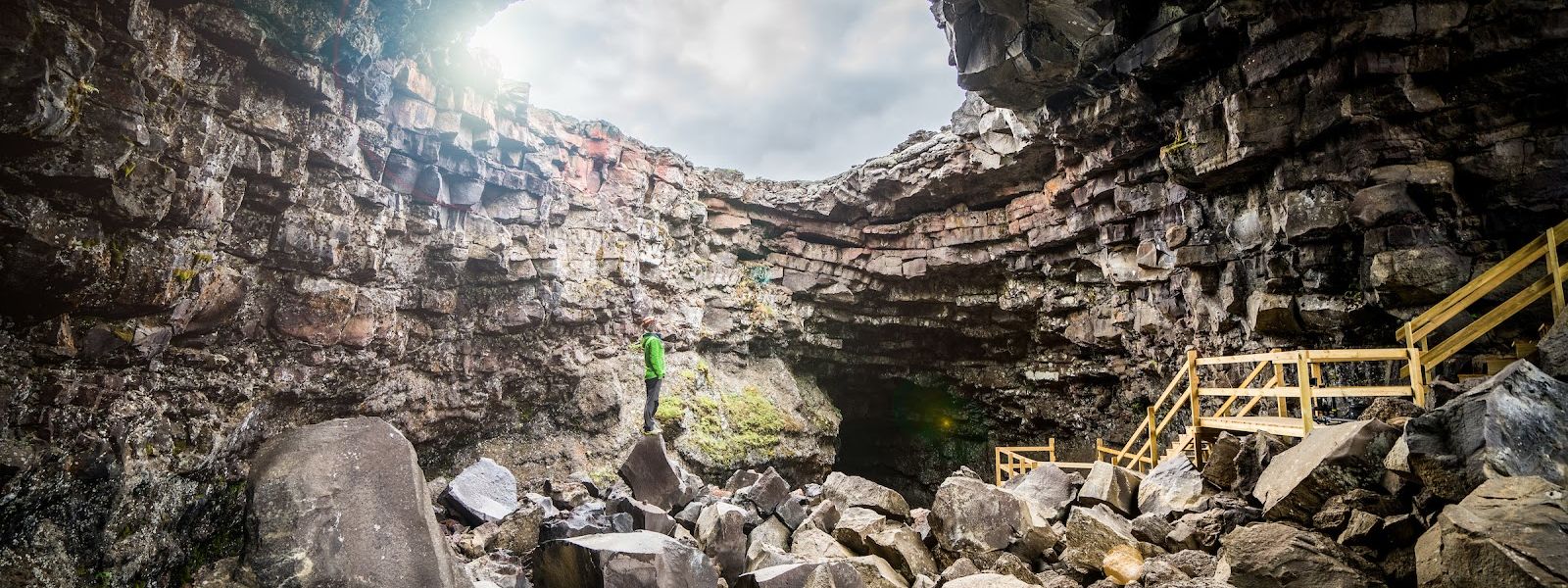
Evidence of human habitation, probably from the Viking Age, was found on the floor of the cave and is now kept in the National Museum of Iceland.
- Entrance
- Paid — guided tour only
- Accessibility
- The entrance is not wheelchair accessible.
- Parking
- Free car park at the site.
- Difficulty
- Easy. A boardwalk covers almost the whole route inside, with one short stretch where you have to duck.
- Transport
- Self-drive to Fljótstunga (beyond Húsafell)
- Advance booking
- Recommended — book the tour
- Hours
- Daily 9:00–18:00.
- Address
- Fljótstunga, 320 Reykholt
What makes it special
The numbers are the point here. Víðgelmir runs 1,585 m through the Hallmundarhraun lava field, and at its widest the passage stands 15.8 m high and 16.5 m across. That makes it the largest lava tube in Iceland by a wide margin.
The lava that formed it erupted around 900 AD, so the cave is about as old as the settlement of Iceland, and people used it. Evidence of human habitation, probably from the Viking Age, was found inside and is now kept in the National Museum of Iceland.
The roof collapsed near the north end of the tube. The two openings it left are the only known way in. Tours follow a boardwalk several hundred metres inside, past lava formations and the colour bands left in the walls by the cooling flow, then return the same way.
Good to know
- Dress for cold. The air inside is cold, and the walk from the warming station to the entrance is cold and windy. Warm layers, hat, gloves.
- Rings and small valuables go in a zipped pocket. Anything dropped on the lava floor is hard to retrieve.
- One low stretch. For a short section you duck; the rest of the route is open and walked on a boardwalk.
- Toilets at the site, and cards are accepted, including contactless.
Getting there
Víðgelmir lies about 2 km southeast of the Fljótstunga farm in Borgarfjörður, West Iceland. A visit starts at Fljótstunga: access to the cave and the guided tours are arranged there, and the car park is at the site. The last stretch is on foot, from the warming station to the collapsed openings that form the cave entrance. It is out in the open and it is cold and windy, so put your jacket on before you set off rather than halfway.
Best time to visit
Best: a wet or windy day. The tour is underground and goes ahead whatever the sky is doing, which makes Víðgelmir one of the few things in Borgarfjörður that bad weather does not spoil.
Avoid: the middle of the day, if you would rather walk with a small group. Later tours tend to be quieter.
Access & restrictions
Víðgelmir is a gated cave. An iron gate was fitted at the first constriction in 1991, to preserve the delicate lava formations that had not already been destroyed, and it still closes the cave to unaccompanied visitors. Beyond the gate you go with a guide, on a tour arranged at Fljótstunga.
Things to do nearby
All tours in West Iceland on GetYourGuide
Paid links: booking through them supports YowJourney.
Sun & daylight
Nearby Places


Similar Places

Víðgelmir Cave on the map
Long stretches of the cave floor are very rough broken lava. Do not go past the gate without a guide.
Get directions

Your whole travel map in one place
Get inspired by new places around the world and find the ones worth the journey
Frequently asked questions
How long does the tour take?
Around an hour and a half. Tours walk several hundred metres into the cave and come back the same way, so only part of the 1,585 m passage is on the route.Can you go into Víðgelmir on your own?
No. An iron gate has closed the passage at the first constriction since 1991, and the floor beyond it is rough. Access and guided tours are arranged at Fljótstunga.How hard is the walking?
Not hard. A boardwalk runs along almost the whole route, with one short stretch where you duck and one place where temporary boards were laid over water. No particular fitness is needed.Is it suitable for children?
Yes. The route is on a boardwalk and asks nothing of you physically, and there are toilets at the site. Dress children for cold, as you would dress yourself.