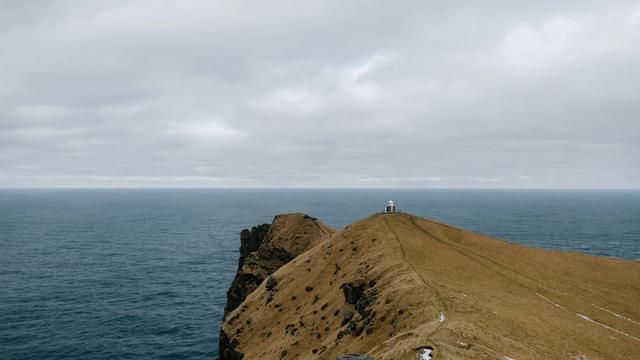
Grímsey is a small island 40 km off the north coast of Iceland, straddling the Arctic Circle. It covers 5.3 square kilometres and rises to 105 metres, with steep cliffs on every side except the south-west. The one settlement, Sandvík, has around 60 residents and lives mainly on commercial fishing. Seabirds breed on the cliffs in numbers that earned the island Important Bird Area status: Atlantic puffins, razorbills, common murres and black-legged kittiwakes. Most visitors come for the Arctic Circle marker near the northern tip.
Grímsey

- Currency
- Icelandic króna (ISK)
- Language
- Icelandic; nearly all speak English
- Power plug
- Europlug and Schuko sockets, 230 V
- Visa
- Schengen; outside the EU
- Time zone
- UTC±00:00 (Atlantic/Reykjavik)
- Tap water
- Safe; hot water smells of sulphur
- Tipping
- Not customary
- Emergency
- 112
Things to do
All tours in Northeast Iceland on GetYourGuide
Paid links: booking through them supports YowJourney.
When to go
Shoulder
Apr – May
Daylight increases quickly, and by late May there is barely any darkness at this latitude. The island is treeless: grass, moss and marshland, and nothing to break the wind.
High season
Jun – Aug
Around midsummer the sun barely sets on the Arctic Circle, and the seabird colonies are on the cliffs. Dress for cold anyway. No month here averages a daily mean above 10 °C, and the record high, set in July 1955, is 22.2 °C.
Shoulder
Sep – Oct
Days shorten fast and the seabird breeding season is over. The ferry and the flights keep running, and they set the shape of any visit.
Low season
Nov – Mar
Around the winter solstice the sun hardly clears the horizon and daylight lasts a few hours. Grímsey works through the winter as a fishing island, with few visitors.
How long to stay
A day on foot covers the island: the Arctic Circle marker at the northern tip, the bird cliffs and Sandvík. The ferry timetable usually decides the rest. It sails three to five days a week, so returning the same day is not always possible, and one night often makes the simpler plan. There are two small hotels and a campsite.
Getting around
There are two ways in. A ferry from Dalvík runs three to five days a week, and Grímsey Airport on the west side of the island has regular flights to Akureyri. Check the ferry days before you plan: on the days it does not sail, the plane is the only way off the island.
Once ashore, nothing needs a car. The island is 5.3 square kilometres, and Sandvík sits on the south-western shore, so the Arctic Circle marker near the northern tip is a walk from the settlement. Cliffs line the whole coastline except that south-western side.
What to see

Destinations in Grímsey
Frequently asked questions
Does the Arctic Circle really cross Grímsey?
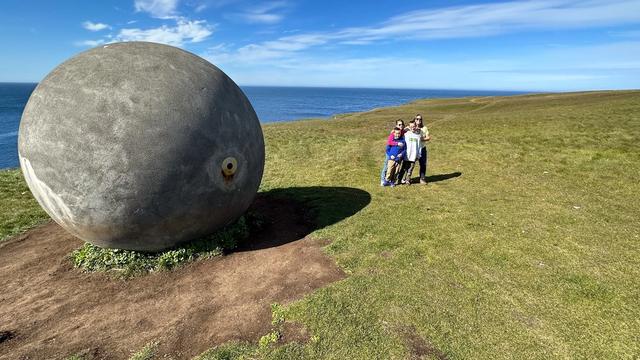
Yes, and it is the only accessible point in Iceland that far north. The line is moving north by about 14.5 metres a year, so as of 2020 it lay close to the northern tip. Four permanent markers record its historical positions in 1717, 1817 and 1917. In 2017 an eight-tonne stone sphere, Orbis et Globus, was placed on the line and is rolled to the corrected spot from time to time. The circle will leave the island around 2047, and the plan is to roll the sphere into the ocean.How do you get to Grímsey?
By ferry from Dalvík, three to five days a week, or by air. Grímsey Airport lies on the west side of the island and has regular flights to Akureyri, on a 1,036-metre north–south runway.Can you see puffins on Grímsey?
The cliffs hold breeding colonies of Atlantic puffins, razorbills, common murres and black-legged kittiwakes, and BirdLife International has designated the island an Important Bird Area. Gulls and Arctic terns nest here too.What is there in Sandvík?
Sandvík is the island's only settlement, on the south-west shore. It has a shop, a library, a community centre, a public indoor swimming pool and a school up to grade 8; older pupils go to Akureyri. There are also two small hotels, a campsite and a nine-hole disc golf course. The island is not connected to the Icelandic grid, and a 12 kW solar array and a 36 kW wind turbine were installed in 2022 to cut its use of diesel.Is there a church on the island?
Yes. The old Midgard church, built of driftwood in 1867, burned down in September 2021. The New Midgard Church was consecrated on 10 August 2025, after a long reconstruction; the bells of Hallgrímskirkja in Reykjavík were rung as the ceremony began.