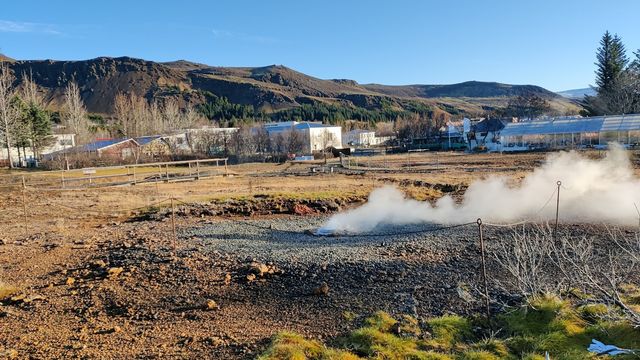
Hveragerði is a town of about 3,300 people in southern Iceland, on Route 1 some 45 km east of Reykjavík. It stands within the Hengill volcanic system, and the ground beneath it is hot. Hot springs and fumaroles vent inside a fenced field in the centre, and steam drifts from the hills to the north. That heat has warmed houses since 1929 and greenhouses since 1923, making the town a centre of Icelandic horticulture. Minor earthquakes are frequent; a magnitude 6.3 quake damaged buildings here in 2008.
Hveragerði

- Currency
- Icelandic króna (ISK)
- Language
- Icelandic; nearly all speak English
- Power plug
- Europlug and Schuko sockets, 230 V
- Visa
- Schengen; outside the EU
- Time zone
- UTC±00:00 (Atlantic/Reykjavik)
- Tap water
- Safe; hot water smells of sulphur
- Tipping
- Not customary
- Emergency
- 112
Things to do
All tours in Hveragerði on GetYourGuide
Paid links: booking through them supports YowJourney.
When to go
High season
Jun – Aug
Daylight lasts almost the whole night, so the geothermal park and the streets can be walked late in the evening. Route 1 into town is clear of snow.
Shoulder
Sep – Oct
Daylight shortens quickly and the cold sets in. The heated greenhouses and the swimming pool work regardless of the weather.
Low season
Nov – Mar
Days are short, a few hours around midwinter, and snow and ice are normal on Route 1. The town is compact enough to cross on foot in any weather.
Shoulder
Apr – May
Light returns fast and the ring road clears, while snow lingers on the hills north of the town where the steam plumes rise.
How long to stay
Half a day covers the town. The geothermal park, the art museum and the swimming pool sit within a few streets of one another, so the walking between them takes minutes rather than hours. Stay a night if you are breaking the drive east from Reykjavík, or if you want a swim before the day starts. Most visitors stop here on the way along Route 1 and move on the same day.
Getting around
Everything in Hveragerði can be reached on foot. The municipality covers nine square kilometres and is the third smallest in Iceland, and the church, the geothermal park, the swimming pool and the shopping centre stand within a few streets of one another. The town sits directly on Route 1, the ring road, 45 km east of Reykjavík, so arriving by car is straightforward. Bus 51 runs from Reykjavík; check the current timetable before you travel. A car is unnecessary inside the town and necessary for anything beyond it.
What to see

Destinations in Hveragerði
Frequently asked questions
How far is Hveragerði from Reykjavík?
45 km east, on Route 1, Iceland's ring road. Driving is the simplest way in. Bus 51 also runs from Reykjavík.Why does the middle of the town steam?
Hveragerði stands on the Hengill central volcano and the ground under it is geothermally active. A fenced field in the town holds numerous hot springs and fumaroles, and the park around them (Hveragarðurinn) has information boards explaining what is happening underfoot. Steam also drifts from active areas in the hills to the north. Stay outside the fence.What are the greenhouses for?
Mainly flowers. They are heated with hot water from the volcanic springs, the first one was built in 1923, and the town has been a centre of Icelandic horticulture ever since. Several garden shops sell the plants grown in them.Does Hveragerði get earthquakes?
Yes, very frequently, and almost always minor ones. A magnitude 6.3 earthquake on 29 May 2008 injured people and damaged many buildings in the town and around it; an exhibition about it, Skjálftinn 2008, is in the Sunnumörk shopping centre. The hot spring by the church, Sandhólshver, was formed by the South Iceland earthquake of 1896.Is there a swimming pool?
Laugaskarð, one of the two largest swimming pools in Iceland, level with Laugardalslaug in Reykjavík.