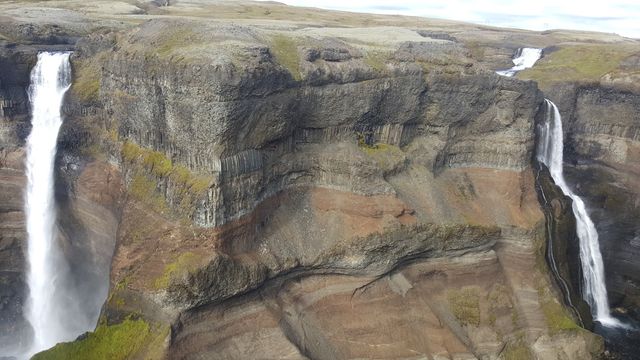
Háifoss is a waterfall in South Iceland, near the volcano Hekla. The river Fossá, a tributary of the Þjórsá, drops 122 m into a canyon here. That makes Háifoss the fourth highest waterfall in the country, after Morsárfoss, Glymur and Hengifoss. A second waterfall, Granni, falls beside it. Deep canyon walls and bare rock formations frame the drop, and a trail runs from the rim down to the foot of the falls. Reaching the site requires a 4x4.
Háifoss

The Fossá drops 122 m here — the fourth highest waterfall in Iceland — with a second fall, Granni, coming down alongside it.
- Entrance
- Free
- Accessibility
- No wheelchair-accessible parking or entrance.
- Parking
- Free car park above the waterfall.
- Difficulty
- Trail from the top of the falls to the bottom: demanding in places, not extreme. Route in from Stöng along the Fossá: 5–6 hours there and back.
- Transport
- 4x4 only — a rough gravel track off Route 32
- Hours
- Open 24 hours.
- Address
- Háafossvegur, 804
What makes it special
The drop is the point. The Fossá falls 122 m into a canyon here, and only three waterfalls in Iceland are higher. A second waterfall, Granni, comes down beside it, so both are in view from the same spot.
The rim is bare ground. There are no guard rails and no viewing platforms, and in good weather the falls throw large rainbows across the gorge. The walk down into the canyon changes the view completely: from the bottom you see the fall at full height against the walls, and the wind is weaker there than at the top. The rock formations along the canyon are worth the descent on their own.
Good to know
- Access road: 4x4 only, and potholed. Go slowly.
- Navigation: Google Maps can route you onto the rougher track. The approach on road 332, past Gljásteinn Hostel, is bumpy but manageable.
- No barriers: there are no guard rails and no viewing platforms at the rim.
- Wind: gusts at the top viewpoint can knock you off your feet. Lower in the canyon they ease off.
- Rainbows: in good weather large rainbows form over the falls.
Getting there
Nearly everyone drives. The access road is 4x4 only and potholed, so allow extra time for the last stretch. The car park sits above the waterfall, and a trail leads from the top of the falls down to the bottom — demanding in places, but nothing extreme. The other way in is on foot from the reconstructed farm Þjóðveldisbærinn Stöng, following the Fossá: five to six hours there and back.
Best time to visit
Better: a clear, calm day. In good weather the falls throw large rainbows, and the canyon walls and rock formations show clearly.
Avoid: windy days. The rim is unfenced, and gusts on the top viewpoint have been strong enough to put visitors on their knees.
Wind eases as you descend into the canyon, so the view from the bottom can still work on a rough day, even when the top is unusable.
Sun & daylight
Nearby Places


Similar Places
Featured in our guides
Háifoss on the map
There are no guard rails and no viewing platforms at the top of Háifoss. Wind at the rim can be strong enough to knock a person off their feet — visitors have had to drop to their knees on the viewpoint. Keep well back from the edge.
Get directions

Your whole travel map in one place
Get inspired by new places around the world and find the ones worth the journey
Frequently asked questions
How high is Háifoss?
The Fossá drops 122 m. That makes Háifoss the fourth highest waterfall in Iceland, after Morsárfoss, Glymur and Hengifoss.Do you need a 4x4 to get there?
Yes. The access road is 4x4 only. Any 4x4 will do, but the surface is potholed and bumpy, so drive it slowly.Can you walk down to the foot of the falls?
Yes. A trail runs from the top of the waterfall to the bottom. It is demanding in places but not extreme, and the view from below is a completely different one.Is there a hiking route to Háifoss?
There is. From the reconstructed farm Þjóðveldisbærinn Stöng, destroyed by an eruption of Hekla in the Middle Ages, a route follows the Fossá to the waterfall: five to six hours there and back.Are the viewpoints fenced?
No. There are no guard rails or viewing platforms anywhere at the falls, and the wind at the rim can be violent.