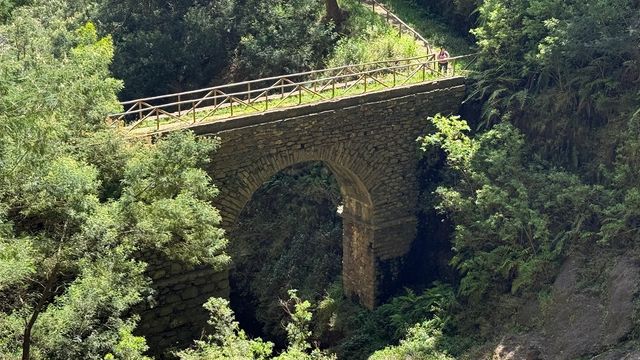
Ponte de Roma is an old stone bridge on Madeira, Portugal, reached on foot along a footpath in the hills. It sits on a circular route of about 9 km that also runs beside a levada and crosses a Tibetan rope bridge above the ravine. The bridge is a place to stop and sit rather than a viewpoint, and the walk in is much of the reason people come. The path turns very slippery in rain and in cold weather, and part of the route has been blocked off.
Ponte de Roma

The bridge is one stop on a circular walk of about 9 km that also follows a levada and crosses a Tibetan rope bridge.
- Accessibility
- Not wheelchair accessible: no step-free entrance and no accessible parking, and the bridge is reached on a footpath.
- Parking
- No car park at the bridge. The nearest mapped parking is about 700 m away, free but signed for customers; a second, asphalted one lies about 1.3 km away.
- Difficulty
- On foot along a footpath. The full circuit past the levada and the Tibetan bridge runs about 9 km and is poorly maintained in places; the path is very slippery in rain and cold, and a section has been blocked off.
- Transport
- Nearest bus stop: João Frino-Depois Cabeço, about 1.5 km from the bridge.
What makes it special
An old stone arch in the hills, quiet by the time you reach it. Most walkers meet it as one stop on a circular route of about 9 km that also follows a levada and crosses a Tibetan rope bridge above the ravine. Handsome in stretches, rough in others: the loop sees little use, and the state of the path shows it. At the bridge the sound is water under the arch and wind in the trees, with moss thick on the stonework and the ravine walls closing in on both sides. Warm, dry weather is what makes the walk work — in rain or cold it becomes a different proposition altogether.
Good to know
- No facilities: no toilets at the bridge, and none mapped within 800 m; no drinking water either.
- Footwear: the path is very slippery in rain and in cold weather — one visitor found good hiking shoes were not enough.
- The loop: the 9 km circuit is poorly maintained in places, and a section of the path has been blocked off.
- Quiet: the route sees little use, so expect few other walkers and little help if something goes wrong.
Getting there
Nearly everyone arrives by car, and the last stretch is on foot along a footpath. Google's routing is the trap here: one visitor was sent to park high above and well away from the bridge, and recommends taking the road named Madre d'Água instead. An information board for the Vereda do Arvoredo stands on the approach and is a useful sign you are on the right line. The same footpath turns very slippery in rain and in cold weather.
Best time to visit
Best: warm, dry weather.
Avoid: rain and cold.
The path decides the visit. It turns very slippery when wet, and one visitor who came in the cold found good hiking shoes were not enough and would only recommend the walk in warm weather. Dry ground also makes the rougher, poorly maintained stretches of the loop far less of a problem.
Sun & daylight
Nearby Places


Similar Places

Ponte de Roma on the map
The path turns very slippery in rain and in cold weather, and good hiking shoes on their own are not enough. Part of the route has been blocked off.
Get directions

Your whole travel map in one place
Get inspired by new places around the world and find the ones worth the journey
Frequently asked questions
How long is the circular walk past Ponte de Roma?
About 9 km for the full loop, taking in the bridge, the levada and the Tibetan rope bridge. It is beautiful in stretches but poorly maintained in others, largely because it is rarely walked.How hard is the path to the bridge?
It is a footpath, and its condition swings with the weather. In rain and in cold it turns very slippery — one visitor found good hiking shoes were not enough — and a section of the route has been blocked off.Can you get there by public transport?
Not to the bridge itself. The nearest bus stop, João Frino-Depois Cabeço, is about 1.5 km away, and almost everyone drives instead.Are there toilets at Ponte de Roma?
No. There are no toilets at the bridge and none mapped within 800 m of it, and no drinking water either. Sort both out before you set off.