Snæfellsjökull National Park covers the western tip of the Snæfellsnes peninsula in West Iceland. It was established in 2001 and takes in about 167 square kilometres of lava fields, black-sand beaches, rock formations and coastline. At its centre stands Snæfellsjökull, a glacier-capped stratovolcano roughly 700,000 years old. The mountain is the way underground in Jules Verne's Journey to the Center of the Earth. Most people see the park by driving the peninsula road and stopping at the pullouts.
Snæfellsjökull National Park
Local name: Þjóðgarðurinn Snæfellsjökull
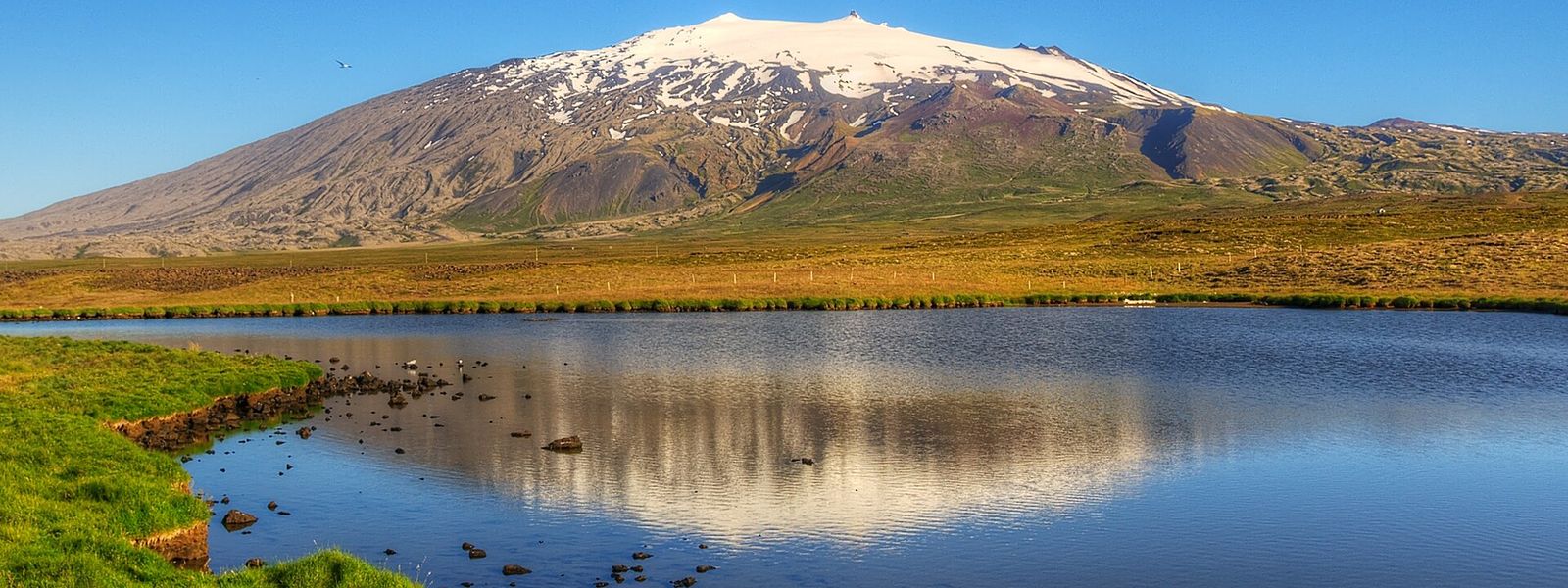
In Jules Verne's Journey to the Center of the Earth the passage to the centre of the Earth opens on Snæfellsjökull.
- Entrance
- Free
- Parking
- Free car park.
- Difficulty
- Summit route: in summer the saddle near the summit is reached on foot; the glacier is crevassed, and the true summit requires technical ice climbing.
- Transport
- Self-drive (peninsula loop road)
- Hours
- Open year-round
- Address
- 360 Hellissandur (visitor centre)
What makes it special
The beaches here are black sand, and an old shipwreck lies out on the shore. Behind them rises Snæfellsjökull, a stratovolcano about 700,000 years old under a shrinking ice cap: 16 km² of ice in 1946, 10–11 km² by 2008, and in August 2012 the summit was ice-free for the first time in recorded history. The coast road runs past a string of pullouts, and each one opens onto something different — lava field, cliff, beach, crater. The peninsula gets called Iceland in miniature, and the label holds up. Two days spent here still leave most of it unseen.
Good to know
- Wind: it blows around the clock here, and the weather can turn from pleasant to impossible within an hour.
- Clothing: waterproof, not water-repellent — jacket, over-trousers, gloves, hat and hiking boots with good tread.
- Roads: a warning sign stands at the park entrance, and the roads inside are rocky. A 4x4 handles them better.
- Time: driving the peninsula fills a long day, and two days still leave most of the park unvisited.
- Dogs and children: dogs are allowed, and the park works as an outing with children.
Getting there
The park sits at the western end of the Snæfellsnes peninsula, and people reach it by car. The peninsula road is the way in, and the sights are reached from pullouts along it. Inside the park the roads are rocky, and a warning sign stands at the entrance — a 4x4 is the sensible choice. Driving the peninsula fills a long day, and that is before stopping properly at any of the pullouts.
Best time to visit
Best: early morning or evening; summer, if the glacier is the point of the trip.
Avoid: squeezing the whole peninsula into one hurried stop.
Early and late the light is low and the road is quieter. In summer the saddle near the summit can be walked, and several companies run guided trips during the season. Wind blows year-round and the weather changes by the hour, so how much time you set aside matters more than the date.
Sun & daylight
Nearby Places


Similar Places

Snæfellsjökull National Park on the map
The glacier is crevassed. In summer the saddle near the summit can be reached on foot, but the crevasses have to be avoided, and the true summit requires technical ice climbing. Wind is constant and the weather can turn within an hour: carry waterproof gear, not water-repellent gear.
Get directions

Your whole travel map in one place
Get inspired by new places around the world and find the ones worth the journey
Frequently asked questions
Can you walk up Snæfellsjökull?
In summer the saddle near the summit is reached on foot, though the glacier's crevasses have to be avoided. Several tour companies run guided walks during the season. The true summit requires technical ice climbing.Do you need a 4x4?
The roads inside the park are rocky, and a warning sign stands at the entrance. A 4x4 is the safer vehicle for them.How much time does the park need?
Driving the peninsula fills a long day. Two days here still cover only a fraction of what lies along the coast, and each pullout is worth a longer stop than the schedule allows.Can you bring dogs and children?
Dogs are allowed, and the park works as an outing with children. Both need proper wind and rain gear, since the weather can change within an hour.Can Snæfellsjökull be seen from Reykjavík?
Sometimes. The mountain stands about 120 km away across Faxa Bay and shows up from the city on clear days. On 17 July 1939 an arctic mirage carried it far further: a ship's captain sighted it from more than 500 km away.