Þeistareykir is a volcanic system in Þingeyjarsveit, north-eastern Iceland, rising to 564 metres. It takes in two fissure vents, Þeistareykjahraun and Borgahraun, and two cones, the 370-metre Stórahversmór and the 540-metre Stóravíti. Long classed as the shield volcano Theistareykjarbunga, it is now read as an embryonic central volcano with a fissure swarm. At its centre is a high-temperature geothermal area of steam vents and fumaroles, tapped by a 90 MWe power station. The last eruption was around 900 BCE.
Þeistareykir
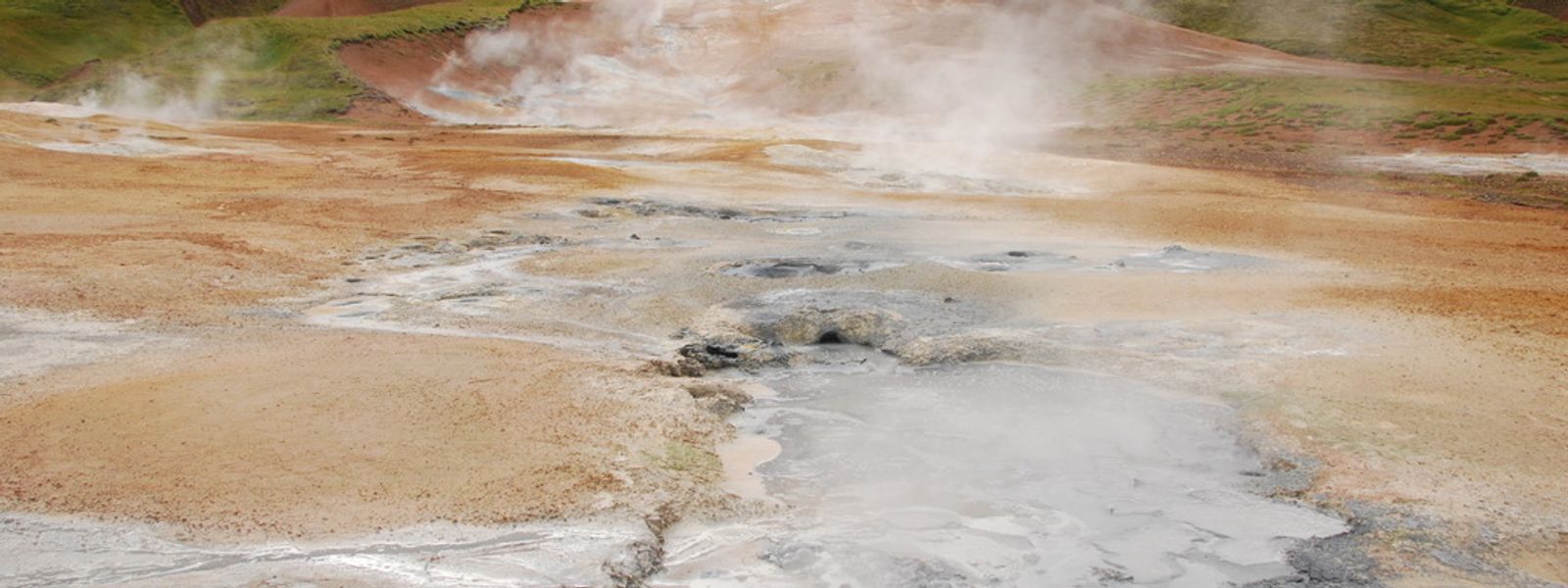
The last eruption here was around 900 BCE; the same heat now runs a 90 MWe power station.
- Entrance
- Free
- Parking
- Free, by the ramblers' hut
- Difficulty
- Easy to reach by car, but unfenced boiling ground demands care
- Transport
- Paved road (2WD) from Húsavík; gravel link from Route 87
- Address
- Þeistareykir, 641
What makes it special
Steam comes straight out of the ground here, and nothing is fenced. Þeistareykir is a high-temperature geothermal area of steam vents and fumaroles, sitting in a volcanic system whose cones are extinct but whose heat is not. That heat is in use: a 90 MWe power station draws on the field, and industrial buildings stand in the middle of the view.
Mass tourism has not reached it. Having the whole field to yourself is the normal experience, in high summer as much as in spring. The absence of barriers is the character of the place and its risk at the same time — no railings, no marked route between the vents, and no one to tell you where the ground is safe.
Good to know
- Nothing is fenced. Steam vents and fumaroles open in bare ground, with no barriers and no marked route between them.
- This is a working geothermal site. A 90 MWe power station runs on the field, and its buildings are part of what you see.
- Expect rain. Cloud and rain are the normal weather here, and hail falls even in midsummer. Bring waterproofs whatever the month.
- Some come away disappointed. One visitor in 2026 found the plant had taken the place over and thought there was nothing left to see.
Best time to visit
Better: a dry day with cold, still air, when the steam from the vents stands up clearly instead of shredding sideways.
Avoid: planning around summer sunshine. Cloud and rain are the usual weather here, and hail falls even in midsummer.
Crowds play no part in the decision. Mass tourism has not found the field, and being alone on it is the normal experience — in August as much as in late April, before the sheep are let out onto the mountain.
Sun & daylight
Nearby Places



Similar Places


Þeistareykir on the map
There are no fences. Steam vents and fumaroles open directly in the ground, with no barriers and no marked route between them. Watch every step and keep children in hand.
Get directions

Your whole travel map in one place
Get inspired by new places around the world and find the ones worth the journey
Frequently asked questions
Is Þeistareykir still an active volcano?
The two cones, Stórahversmór and Stóravíti, are classed as extinct. The ground is not quiet, though: there is recent localised uplift and seismicity, and a high-temperature geothermal system underneath.When did it last erupt?
Around 900 BCE. The eruption before that was in 6800 BCE, and one around 9500 BCE produced roughly 18 billion cubic metres of basaltic lava. All three dated eruptions were VEI-0.Is the geothermal area fenced off?
No. The steam vents and fumaroles sit in open ground with no barriers. Nothing marks where it is safe to walk.Is there a power station on the site?
Yes. A 90 MWe power station uses the high-temperature field. One visitor in 2026 felt the industrial buildings had taken the interest out of the place.How busy does it get?
Very quiet. Mass tourism has not reached Þeistareykir, and having the field to yourself is normal in summer and in spring alike.