Tvísöngur stands on the hillside above Seyðisfjörður in East Iceland. German artist Lukas Kühne built it in 2012: five interconnected concrete domes of different heights and widths, each with its own resonance. Openings in the walls let you step inside, where a voice comes back amplified. The name comes from an Icelandic twin-singing tradition sung in parallel fifths. Reaching it means a walk uphill from a car park at sea level, with the fjord and the town in view behind you.
Tvísöngur Sound Sculpture
Local name: Tvísöngur
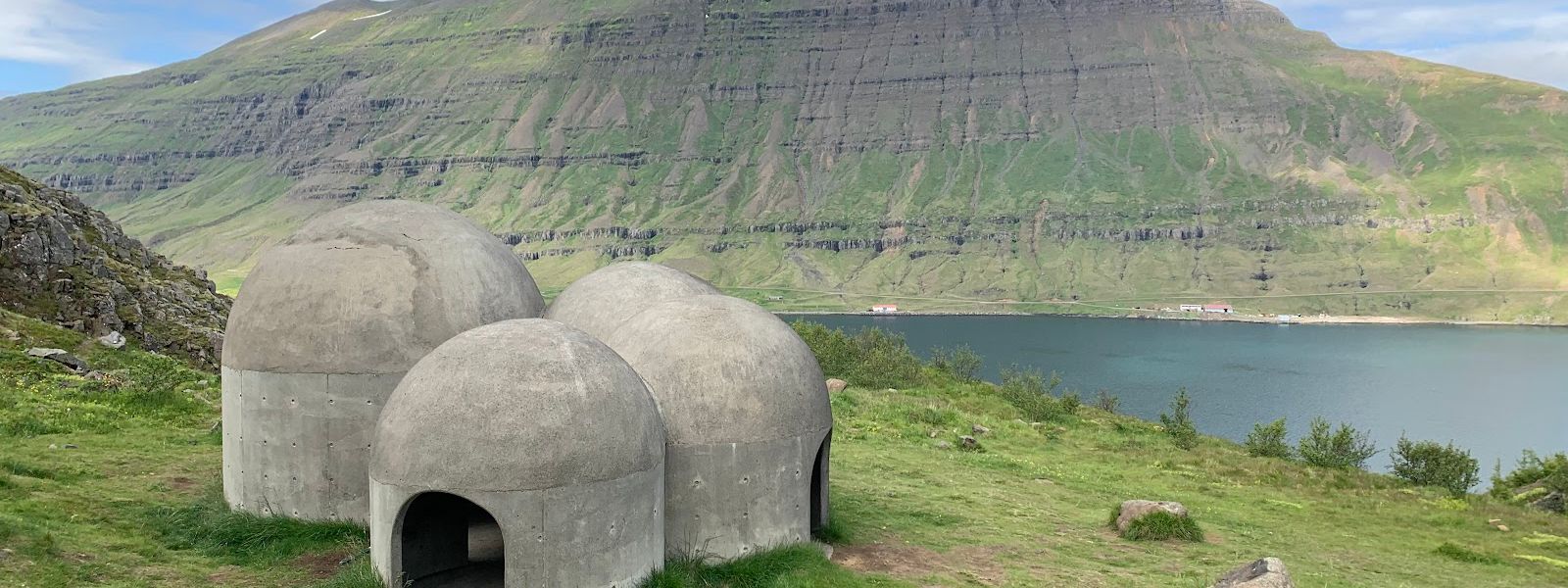
The five domes answer to the five tones of tvísöngur, the Icelandic twin-singing style in parallel fifths that goes back to the Middle Ages and is still taught in schools.
- Entrance
- Free
- Accessibility
- Not wheelchair accessible: the entrance is not step-free, and the only approach is an uphill walk from the car park.
- Parking
- Dedicated car park at sea level, about 750 metres below the domes. The rest of the way is on foot.
- Difficulty
- About 750 metres uphill on foot, roughly 20 minutes up. The path crosses small waterfalls and wooded ground.
- Transport
- Self-drive to the car park below, then walk up
- Hours
- Open 24 hours, every day.
- Address
- 711 Seyðisfjörður
What makes it special
Five concrete domes sit on the open hillside above Seyðisfjörður, linked into one structure and built to different heights and widths. From outside they look plain. The point is inside: each dome carries its own resonance, and entry points in the walls let you step from one into the next. Sing a note in one of them and it comes back louder than you made it. Do not count on the wind to do that for you — waiting for it can leave you with silence. Not everyone hears a difference between the domes either. The hillside is part of the visit: the way up passes small waterfalls and wooded ground, and the fjord and the town lie below.
Good to know
- The domes need a sound source. Sing or play inside one. Waiting for the wind to set them off can leave you with silence.
- The route up crosses small waterfalls and wooded ground. Wear shoes you do not mind getting wet.
- The domes can sound alike. Each is built to its own resonance, but not everyone picks up the difference inside.
- The view is part of it. The fjord and the town open up behind you on the way up, not only from the domes themselves.
Getting there
The turn is off Route 952 at Seyðisfjörður, and a dedicated car park sits at sea level below the sculpture. From there it is about 750 metres uphill on foot, roughly 20 minutes. The path climbs past small waterfalls and through woodland. There is no way to drive closer.
Best time to visit
Better: clear weather, when the fjord and the town below are visible from the domes. Avoid: relying on the wind to make them sound.
The domes amplify sound made inside them, not around them. Bring a voice or an instrument and the acoustics work whatever the weather does.
Sun & daylight
Nearby Places

Similar Places
Tvísöngur Sound Sculpture on the map
The path up is steep, loose gravel and the mountainside is fully exposed — wear proper footwear and turn back if fog or strong wind closes in.
Get directions

Your whole travel map in one place
Get inspired by new places around the world and find the ones worth the journey
Frequently asked questions
What is Tvísöngur?
A sound sculpture on the hillside above Seyðisfjörður: five interconnected concrete domes of different heights and widths, built by German artist Lukas Kühne. Each dome has its own resonance.Can you go inside the domes?
Yes. There are entry points in the walls, and the domes are connected, so you can move from one into the next.Do the domes make sound by themselves?
No. They amplify sound made inside them. Sing or play something rather than waiting for the wind to do it.How long is the walk up?
About 750 metres uphill from the car park at sea level, roughly 20 minutes on foot.Where does the name come from?
From tvísöngur, or twin singing, an Icelandic style in which a melody is sung against itself in parallel fifths. It dates from the Middle Ages and is still taught in schools.