Eggin í Gleðivík stands on the old fish-loading dock in Djúpivogur, on the coast of East Iceland. Thirty-four granite eggs sit in a line on concrete plinths, each a scaled-up copy of the egg of a bird that nests in the area, with the species named in Icelandic and in Latin. The work is by the Icelandic artist Sigurður Guðmundsson and was installed in 2009. A paved walkway runs the length of the row from the port, with the harbour and the fjord behind it.
Eggin í Gleðivík (The Eggs of Merry Bay)
Local name: Eggin í Gleðivík
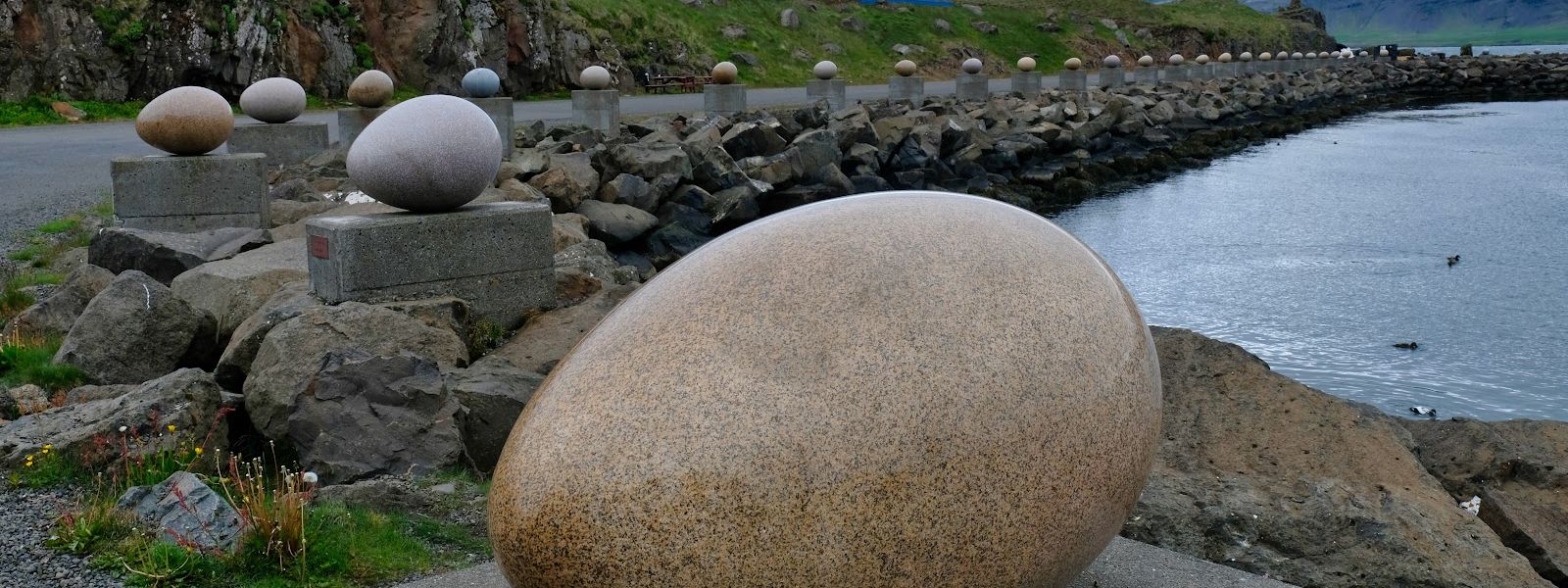
Thirty-four granite eggs in a row, one for each bird species that nests around Djúpivogur — the biggest of them is the eider's.
- Entrance
- Free.
- Accessibility
- Wheelchair-accessible entrance and parking. The walkway from the port is paved and easy going, so prams and wheelchairs manage the row.
- Parking
- Parking at the site, with wheelchair-accessible spaces.
- Difficulty
- Easy: a paved walkway, no climbing.
- Transport
- Self-drive; short walk from Djúpivogur harbour
- Hours
- Open 24 hours, every day.
- Address
- Víkurland, 765 Djúpivogur
What makes it special
A line of granite eggs stands on the old loading quay at the edge of Djúpivogur harbour, one for each bird species that nests around the village. Thirty-four of them sit on low concrete plinths, each a scaled-up copy of a real egg, down to the speckles and blotches. The plinths carry the bird's name in Icelandic and in Latin, so the row doubles as a field guide you walk along. The largest egg is the eider's, the town's own bird. The work is by the Icelandic artist Sigurður Guðmundsson and went up in 2009, on a dock that had stopped handling fish. Behind the eggs lie the water of Gleðivík and the ridge on the far side of the fjord.
Good to know
- A stop, not a day out: there is one row of eggs. Walk it, read the plinths, and you have seen the whole thing.
- No shelter on the quay: the walkway is open to the wind off the fjord from every direction. Bring a windproof layer even on a bright day.
- The labels are half the point: each plinth gives the bird's name in Icelandic and Latin, and the eggs make far more sense once you read them.
- Not everyone warms to it: the interest is in the idea rather than the object, and a row of eggs stays a row of eggs for some people.
Getting there
The eggs stand on the harbour front in Djúpivogur, at the edge of the village, and visitors reach them by car. From the port a paved walkway runs the length of the row, so the last stretch is done on foot with no climbing involved. The surface is even enough for prams and wheelchairs, and you can turn back at any point along the line rather than walking it twice.
Sun & daylight
Nearby Places



Similar Places


Your whole travel map in one place
Get inspired by new places around the world and find the ones worth the journey
Frequently asked questions
What are the eggs at Gleðivík?
Thirty-four granite eggs on concrete plinths, standing in a row along the old loading quay in Djúpivogur harbour. Each one is an enlarged copy of the egg of a bird that nests in the area.Who made Eggin í Gleðivík?
The Icelandic artist Sigurður Guðmundsson. The work was installed in 2009 on a dock that had gone out of use.How long does a visit take?
It is a short stop. The row is the whole attraction, and most people fit it in on the way through the village rather than making a trip of it.Are the birds identified?
Yes. Every plinth carries the species name in Icelandic and in Latin. The largest egg belongs to the eider, the town bird of Djúpivogur.