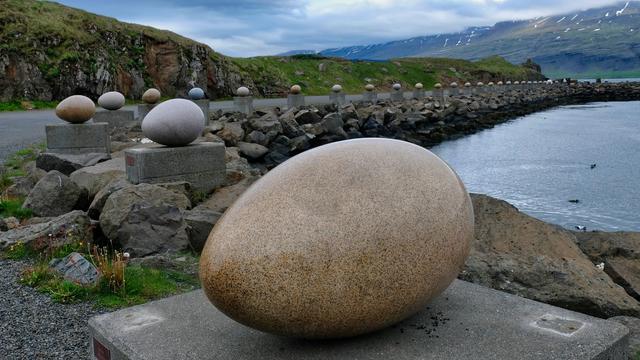
Djúpivogur is a village of about 470 people in eastern Iceland, on a peninsula between the fjords Berufjörður and Hamarsfjörður. Langabúð, one of Iceland's oldest commercial buildings, holds a café, the heritage museum and an exhibition on the sculptor Ríkarður Jónsson, who was born in the village. About 900 m west, on the shore of Gleðivík, stand replicas of the eggs of 34 birds that nest in the area. Djúpivogur is the only Cittaslow town in Iceland.
Djúpivogur

- Currency
- Icelandic króna (ISK)
- Language
- Icelandic; nearly all speak English
- Power plug
- Europlug and Schuko sockets, 230 V
- Visa
- Schengen; outside the EU
- Time zone
- UTC±00:00 (Atlantic/Reykjavik)
- Tap water
- Safe; hot water smells of sulphur
- Tipping
- Not customary
- Emergency
- 112
Things to do
All tours in Djúpivogur on GetYourGuide
Paid links: booking through them supports YowJourney.
When to go
High season
Jun – Aug
The warmest weeks, though no month here averages above 10 °C. At almost 65° north the summer nights stay light, so the walk out to Eggin í Gleðivík works late in the evening.
Shoulder
Sep – Oct
Daylight shortens quickly and temperatures fall back towards the winter mean. The village and Langabúð stay the fixed points of a visit; the fjord weather turns unsettled.
Low season
Nov – May
Days are short at this latitude, and full daylight returns only in late spring. Winters are mild for a tundra climate, because the village stands on the open coast between two fjords.
How long to stay
Half a day covers Djúpivogur itself: Langabúð with its museum, café and Ríkarður Jónsson exhibition, and the walk west to Eggin í Gleðivík. A full day takes in Teigarhorn, 5 km west along Berufjörður. Cittaslow membership is about slowing the pace of a town, so an overnight stay suits the village better than an hour on the way past.
Getting around
The village has fewer than 500 residents and is crossed on foot in minutes. Eggin í Gleðivík lies about 900 m west of the village, a walk of ten minutes or so. Teigarhorn, the old weather station on Berufjörður, is about 5 km west and needs a vehicle. Djúpivogur sits on a peninsula between Berufjörður and Hamarsfjörður, so anything on the opposite shore of either fjord means driving around the head of the water rather than straight across.
What to see


Destinations in Djúpivogur
Frequently asked questions
What is Eggin í Gleðivík?
A work by Sigurður Guðmundsson, installed in the summer of 2009 about 900 m west of the village. It reproduces the eggs of 34 birds that nest in the area. The name translates as The Eggs of Merry Bay.What is there to see in Langabúð?
Langabúð is one of Iceland's oldest commercial buildings. The south end dates from 1790, and the building took its present form when the northern part was built in 1850. It served as a warehouse and a slaughterhouse. Today it holds a café, the heritage museum and an exhibition on the sculptor Ríkarður Jónsson, a native of the village.Where was Iceland's highest temperature recorded?
At Teigarhorn, a farm on the shore of Berufjörður about 5 km west of Djúpivogur: 30.5 °C on 22 June 1939. Observations there began in 1874, which makes it one of the oldest weather stations in the country. A reading of 36.0 °C in September 1940 is claimed but not recognised by the Icelandic Meteorological Office. Temperatures above 30 °C have been measured in Iceland only five times since records began.Is Djúpivogur still its own municipality?
No. The municipality of Djúpavogshreppur was formed on 1 October 1992 from the rural communities of Berunes, Buland and Geithellur. In 2020 it merged with Borgarfjarðarhreppur, Fljótsdalshérað and Seyðisfjarðarkaupstaður to form Múlaþing.What does Cittaslow mean here?
Djúpivogur is the first and only Cittaslow town in Iceland. Cittaslow belongs to the slow movement and works to improve quality of life in towns by slowing their overall pace, above all in the use of public space and the flow of traffic.